Though it may never be the bread and butter of your business, small fly services are a critical part of most pest management programs.
Typically, this market includes fruit flies, drain flies and phorid flies. Residential customers often don’t place the same emphasis on this service as they do others, unless small fly control is part of the overall service.
According to the 2026 PCT State of the Small Fly Market Report, sponsored by Nisus, 93% of respondents offer small fly control service, with 51% including it as part of their general pest control offering.
“Business owners and managers need to understand that controlling small flies is important to keep their customers comfortable,” said Chris McNall, regional director of operations for Mosquito Squad Plus of the Mid-Atlantic. “Having a professional come out and look through areas to find those breeding sites will allow us to help them stay ahead of the issue.”
Communication with residential and commercial customers is critical to the growth and success of small fly programs. Educating customers makes them more ready for professional assistance, said Scott Hornemann, field training, quality and safety director, Adam’s Pest Control, Medina, Minn. “The persistent issue of customer cooperation remains the most significant challenge for all pest control operators, and it will likely continue to be the biggest obstacle in eliminating and preventing these small flying pests,” he said. “It is a shared burden; we simply need customers to help us help them.”

Much of the fly small segment is focused on commercial accounts, with a 2-1 margin on those providing the service for restaurants and other corporate clients (64%) versus those seeking it for home or residential control (34%).
In New York City, fly control is essential in consumer-focused businesses, said Timothy Best, director of training, Suburban Pest Control, Yonkers, N.Y.
“Commercial food service is the obvious anchor, alongside other applications such as restaurants, bars, commissaries, food processing facilities,” Best said. “In urban markets, such as New York City, I would also equally highlight health care, hospitality and high-end multi-unit residential dwellings.” These account types, Best added, have zero tolerance for visible fly activity and have the budget to support a proper program.
Taking care of the problem before it becomes an infestation-level issue is important for both pest management professionals (PMPs) and customers, said Gerry Marsh, president and CEO of Wichita, Kan.-based Patton Termite and Pest Control. “Our small fly programs have been growing because I think we’re doing better technician education about selling our customers about proactive preventative treatments. We’re more aware of it and we’ve made a conscious decision to emphasize the education with our technicians,” he said.
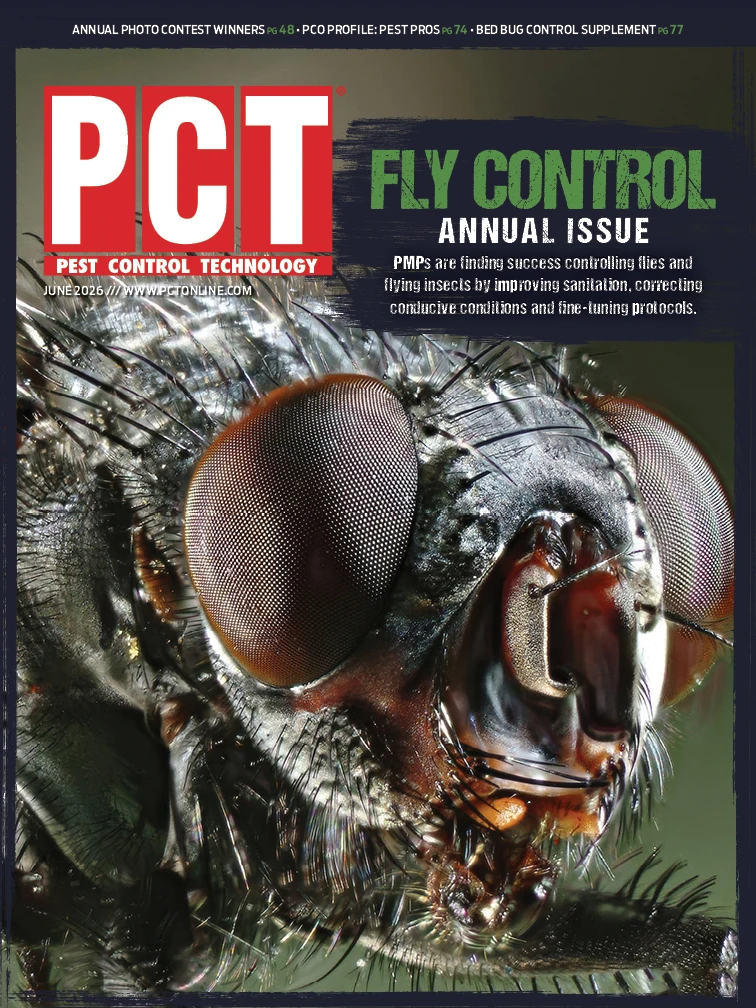
Explore the June 2026 Issue
Check out more from this issue and find your next story to read.
Latest from Pest Control Technology
- Envu Offers Fall Promotion for Horizon Members
- Pest Management Foundation Announces the E. Raymond Crim, III Scholarship
- Tyro Group Acquires Dowell Pest Control
- Podcast: Beyond the Pest | Ep. 14 — Dr. Zach DeVries
- Webinar: The AI-Run Pest Control Company: Hype vs. Reality, What Actually Works (and What Doesn’t)
- Select Exterminating Acquires Three Businesses Across New York and New Jersey
- Catseye Pest Control Acquires Security Pest Elimination and Biologic Pest Control
- Researchers Confirm New York's First Bourbon Virus Case