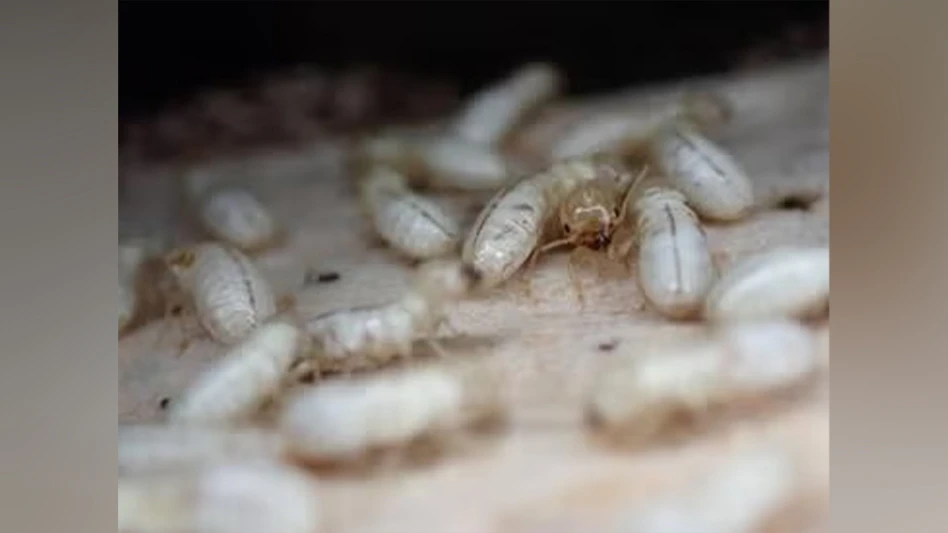
Drywood termites, which live and feed inside wooden structures, molt roughly seven times during their lives. Researchers at University of California, Riverside have found that disrupting this molting process can effectively collapse termite colonies.
A new study published in the Journal of Economic Entomology examined the insect growth regulator bistrifluron, a chemical that prevents termites from producing chitin, the material that forms their protective exoskeletons. Researchers found the treatment eliminated about 95 percent of western drywood termite colonies while showing no off-target effects on mammals.
“This chemical is more environmentally friendly than ones traditionally used for drywood termite infestations,” said Nicholas Poulos, corresponding author of the paper. “It’s specific to insects and can’t harm humans.”
As termites prepare to molt, they must form a new exoskeleton before shedding the old one. Bistrifluron blocks that process, ultimately killing the insects.
“Once the termites reach a certain stage, they have to molt. They cannot avoid that,” said Dong-Hwan Choe, senior author of the study. “With a lethal dose of this chemical, they’ll try to shed their old exoskeleton but won’t have a new one ready to protect them.”
The researchers observed that treated termites slowed their feeding before dying from incomplete molting. Because termites share food within the colony, the chemical spread to other members, leading to colony collapse in about two months.
The study suggests insect growth regulators could provide a lower-impact, localized alternative to whole-structure fumigation. Researchers also believe the treatment may remain active in wood long enough to help prevent future infestations.
Source: UCR.edu
Latest from Pest Control Technology
- Envu Offers Fall Promotion for Horizon Members
- Pest Management Foundation Announces the E. Raymond Crim, III Scholarship
- Tyro Group Acquires Dowell Pest Control
- Podcast: Beyond the Pest | Ep. 14 — Dr. Zach DeVries
- Webinar: The AI-Run Pest Control Company: Hype vs. Reality, What Actually Works (and What Doesn’t)
- Select Exterminating Acquires Three Businesses Across New York and New Jersey
- Catseye Pest Control Acquires Security Pest Elimination and Biologic Pest Control
- Researchers Confirm New York's First Bourbon Virus Case