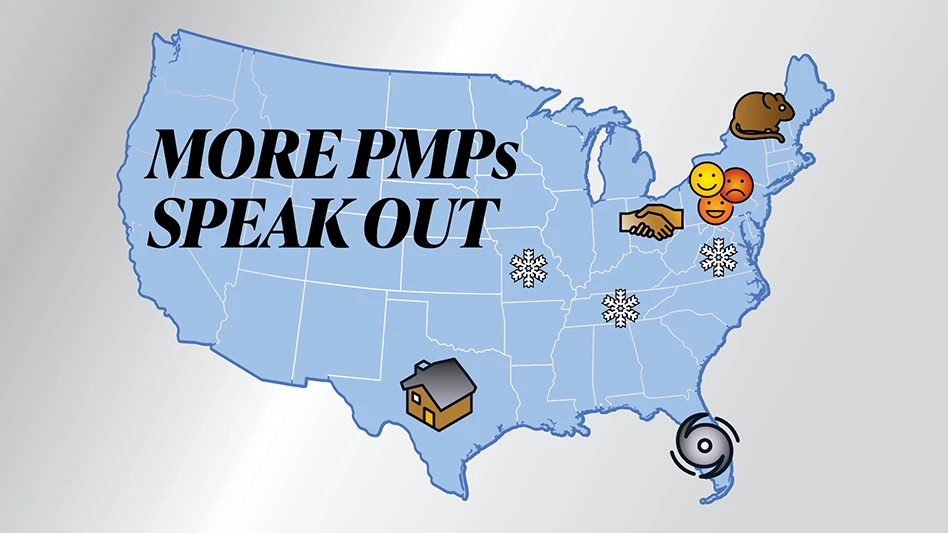
Editor's note: The following article provides additional insights and interviews from the Top 100 Map & More cover story that appears in the 2026 May issue.
Texas
A Market Reset — and a More Complex Playbook
After years of rapid expansion in Austin, Texas, the city's breakneck growth is beginning to normalize and with it, the pest control market.

Dauphin Ewart described the past year as “funky,” shaped by shifting marketing dynamics and broader economic uncertainty.
Digital advertising, once a reliable growth engine, is evolving, forcing companies to rethink how they reach customers, said The Bug Master’s president. At the same time, rising interest rates and a cooling real estate market are slowing the pace, particularly in once-hot suburban corridors.
Still, Ewart sees this as a return to fundamentals. “Good businesses do well regardless of how the market is performing,” he said. In a maturing market, discipline is becoming the differentiator.
Sprawl Triggers Wildlife Calls
Growth in Austin, Texas, isn’t just vertical, it’s pushing outward and pest control is following. “A lot of it is out in surrounding communities, not in the city,” said Ewart, whose family business, The Bug Master, has watched the metro swell from a half-million residents to 2 million.
New neighborhoods are rising where fields once supported wildlife, creating a collision between development and existing pest ecosystems. For pest control companies, that expansion means more opportunity — but also more complexity, from larger service territories to increasingly sophisticated routing demands. “What used to be country is now the city, bringing ants, rodents and even more complex wildlife issues into residential areas,” Ewart said.
Texas and Across the South
Growth in a Niche Market
In a crowded industry, specialization can be a powerful differentiator. Versacor operates exclusively in the commercial sector, particularly in premium, highly regulated environments like food processing, where expectations are high and competition is fierce. “Every potential client already has pest control,” said Jason Eicher, president.
Always Under Pressure
Versacor is seeing more consistent rodent pressure year-round, rather than the traditional winter spike, along with earlier and heavier insect activity in the spring. “We’re not seeing that same winter bump,” said Ryan Gates, technical services manager. For commercial clients — especially in food processing — those shifts require earlier preparation and more proactive management. Programs that once ramped up in March may now need to start weeks earlier, he said.
Customer-Aligned Expansion
For Versacor, expansion follows the flow of economic growth across the southern United States. The company has added new branches and is pushing into additional states, tracking a corridor that stretches from Texas to Georgia. Much of that growth is tied to industries like food processing and manufacturing, which continue to cluster in lower-cost, business-friendly regions. “We expand with our customers,” Eicher said, leveraging existing relationships while pursuing competitive takeaways in new markets. Rather than chasing residential volume, the strategy is targeted: deepen presence in high-value commercial sectors and grow alongside the industries driving regional economies.
Going Big
Versacor is expanding geographically and on site at its headquarters, with plans for a 7,800 square-foot addition that will more than double its size and allow space for Versacor Academy, supporting the company’s focus on developing its people and creating career paths. It’s due to open by the end of 2026. “Having this in place sends a message that training is important to our company, and we’ll have this structure in place for in-person training,” Eicher said.
Virginia
Weather Whiplash and the Spring Surge
A colder-than-usual winter across parts of the Mid-Atlantic and Southeast has delayed the start of pest season — but not for long. “Ant activity has actually been slower,” said Brett Lieberman, owner of My Pest Pros in northern Virginia.

Snow and cold kept early calls down in early 2026. But as temperatures climb, the rebound is already underway.
In Cleveland, Tenn., Michael Burks of Burks Pest Control is seeing carpenter ants, odorous house ants and fire ants surge with the first stretch of warm weather. The pattern underscores a growing reality for pest control companies: weather no longer follows a predictable script. Cold snaps may buy a brief pause, but they often compress demand into shorter, more intense bursts. As spring accelerates, operators are bracing for a rapid uptick in calls tied to warming conditions.
Instant Demand
Patience is wearing thin among customers, even as pest problems grow more complex. “People want you to wave your magic wand,” Lieberman said, pointing to rising expectations for immediate results. At the same time, ant pressure — especially from odorous house ants and carpenter ants — remains persistent and often misunderstood.
Burks said that education is still a key part of the job, from explaining that carpenter ants don’t eat wood to identifying hidden nesting sites driven by moisture and food sources. For operators, success increasingly depends on setting expectations while delivering layered, targeted solutions. The pests may be predictable, but customer expectations are not. Managing both is becoming a bigger part of the job.
Ohio
Expansion That Actually Fits
Growth is most effective when it makes geographic sense. For Kurt Scherzinger, president of Scherzinger Pest Control, that meant expanding into Lexington, Ky., through the acquisition of a 60-year-old family business. This move extended his company’s footprint into a neighboring market with similar pest pressures. “It was a natural fit,” he said.
Unlike expanding into regions with different climates or seasonality, the overlap allows for operational consistency and easier scaling, he said. The acquisition also brought new customer segments, including equine facilities tied to Kentucky’s horse industry. In a consolidating landscape, strategic, adjacency-based growth is proving to be an efficient way for regional players to expand, Scherzinger said.
Erratic Weather, Pest Surprises
Weather patterns are becoming less reliable and pest activity is following suit. Scherzinger points to a wet spring followed by an unusually dry late summer, a shift that disrupted typical seasonal patterns. “Sometimes you’re like, 'Where are the stinging insects this year?'” he said, noting lower activity tied to heat and dryness. Just a few years earlier, those same pests were at all-time highs. This variability requires flexibility in staffing, service planning and customer communication as traditional seasonal expectations continue to shift, he said.
Demand for People
Demand isn’t the problem. Finding people is. Scherzinger is seeing hiring challenges reminiscent of the early pandemic era, with no-shows for interviews and even first days. “You’re playing a numbers game,” he said. At the same time, customer demand remains steady, particularly among busy households.
Commercial clients, meanwhile, are increasingly seeking local providers as consolidation reshapes the market, Scherzinger said. “We’re capitalizing on that in a market that has cycled through [acquisitions] and there aren’t a lot of family-owned businesses marketing like we are,” he said.
Florida
Smart Growth
Rapid growth is one thing. Sustaining profitably is another. After years of eye-popping expansion, Kyle Selbach, COO of All U Need Pest Control based in Fort Meyers, Fla., is shifting focus from pure growth to operational efficiency.

“It’s been more about how we become more efficient and bring up profitability,” he said. With more than 220 employees and nearly $30 million in revenue, the company is refining everything from routing to service delivery. “At the end of the day, we’re a logistics company,” Selbach said, pointing to tighter routes and reduced “windshield time” as critical levers.
Boom Towns
Florida’s growth wave is still rolling, fueled by pandemic-era migration and ongoing development. “Customers are still prioritizing essential services like pest control,” Selbach said, “but they’re more price aware than ever.” That shift is forcing companies to balance rising costs — vehicles, insurance, labor — with careful pricing strategies and stronger value propositions.
Organic growth remains strong, powered by in-house marketing, door-to-door outreach and referrals, Selbach said. But in a more competitive environment, success increasingly depends on delivering consistent service while justifying every dollar.
Weather Swings Are Reshaping Demand
Extreme weather is becoming a defining factor in Florida’s pest control cycle. Recent years have brought a string of major hurricanes, followed by unexpected cold snaps. “Activity dies when it gets cold,” Selbach said, noting that even Florida is experiencing more pronounced seasonal slowdowns.
But those lulls are temporary. Storm damage, flooding and rebuilding often trigger new pest issues, from rodent displacement to uncovering hidden termite problems. “Once it heats up, they come back,” he said.
Demand Keeps Surging
In South Florida, demand for pest control isn’t just steady, it’s accelerating. Luke Lewis said Tallahassee, Fla.-based Native Pest Management grew 30% last year entirely organically, fueled by population growth and strong digital visibility.
“Demand has skyrocketed,” he said, driven in part by an influx of new residents from high-cost states. With more homeowners unfamiliar with Florida’s pest pressures, services like termite and rodent control are seeing increased demand. Add in strong online reviews and brand recognition, and the growth loop continues.
In a state often defined by volatility, one thing remains consistent: more people are arriving and they all need pest control. “Where our main operations are is the pest capital of the U.S.,” Lewis said.
Weather Extremes Expand the Playbook
Florida’s climate has always shaped pest control, but recent swings are widening the impact. Lewis said hotter conditions and colder-than-usual winters are drivers of increased demand. Heat and drought are contributing to termite activity, while cold snaps are pushing rodents indoors. “On both ends, we’re getting an increase in demand,” he said. Even without a major hurricane last year, the variability is enough to shift patterns, said Lewis.
Raising the Bar
South Florida may be one of the most competitive pest control markets in the country, and it’s only getting more crowded. Lewis estimates hundreds of competitors in his service area alone, fueled by ongoing consolidation and new entrants spinning out of acquired companies. At the same time, larger players backed by private equity are driving up marketing costs, especially for digital leads. To stay competitive, his company is doubling down on brand, reviews and operational efficiency, including tighter routing to offset rising fuel costs.
New Hampshire
Regional Players Gain Ground
As consolidation continues, regional pest control companies are finding new opportunities, especially on the commercial side. Adam Carace, CEO of Pest-End in Plaistow, N.H., said larger retail and food-processing clients are increasingly turning to regional providers.

“They want a regional business servicing their accounts,” he said. Expansion into new states like Connecticut and New York has helped his company meet that demand, while an active sales structure has driven recurring revenue growth. In a market reshaped by acquisitions, the advantage may be shifting back to companies that can offer both scale and regional responsiveness, he said.
Rodents Go Year-Round
Seasonality is changing, especially when it comes to rodents. In the Northeast, Carace said rodent activity is no longer confined to colder months. “We’re seeing just as many calls in May and June as in November and December,” he said, marking a shift from traditional winter spikes.
Talent Search
In a tight labor market, how you recruit matters as much as who you hire. Carace credits a dedicated recruiter with transforming his company’s hiring approach, from messaging to candidate experience. “She put us in a different light,” he said of stronger pipelines and hiring outcomes after a period marked by no-shows and inconsistent follow-through. For growing companies, talent strategy isn’t just an HR function. It’s a growth lever.
Rhode Island
Speed Matters More Than Price
In today’s market, customers are less sensitive to price and far more focused on response time, said Brian Goldman, CEO of Big Blue Bug Solutions. “People don’t care as much about price,” Goldman said. “They want to know you can get out there quickly.” That shift has led to operational changes, including a move toward inside sales and dedicated technicians ready to deploy for same- or next-day service. The goal: reduce lag between the call and the solution.
A historic winter storm that dropped more than three feet of snow in a single day brought operations to a halt, but it may also set the stage for a surge in pest activity. Goldman expects melting snow and heavy rainfall to create standing water, fueling mosquito populations and driving a strong spring season.
Pennsylvania
Organic Growth, Done Right
While much of the industry leans on acquisitions or seasonal sales teams, Jim Carnelli, CEO of Green Pest Solutions in West Chester, Pa., is doubling down on organic growth, and it’s paying off. His pest division grew just over 22% last year, driven entirely by internal marketing and operations.
“Consumers are going online, searching for a highly rated company nearby,” he said. That means showing up — and delivering. With a near-perfect rating across thousands of reviews, the company has built a feedback loop where strong service fuels visibility, and visibility fuels growth.
Speed, Simplicity, Value
Today’s customer is more informed and more demanding. Carnelli is seeing a clear shift toward value-driven decision-making, with customers asking more questions about pricing and what they’re getting in return. But cost isn’t the only factor. “They want speed. They want ease of doing business,” he said. From fast response times to frictionless scheduling, the overall experience now plays a central role in closing and keeping accounts. “Pricing is impactful but they want their calls to be answered fast,” Carnelli said.
Weather Delays, Then Delivers
An unusually cold, snow-heavy winter across the Mid-Atlantic delayed the typical start to pest season this year. But Carnelli expects a compressed surge, with activity ramping up later and more intensely. “You never get that time back,” he said, noting that missed early-season weeks can shift demand into a shorter window. At the same time, steady home sales and ongoing construction — especially in multifamily housing — continue to create new opportunities.
Missouri
Steady Growth in a Stable Market
In the Midwest, growth may not be flashy, but it’s reliable. Mike Rottler’s company, Rottler Pest & Lawn Solutions based in St. Louis, Mo., posted just under 10% growth last year, in line with long-term targets, despite a slow start driven by unusually cold, snowy weather.
“January, we went backward a little,” he said of the rarity. But once conditions improved, demand followed at the company. His region tends to be more insulated from the extremes seen on the coasts and outlook, overall, is positive, he said. “We are pretty predictable.”
Relationships Still Drive Retention
In an industry shaped by pricing pressure and competition, Rottler sees one constant: relationships matter. His company emphasizes consistent service and technician familiarity, creating a level of trust that helps retain customers even as costs rise.
“They know the technicians by name,” he said. This connection has helped buffer the business against growing price sensitivity, particularly among busy households that rely on pest control to save time. In a market where customers are weighing every dollar, service quality and personal relationships remain powerful differentiators. “But you take care of customers and do a really good job, pricing tends to be secondary,” Rottler said.
Latest from Pest Control Technology
- Envu Offers Fall Promotion for Horizon Members
- Pest Management Foundation Announces the E. Raymond Crim, III Scholarship
- Tyro Group Acquires Dowell Pest Control
- Podcast: Beyond the Pest | Ep. 14 — Dr. Zach DeVries
- Webinar: The AI-Run Pest Control Company: Hype vs. Reality, What Actually Works (and What Doesn’t)
- Select Exterminating Acquires Three Businesses Across New York and New Jersey
- Catseye Pest Control Acquires Security Pest Elimination and Biologic Pest Control
- Researchers Confirm New York's First Bourbon Virus Case