Editor’s note: Barry Goodell, recently retired professor of microbiology at UMass Amherst, and his research team are examining if adding live termites (taken from a home) to bait stations will boost their attractiveness. They would like to hear from PMPs who have tried this method or are interested in trying it. In the following article, Goodell shares how this research project came about and how pest management professional can assist.
Early in 2026, we installed bait stations around a home infested with Formosan termites. The termites had been active in the home over several years, invading sections of walls, ceilings and floors. During renovation of the home to remove termite infested wood we transferred termites from that interior wood directly to two of the exterior ground-perimeter bait stations. In all cases, the bait stations were located within 25 to 30 ft of where the infestation was found inside the home. There were 9 total bait stations, with 7 bait stations receiving no supplemental termites. For the two stations where termites were added, the termites were brushed into the center hole of the wood base station. The objective was to assess whether the addition of termites from an infested home to bait stations surrounding that home, might speed the rate of bait station discovery by the larger colony, and alert the colony that fresh bait/wood was available in the station(s) to feed on.
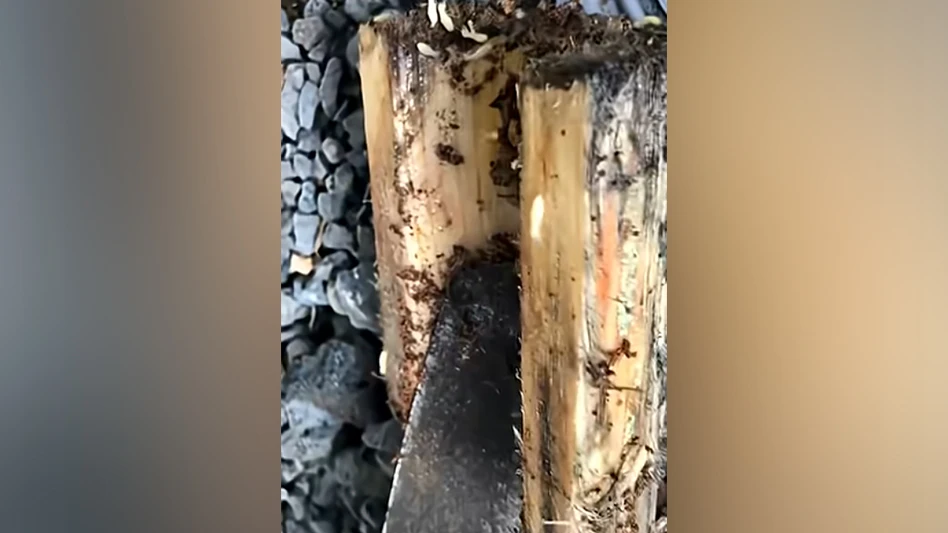
Although this is a single case-study, we found that adding termites found originally within the home to bait stations surrounding the structure, may be an effective way of increasing the speed with which bait stations are discovered by the termite colony. In our case, one of the two bait stations that were supplemented with termites from within the home was observed to have the solid wood monitoring base material aggressively colonized when inspected only 7 weeks after installation of the station (short video clip). None of the other bait stations were colonized, and that trend has continued now for 4 months. We also added loosely packed wetted paper towel into the center hole of the solid wood base material in all stations to promote colonization.
REQUEST: If others in the pest control community have tried this method to increase bait station discovery, or are interested in trying it in the future, it would be useful to hear about their results. We have heard concerns that adding termites from within the home to nearby exterior bait stations could potentially deter bait station discovery, as the procedure could injure some termites which could potentially alert the colony to avoid that bait station. Our single case-study experience suggests that this is not the case, and any deterrent effect may be less than that observed when termites are added back into the bait station when new growth-hormone-infused bait material is added to the station.
Assessment of bait stations which may be colonized in less than two months will obviously require more active monitoring than is normally conducted by PCOs (and would only be done for purposes of the test/study). Note that the brand of bait station, or type of active ingredient inhibitor used, is not critical for studies such as this where the focus is about ways to increase bait station discovery prior to the addition of any growth hormone or active ingredient.
Goodell can be contacted at bgoodell@umass.edu or barry.goodell@gmail.com.
Latest from Pest Control Technology
- Envu Offers Fall Promotion for Horizon Members
- Pest Management Foundation Announces the E. Raymond Crim, III Scholarship
- Tyro Group Acquires Dowell Pest Control
- Podcast: Beyond the Pest | Ep. 14 — Dr. Zach DeVries
- Webinar: The AI-Run Pest Control Company: Hype vs. Reality, What Actually Works (and What Doesn’t)
- Select Exterminating Acquires Three Businesses Across New York and New Jersey
- Catseye Pest Control Acquires Security Pest Elimination and Biologic Pest Control
- Researchers Confirm New York's First Bourbon Virus Case