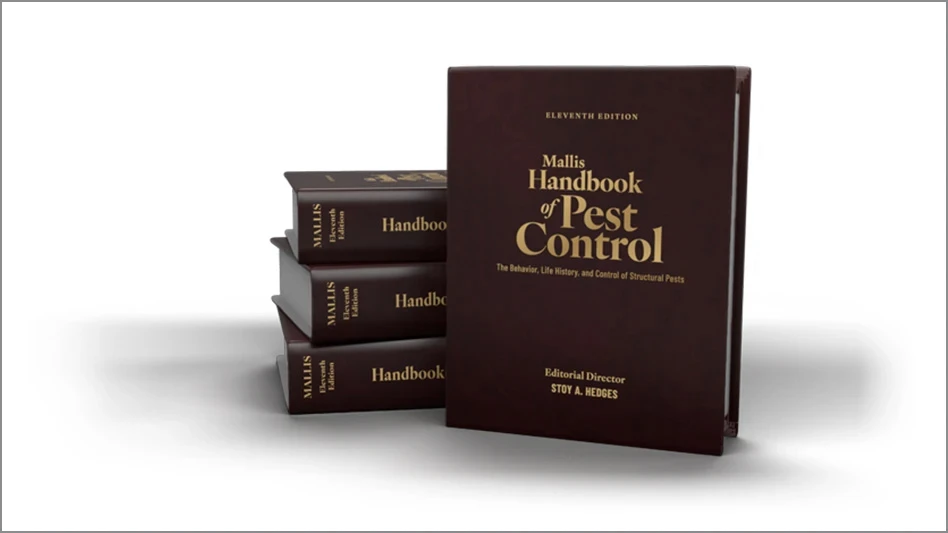
April PCT included “The Fascinating World of Ants,” an excerpt from the recently published Mallis Handbook of Pest Control, 11th edition. Authored by Dr. Edward Vargo and Dr. Robert Puckett, this feature provides practical insights into the feeding habits, colony formation and population dynamics of one the world’s most highly evolved insect species prove helpful when designing pest management programs for ants.
Below are references cited in this feature.
REFERENCES
ABBOTT, A. — 1978. Nutrient dynamics of ants, pp. 233-244, In: Production Ecology of Ants and Termites. (M.V. Brian, Ed.) Cambridge University Press, Cambridge.
AKRE, R.D., L.D. HANSEN, and E.A. MYHRE — 1994a. Colony size and polygyny in carpenter ants (Hymenoptera: Formicidae). J. Kan. Entomol. Soc. 67: 1-9.
FISHER, B.L. and S.P. COVER — 2007. Ants of North America: A Guide to the Genera. University of California Press, Berkeley, CA. 194 pp.
FOURNIER, D., A. ESTOUP, J. ORIVEL, J. FOUCAUD, H. JOURDAN, J. LEBRETON, and L. KELLER — 2005. Clonal reproduction by males and females in the little fire ant. Nature. 435: 1230-1235.
FOWLER, H.G. — 1985. Alloethism in the carpenter ant, Camponotus pennsylvanicus (Hymenoptera: Formicidae). Entomol. Gener. 11: 69-76.
FOWLER, H.G. and R.B. ROBERTS — 1980. Foraging behavior of the carpenter ant, Camponotus pennsylvanicus (Hymenoptera: Formicidae) in New Jersey. J. Kans. Ent. Soc. 53: 295-304.
GIRAUD, T., J.S. PEDERSON, and L. KELLER — 2002. Evolution of supercolonies: the Argentine ants of southern Europe. Proc. Natl. Acad. Sci. USA. 99: 6075-6079.
GRODEN, E., F.A. DRUMMOND, J. GARNAS, and A. FRANCEOUR — 2005. Distribution of an invasive ant, Myrmica rubra (Hymenoptera: Formicidae), in Maine. J. Econ. Entomol. 98: 1774-1784.
HAGEN, K.S., R.H. DADD, and J. REESE — 1984. The food of insects, pp. 79-112. In: Ecological Entomology. (C.B. Huffaker and R.L. Rabb, Eds.) Wiley, New York, NY.
HÖLLDOBLER, B. and E.O. WILSON — 1990. The Ants. Harvard University Press. Cambridge, MA. 732 pp.
KLOTZ, J., L. HANSEN, R. POSPISCHIL, and M. RUST— 2008. Urban Ants of North America and Europe: Identification, Biology and Management Comstock Publishing Associates, Cornell University Press, Ithaca, NY. pp. 196.
PASSERA, L. — 1994. Characteristics of tramp species, pp. 23-43. In: Exotic Ants: Biology, impact and control of introduced species. (D.F. Williams, Ed.) Westview Press, Inc., Boulder, CO.
PEACOCK, A.D., D.W. HALL, I.C. SMITH, and A. GOODFELLOW — 1950. The biology and control of the ant pest Monomorium pharaonis (L.) Dept. of Agr. of Scotland. Misc. Publ. No. 17.
STRADLING, D. — 1987. Nutritional ecology of ants, pp. 927-969. In: Nutritional Ecology of Insects, Mites, Spiders, and Related Invertebrates. (F. Slansky Jr. and J.G. Rodriguez, Eds.) Wiley, New York, NY.
TSUTSUI, N.D., A.V. SUAREZ, D.A. HOLWAY, and T.J. CASE — 2000. Reduced genetic variation and the success of an invasive species. Proc. Natl. Acad. Sci. USA 97: 5948-5953.
WANG, Z., L. MOSHMAN, E.C. KRAUS, B.E. WILSON, N. ACHARYA, and R. DIAZ — 2016. A review of the tawny crazy ant, Nylanderia fulva, an emergent ant invader in the southern United States: Is biological control a feasible management option? Insects 7: 77.
WHEELER, W.M. —1910. Ants. Columbia Univ. Press, New York, NY. 663 pp.
WILSON, E.O. — 1971. The Insect Societies. Belknap Press, Cambridge, MA. 548 pp.
Latest from Pest Control Technology
- Envu Offers Fall Promotion for Horizon Members
- Pest Management Foundation Announces the E. Raymond Crim, III Scholarship
- Tyro Group Acquires Dowell Pest Control
- Podcast: Beyond the Pest | Ep. 14 — Dr. Zach DeVries
- Webinar: The AI-Run Pest Control Company: Hype vs. Reality, What Actually Works (and What Doesn’t)
- Select Exterminating Acquires Three Businesses Across New York and New Jersey
- Catseye Pest Control Acquires Security Pest Elimination and Biologic Pest Control
- Researchers Confirm New York's First Bourbon Virus Case