Andrew Greess
Editor's note: Andrew Greess, a pest control equipment expert and president of equipment website Qspray.com, shared ways pest control company owners and managers can improve productivity and reduce downtime through the use of quick disconnects.
When it comes to pest control power sprayers, most of the focus is on the expensive parts: Tank, motor, pump, reel. The little stuff matters too.
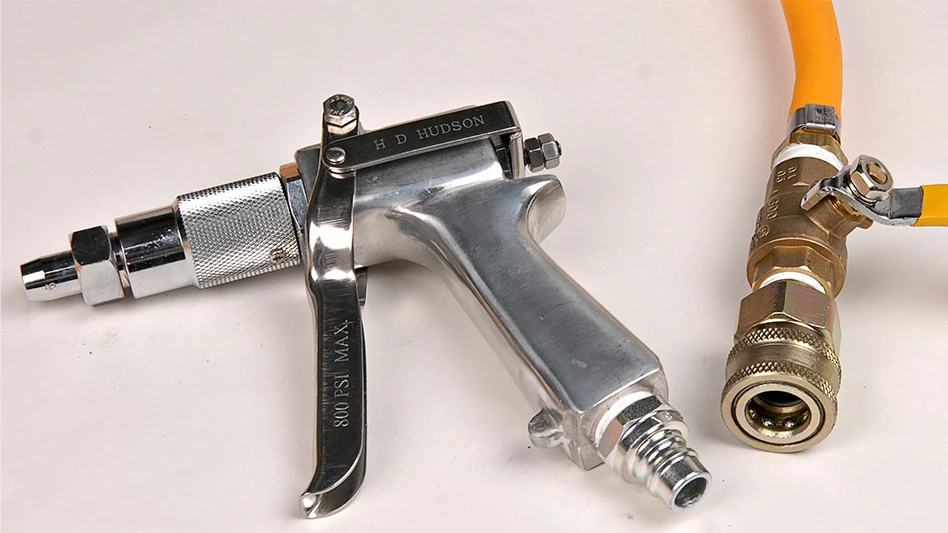
Installing quick disconnects on your power spray hose can save time and money. Quick disconnects (QDs) are spring-loaded couplings that allow the technician to quickly remove the spray gun or tool from the end of the hose.
QDs offer numerous advantages over hard plumbing the gun directly to the hose:
- Remove gun for safe storage, reducing the risk of theft, loss or damage.
- Easily interchange spray guns and tools to select the correct tool for the application.
- Easily remove spray gun for repair.
- Allows easy interchange of tools or installation of backup tools should the primary spray gun fail.
- QDs allow the spray gun to rotate freely on the hose, making the hose easier to handle and putting less stress on the last few feet of hose.
- Proper use of QDs can help reduce leaks and spills.
Quick disconnects have two parts, the male (nipple) and the female (coupler), which fit together. They come in standard sizes; most commonly pest control applications require 3/8” or 1/2”. Larger volume applications such as termite pretreats often use larger sizes, e.g., 3/4” and 1”.
QDs are available in two general styles:
- Valved QDs have internal shutoffs that prevent the water from passing through the QD when the nipple and coupler are separated. You can remove the gun from the spray hose, and the QD will not allow water to pass, even if the pump is on. The advantage to valved QDs is they can help prevent leaks and spills, and allow the technician to remove the spray gun without worrying about leaks or spills. Disadvantages are they are heavier, more expensive and because they are under pressure, can be more difficult to operate than unvalved QDs.
- Unvalved, or Free Flow QDs allow water to pass through unimpeded, whether or not they are connected. They are lighter and less expensive than their valved counterparts, but the spray gun cannot be removed from the hose or a spill will occur. We prefer using a brass ball valve in front of an unvalved QDs, which overcomes this last drawback.
Here are some hints for using Quick Disconnects:
- Standardize. Installing the same size and style QDs on all vehicles and spray tools, ensures the correct tool and backup is always available.
- Periodically inspect QDs for wear or damage to proactively prevent problems. Make sure the spring mechanism works properly and that QDs can be operated easily.
- Maintenance. Eventually the o-ring in the coupler will wear out. Keep a couple of repair kits and backup QD sets available for maintenance.
Quick disconnects can help improve productivity and reduce downtime. Properly used, the advantages more than offset the small incremental cost of their installation.
Andrew Greess is a pest control equipment expert and president of equipment website Qspray.com. Contact him at Andrew@Qspray.com.
Latest from Pest Control Technology
- Envu Offers Fall Promotion for Horizon Members
- Pest Management Foundation Announces the E. Raymond Crim, III Scholarship
- Tyro Group Acquires Dowell Pest Control
- Podcast: Beyond the Pest | Ep. 14 — Dr. Zach DeVries
- Webinar: The AI-Run Pest Control Company: Hype vs. Reality, What Actually Works (and What Doesn’t)
- Select Exterminating Acquires Three Businesses Across New York and New Jersey
- Catseye Pest Control Acquires Security Pest Elimination and Biologic Pest Control
- Researchers Confirm New York's First Bourbon Virus Case