Ed DeMask
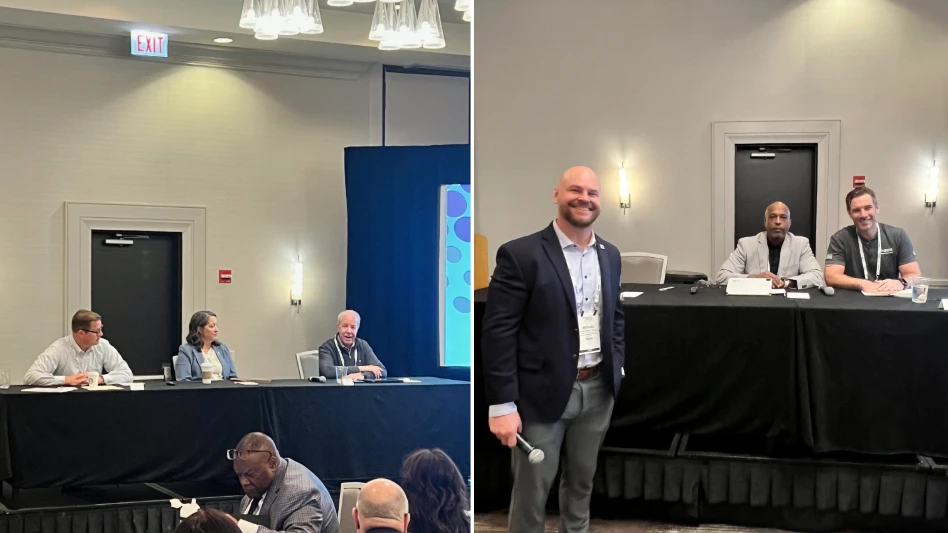
CHICAGO — Industry leaders from the manufacturing, distribution and pest management sectors gathered last week on April 14 in Chicago to discuss and push forward programs at the National Pest Management Association's (NPMA) 2026 Spotlight Series: Sustainability.
"Today's event was a milestone moment for our industry. Pest management executives came together to tackle sustainability not as a trend, but as a proven business strategy that's already delivering real cost savings and operational improvements for companies across the country,” said Jim Fredericks, executive director, the Professional Pest Management Alliance (the Alliance), and senior vice president of public affairs, NPMA.
“This event, alongside the resources developed by NPMA's Sustainability Task Force, marks a significant step forward in equipping our members with the tools they need to build more efficient, profitable and responsible businesses," he added.
Six sessions were hosted at the series, focusing on topics ranging from sustainability in general to equipment to marketing. Each program provided insights from leaders who have developed successful sustainability programs.
Three company leaders led a session called “The Sustainability Edge: Why Forward-Thinking Pest Control Companies Win,” which included speakers Jerry Gahlhoff, president and COO, Rollins; John Myers, chairman emeritus, Rentokil Terminix; and Deedee Smith, senior vice president and general manager, Ecolab.
Smith said companies will do some things right and some wrong when starting a sustainability program, and that finding a status quo is important. Gahlhoff echoed that, stating that protocols like the types of treatment were important. He also wished he had started the program decades earlier. Myers said it was fundamental to first make sure the program was legitimate to himself before going forward with it.
“I love this industry,” said Gahlhoff. “If you think about it from the standpoint of the term sustainability, it will endure for future generations and the importance of what we do and the validity of what we do will continue to exist long after I'm gone.”
According to Smith, any company can start focusing on sustainability — it’s never too late.
“I think it's really important that you find your voice and know where you are on your journey on sustainability," said Smith. “One of the comments I made to our team was, ‘The best time to plant an Oak tree was 100 years ago, the second-best time is today.’ It doesn't matter where you start on your journey [or] if you have or haven't yet. Today's a great time to start.”
Scott Broaddus, vice president of expansion, Hawx Pest Control, and Joe Campbell, senior vice president, ABC Home & Commercial of Dallas-Fort Worth, focused on leveraging technology in their session.
Campbell said that while all companies are focused on how to sell more services to existing clients or to secure new customers, managing the technology is critical. For example, he said it’s difficult to have customers receiving multiple bills for various services from the same company. Also, reducing the number of people a customer has to deal with at a company is significant. Internally, making sure employees are used correctly is important too. An example was that a person mowing lawns is not a landscaper — and vice versa — so they should be separate.
The data is the key, Campbell said. “I think the key to it is collecting the right data. That really is going to be key to whatever that line of service is. ... Then when you get the data, you have to constantly be reviewing it because it’s not a one and done type of thing," he said. "This is part of that whole idea of working on the business instead of in the business.”
Broaddus said the one of the vital parts of growing a sustainability program should focus on people. “Just be super open and transparent, find those early adopters and product champions that will help spread the message of the value and the reason and the why behind why you are implementing and bringing technology on board," he said.
Scot Hodges, vice president of professional development, Arrow Exterminators, and Curtis Rand, president, Rose Pest Solutions, discussed optimization through equipment and tools. They shared various uses and suggestions for everything from sprayers to field cameras to battery vs. gas-powered equipment. Hodges demonstrated the custom designed shoulder pack he developed for technicians, allowing them to carry multiple items on a truck all in one carryall, adding that walking to a customer’s door with everything on the shoulder is a “lasting” first impression.
Lee Barrett, president and CEO, Nisus, along with Shane Dooley, president, FORSHAW, and Ross Treleven, president and CEO, Sprague Pest Solutions, shared the background of building an eco-friendly business model. Examples included installing recyclable packaging for customers, making the program work for all partners (manufacturers, distributors and end-users) and earning adoption across the board.
Treleven recalled the moment they decided to first start their sustainability program. “We’ve always thought of ourselves as an environmentally focused business, and we were struggling to tell that story," he said. "Sustainability became fashionable, and we thought to ourselves, ‘Hold on, wait! We do all those things! Why don’t we have sustainability goals and plans?’ From that day forward we put together a plan and went out and told our team and customers about it.”
Matt Mehr, president, Hawx, and Ali Silva-Mulgrew, president, Plunkett’s Pest Control, gave a presentation on optimizing routes and schedules. Mehr’s company uses scheduling powered by artificial intelligence (AI) that allows customers to book their own appointments. The company added a small leaf icon next to the time so customers could choose the most sustainable route — even if it isn’t the fastest and meant a delay in a technician coming by a day or two or a week. The response has been overwhelmingly positive.
Mehr’s company also developed an idle time reduction program with the goal of reducing idling company-wide to less than 30 minutes per vehicle per day. They also instituted smart lights at corporate, so all lighting would turn off when not a facility was not being used.
Silva-Mulgrew said Plunkett’s made significant investments in safety technology and fleet management software. They also instituted new processes focused on data and created a safety culture. The results included vehicles using less gas, drivers speeding less and less trucks being serviced for maintenance. She said they also separated corporate roles for those managing data from operations in order to make the data faster and available remotely.
The final session centered on marketing content and creating credible claims, which featured Fredericks and Patricia Stofanak, senior vice president, Vault Communications. The two discussed types of labeling for services that professionals should and shouldn’t use when promoting their offerings. Stofanak said there’s a “trust deficit” with customers when using the wrong terms to promote pest control.
Stofanak’s presentation showed that up to 48 million people consider sustainable business practices important and are willing to spend money on it. Areas important to consumers included limiting pollutants, natural resources, renewable energy, ethical supply chains, fair wages and more.
Fredericks reminded attendees to visit NPMA’s fully updated sustainability website, which has a roadmap for professionals seeking to start their own programs, as well as videos, articles and resources.
Latest from Pest Control Technology
- Envu Offers Fall Promotion for Horizon Members
- Pest Management Foundation Announces the E. Raymond Crim, III Scholarship
- Tyro Group Acquires Dowell Pest Control
- Podcast: Beyond the Pest | Ep. 14 — Dr. Zach DeVries
- Webinar: The AI-Run Pest Control Company: Hype vs. Reality, What Actually Works (and What Doesn’t)
- Select Exterminating Acquires Three Businesses Across New York and New Jersey
- Catseye Pest Control Acquires Security Pest Elimination and Biologic Pest Control
- Researchers Confirm New York's First Bourbon Virus Case