iStock | photosvit
BUCHANAN, N.Y. — For many pest management professionals, wildlife management often means raccoons in attics or squirrels in soffits. But today's fastest-growing wildlife issue isn't indoors. It's in the customer's yard.
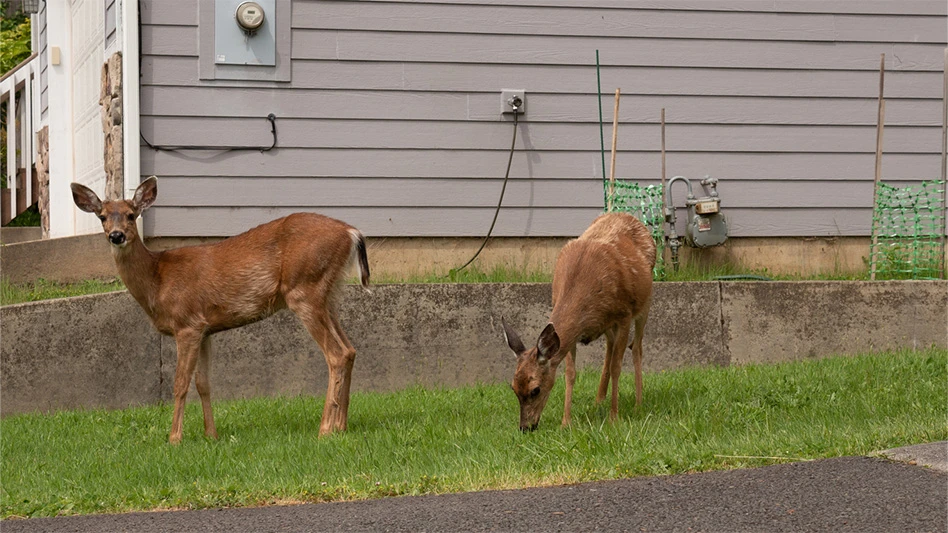
Deer pressure has increased in suburban communities due to plentiful food, few natural predators, limited hunting, and fragmented, edge-rich habitats that enable deer populations to thrive. Homeowners grow frustrated as expensive plantings disappear, with deer turning their yards into an afternoon buffet.
Deer damage complaints now rival those about mosquitoes or rodents. Deer management can be a strong recurring service with the same strategic approach as traditional pest programs.
Understanding the Deer Pressure Problem
A top misconception is that deer damage is seasonal. Deer are active year-round. Even as food dwindles, deer continue visiting consistent feeding areas each season once habits form.
Residential landscapes are particularly attractive because they offer:
- Consistent food sources such as ornamentals, shrubs, and young trees
- Protection from predators
- Predictable, low-disturbance environments
Once deer begin feeding in a yard, this becomes habitual. Reactive treatments rarely work. Effective programs focus on ongoing deterrence and on managing the entire property rather than one-time fixes.
Building a Comprehensive Deer Management Program
A successful deer management program typically combines repellents, exclusion strategies, and customer education.
1. Repellent-Based Treatment Programs
Repellent treatments are one of the most scalable services. Organic repellents, applied regularly, build taste and scent barriers that discourage deer without harming plants or wildlife.
Apply treatments every 3–4 weeks during active plant growth and high feeding pressure, mainly in spring and summer. Once deer form feeding patterns, only consistent, sustained deterrence interrupts them.
2. Exclusion and Physical Deterrents
Repellents alone often aren't enough for heavy deer pressure. Adding exclusion strategies can greatly improve results.
Examples include:
- Plant netting or protective wraps for high-value ornamentals
- Temporary fencing around newly planted trees or shrubs
- Motion-based deterrents such as lights or sprinkler systems
- Landscape modifications that reduce highly attractive feeding areas
Knowing and recommending these tools builds customer credibility.
Communicating the Value to Customers
Setting realistic expectations is a key challenge in deer management.
Unlike wasps or rodents, deer can't simply be removed. Professionals must position the service as behavior modification and property protection.
The goal is not to remove deer, but to make property less attractive to them. This helps customers see why consistent, recurring treatments work.
Marketing Deer Management Services
Many pest companies overlook deer services because they don’t actively market them. Yet homeowners often spend thousands on landscaping and want to protect it.
Customers often respond better to messages about protecting plants and property values than to wildlife control.
Blogs, videos, emails, and social media that explain deterrent programs, offer tips, and educate can drive steady interest.
A Natural Extension of Modern Pest Management
As suburban deer populations grow, so will the demand for management solutions. Pest professionals are positioned to help, already understanding recurring services, integrated strategies, and customer education.
Companies building deer management programs now may solve a rising homeowner problem and create a valuable new service category
Jim McHale, a Cornell-trained entomologist and president of JP McHale Pest Management, is widely recognized as a visionary in the pest management industry. He has redefined the traditional role of the “exterminator,” transforming the small family-run business founded by his father, James McHale, Sr., into a technology- and science-driven company. Today, JP McHale Pest Management serves a combined commercial and residential client base of more than 40,000 customers across the greater New York and Connecticut regions.
Latest from Pest Control Technology
- NCPMA Welcomes New Board Members
- Registration Opens for PestWorld East 2027 in Dubai
- Envu Offers Fall Promotion for Horizon Members
- Pest Management Foundation Announces the E. Raymond Crim, III Scholarship
- Tyro Group Acquires Dowell Pest Control
- Podcast: Beyond the Pest | Ep. 14 — Dr. Zach DeVries
- Webinar: The AI-Run Pest Control Company: Hype vs. Reality, What Actually Works (and What Doesn’t)
- Select Exterminating Acquires Three Businesses Across New York and New Jersey