Before Mary Engle Pennington revolutionized the United States’ food supply by helping implement the 1906 Pure Food and Drugs Act and became the first female lab chief at the U.S. Food and Drug Administration (FDA) in 1908, she was denied a bachelor’s degree and employment.
Despite educational and labor institutions trying to prohibit Pennington from pursuing science, she went on to earn her Ph.D. and start her own laboratory, working her way to groundbreaking leadership roles.
Today, women are far from new to the food safety industry — and their numbers are growing. According to the Institute of Food Technologists’ 2018 Food Science Academic Knowledge Base survey, 70% of undergraduate food science majors at the top 11 food science programs were women.
As we look up the chain of command, however, just 30% of leadership positions overall in the food and beverage industry are held by women, a 2020 study by Thomas and Women in Manufacturing found. While women have made significant strides in the industry and no longer face the overt barriers Pennington once did, many still see a need for structured support, mentorship and professional community.
Filling an Industry Void.

Melody Ge, president and founder of Women in Food Safety and senior food safety adviser at MarsMel, has more than 20 years of experience in food safety and quality assurance. She started her career as a technical director at Beyond Meat.
“During that journey, I realized food safety is the foundation of all products that are in the food industry, and I really wanted to do something to protect public health,” she said.
Ge’s first official job in the food safety industry was at SQF Institute as a compliance manager. Since then, she has held several leadership roles at other companies in food manufacturing, retail, certification, risk, compliance and quality. Ge, who received her master’s degree in food science from the University of Maryland College Park, said she stays connected with her alma mater and often receives questions from members of the school’s Food Science Club about how to get started and grow in the industry.
“I get a lot of questions: ‘How do you get there? How do I prepare my first resume? How do I prepare for my job interview?’ And that’s where I realized we don’t have a community to pipeline the future of food safety professionals,” Ge said. “And being a woman, I’d like to do something to give back to the industry, women in particular.”
Women in Food Safety Comes Alive.
In January 2020, Ge founded Women in Food Safety (WIFS), an organization dedicated to empowering and advancing women in the food safety and quality industry, after pitching the idea to industry peers — all of whom became leaders of the organization.
The group’s membership started with its leadership team and then expanded to women working in the food safety industry. The group now also accepts students who have ambitions to enter the industry.
WIFS has grown quickly over the past six years. Today, the organization has over 5,500 members and earned its nonprofit status in August 2025. Joining is free of charge, said Ge, in an aim to further support members. They communicate with one another and stay up to date on WIFS’ announcements, events, courses and meetings through the Mighty Networks app.
“This community is with an intention to share and inspire the younger generation to go for it,” said Ge. “Break the glass ceiling and take a seat at the executive level in food safety. The community really supports itself and grows itself. I often tell the community, ‘I provided this platform, but you make it happen,’ because they’re really engaged with each other.”
Each month, WIFS hosts a virtual meeting for members to connect and share stories. The networking opportunities inherent at WIFS have helped members find jobs, Ge said, which is one of the organization’s objectives.
The organization has partnered with industry conferences such as Food Safety Summit and Food Safety Consortium to provide members with more opportunities to network and connect in person. This marks the third year WIFS will be present at Food Safety Summit.
“We have a session from Women in Food Safety,” Ge said. “That’s where we can pick our speakers — because if you look around at conferences, a lot of time there are male speakers. And that’s where I would like to advocate. We have female speakers and good presenters to talk about their experiences and stories.”
Built on Support and Empowerment.

Some may question the need for a gender-based organization in the industry. After all, when professionals look around facilities and offices, women are in good company. Yet gender-based barriers in food safety jobs still exist, both inside and outside the U.S.
Allison Richards, director of WIFS’ Caribbean chapter, food safety trainer, consultant and founder of The Food Safety Girl, said she has faced misogyny from facility management who questioned her expertise.
“I think as women, it’s very important for us to be empowered,” said Richards. “I think we live in a time and world where we are always second-guessing ourselves. I think it’s very important first to empower ourselves.”
Jacqueline Southee, Ph.D., chief members and community engagement officer at WIFS and North American representative at Foundation FSSC, met Ge through industry events. When Ge approached Southee, Jill Hoffman (vice president, WIFS) and Melanie Neumann (general counsel, WIFS) at a meeting about starting a women-based group, Southee admitted she initially questioned the need for one.

“As a ‘seasoned’ professional, I didn’t think there were any barriers anymore, because we’ve been fighting for this for such a long time,” Southee said. “I was wrong, and I stand corrected. … It’s not a male-dominated industry anymore; there’s a lot of women out there, [but] there are still challenges.”
The organization has created a space for women to support one another in work-life balance and the everyday challenges that come with it. One of Southee’s colleagues, for example, once received what she considered invaluable advice when trying to balance her professional and personal life after having kids and juggling her morning routine: Buy more socks to relieve the pressure of trying to keep up with laundry.
This piece of advice is similar to what Southee sees exchanged in the organization.
“I think it’s extremely fulfilling,” Southee said. “We literally work to support each other [and] provide advice.”
WIFS Goes Global.

In April 2021, Damarys Del Castillo, division vice president of global food safety and quality at Sigma, joined WIFS after reading about the organization. Around that same time, she relocated from her native Puerto Rico to Texas.
Del Castillo’s native language is Spanish, and adapting to a professional environment where English was the primary language came with challenges. While she loved being involved in WIFS meetings, the language barrier sometimes made participation feel intimidating, which sparked an idea. In 2023, Del Castillo approached Ge with a proposal to make WIFS accessible for Spanish-speaking women.
“In the U.S., there are a lot of people like me,” said Del Castillo, now global community chair at WIFS. “We are Spanish speakers who are part of organizations based in the United States. We bring a different perspective, and there is so much value in building a bridge that allows Spanish speakers to feel included, heard and connected.”
Ge also appointed Del Castillo as director of the WIFS LATAM chapter. Del Castillo said she doesn’t see herself that way, but rather as a member of the organization dedicated to creating connections within the community. She values how quickly members come to understand and support one another.
“Sometimes one word or one shared experience is enough for someone else to say, ‘Yes, I feel that too.’ That’s when real community is built,” Del Castillo said.
Similarly, Richards, who is based in Jamaica, has been growing the organization’s Caribbean chapter. She quickly realized there was already a strong community of women seeking connection.
“The goal is to bring inclusivity to the Caribbean as it relates to food safety,” Richards said. “It has been a great opportunity for like-minded professional women to connect. That really is the objective of the Caribbean chapter — to provide a networking platform and to open a space of mentorship and for professional growth.”
Amplifying the Mission.

Looking ahead, Ge and other WIFS members have new goals for the organization, including securing more corporate allies and establishing an annual retreat for members to thrive both mentally and professionally.
Ge sees an opportunity to develop educational tools for companies, especially those with food manufacturing facilities, on how best to support their female employees on the floor.
She said she also wants to continue expanding the organization’s global community after seeing the need for WIFS chapters in more countries.
As WIFS grows, its leadership team remains focused on sustaining its founding purpose.
“We have a very good leadership team to continuously support the mission that we initially started,” Ge said. “I’m grateful for the team that I work with and their trust in me.”
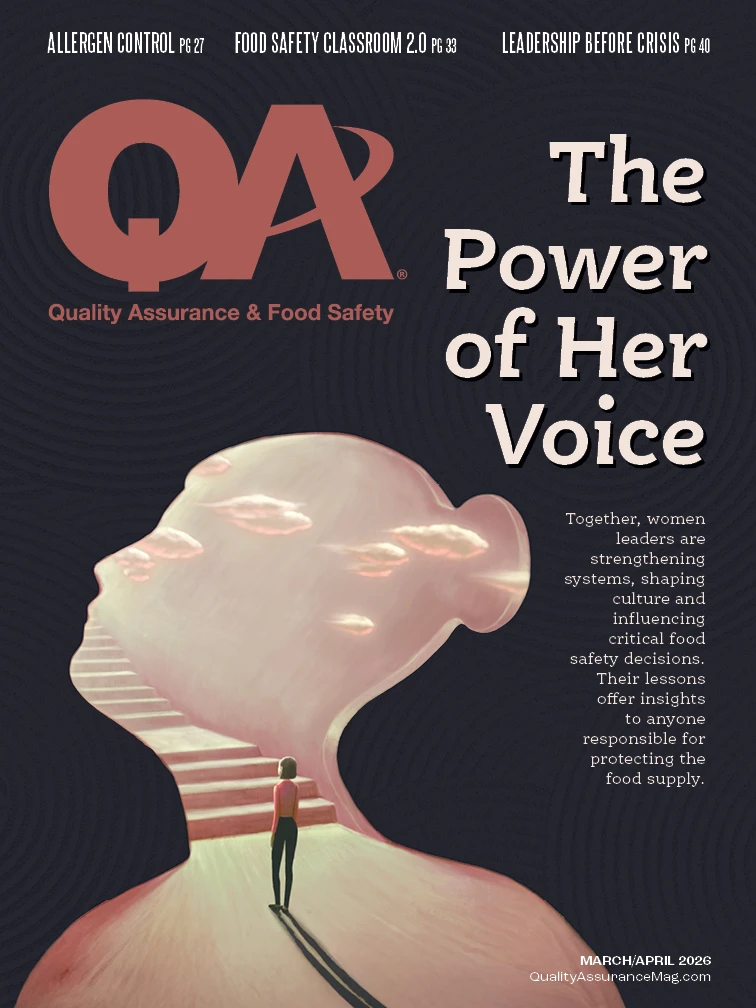
Explore the March/April 2026 Issue
Check out more from this issue and find your next story to read.
Latest from Quality Assurance & Food Safety
- Taylor Farms Removes Iceberg Lettuce Sourced from Mexico Amid Cyclospora Outbreak
- FDA, CDC Tie Multistate Cyclospora Outbreak to Taco Bell Lettuce
- BCG and CGF Release New Report on AI Usage by CPG and Retail Companies
- IntelliAM AI Launches Industrial Intelligence Platform
- QA Virtual Conference to Explore Pest Control Strategies for Food Facilities
- Meat and Poultry Companies Adopt Product of USA Label
- Klobuchar Urges CDC, FDA to Restore Food Safety Funding as Cyclosporiasis Cases Rise
- International Experts Share New Scientific Advice to Support Global Food Safety at 102nd JECFA Meeting