Courtesy of KPM Analytics
Foreign material can get into food products during any point of the manufacturing process, and so far this year, it has, impacting both companies and consumers.
On Feb. 19, Ajinomoto Foods recalled 3,370,530 pounds of its frozen not-ready-to-eat chicken fried rice products because of potential glass contamination. A few days later, Rosina Food Products recalled 9,462 pounds of its ready-to-eat frozen meatball products due to possible metal contamination.
According to Sedgwick’s “U.S. Recall Index 2026 Edition 1,” foreign materials were the second leading cause of FDA food recalls from January to March this year, highlighting that this type of contamination remains a concern and an ongoing problem in the food and beverage industry.
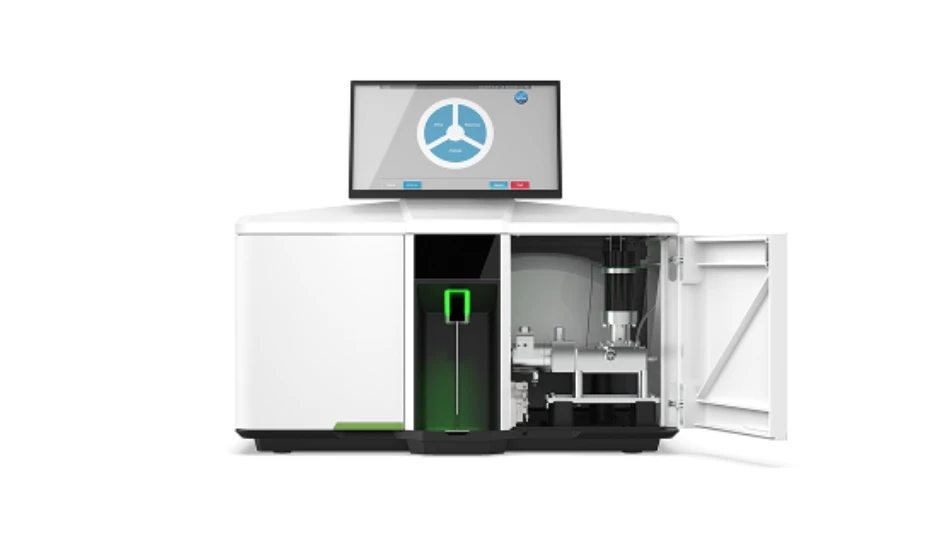
However, certain technology exists to combat foreign material contamination in food processing, and that technology — known as foreign object detection or vision inspection technology — is advancing.
In the past five years, Yuegang Zhao, chief commercial officer, KPM Analytics, said he has seen a growing demand in vision inspection systems from food manufacturers, especially as the technology’s capabilities advance.

“Foreign material detection is not a new subject. It’s been going on in the food processing world for a long time,” Zhao said. “Everybody’s being a lot more alert on foreign material, and there’s more of a demand or need to look at things like paper, wood chips [and] plastic.”
As artificial intelligence (AI) becomes more widely adopted in technology, both foreign materials and unwanted product variations can be discovered with more detail.
The Development of Inspection and Detection.
The most traditional form of food manufacturing inspection involves humans manually checking each product. Given the amount of food produced today (4 billion metric tons per year, as reported by Food Unfolded), the ever-growing demand for a higher standard of product and regulations set by the U.S. Food and Drug Association (FDA), inspection systems have added layers of detection and preventive controls.
Robovision, a platform that helps manufacturers control and standardize vision systems, defined four main types of visual food inspection:
- Direct visual inspection (human observation)
- Indirect visual inspection (tools such as magnification devices and cameras)
- Automated visual inspection (traditional machine systems)
- AI-powered visual inspection (advanced systems with deep learning abilities)
Regarding automated visual inspection, or traditional machine systems, detection of certain defects is pre-programmed depending on a company’s specific product.
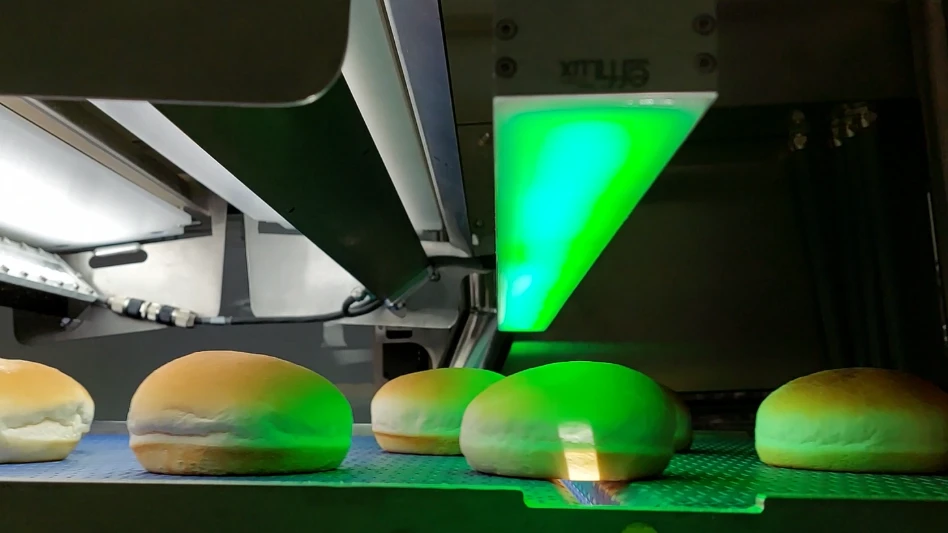
Presently, there are many different types of vision inspection systems to be used to detect foreign materials and quality issues. More traditional versions include technology such as 1D/2D systems. 1D vision systems scan one line at a time, according to TDI Packsys, and put together line images to form a 2D picture. That technology evolved into 2D vision systems, which take full, but flat, images of a product.
These systems can be limited given today’s food manufacturing climate because they cannot capture height/depth of products, according to Keyence. But those standard systems can also present another restriction — “limitations based on the color separation,” Zhao said.
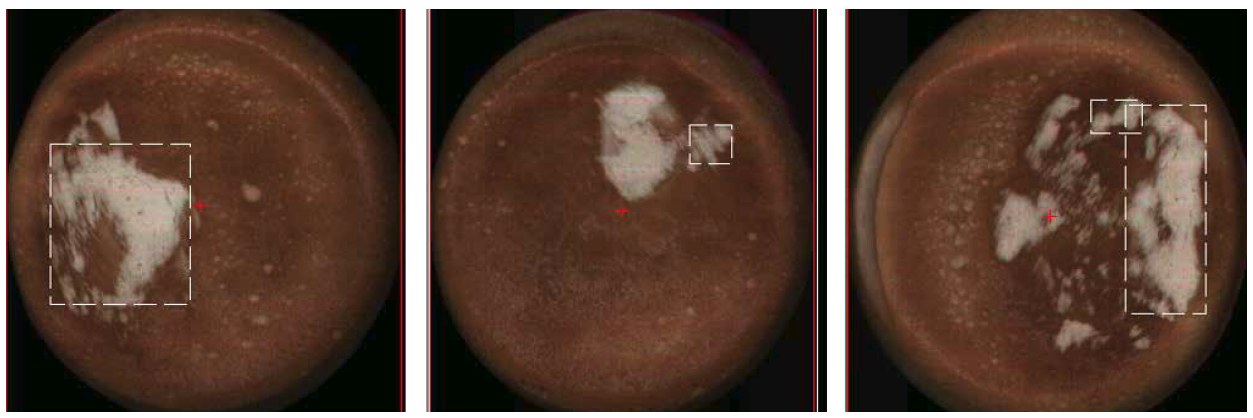
Giving an example of baking and producing burger buns or another product that requires dough, Zhao explained that if an old piece of dough gets stuck to a pan and hardens without being washed, it could get stuck to the next piece of bread or bun, in this case, creating an unappetizing or unsafe experience for the consumer.
Systems that use the traditional color technique can make it more difficult to detect that hard piece of dough because its color may be subtle enough to go undetected and its texture isn’t picked up on.
How AI Has Enhanced Vision Inspection.
With the presence of AI-powered inspection systems in facilities, food defects can be detected with more detail, Zhao said.
“If you look at meat, no two pieces look the same. And then with that, it’s much more challenging to look at [meat] using the color technique to separate things,” Zhao said. “Yes, you can still separate a black plastic in the meat, but if the plastic has blood on it, then it will be very difficult to detect.”
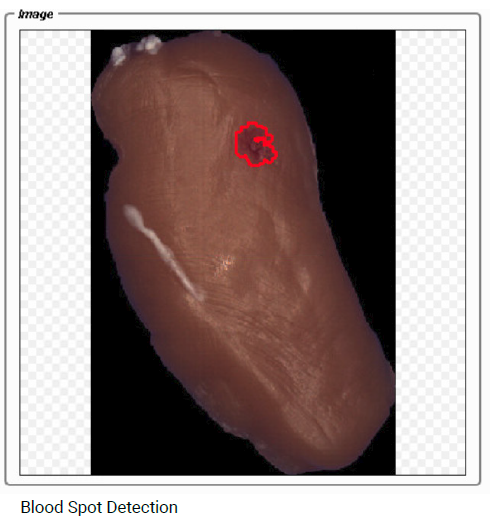
AI-powered systems, according to Robovision, continue to learn about and adapt to “natural variations in food products,” improving their accuracy over time. Deep learning models, a subset of machine learning and a subfield of AI, include multilayered neural networks that mimic the human brain, as defined by IBM, and can reduce the need for human involvement. For inspecting food products, this means that vision inspection systems with deep learning techniques can detect defects and foreign objects more specifically and precisely.
Checks and Balances.
Although the advanced capabilities of AI-powered systems may seem like they could replace the traditional ones altogether, Zhao sees the two as complementary components to inspection that can work together.
“I [think] they will coexist for the foreseeable future, and AI will enable you to detect more things that are very difficult to detect,” he said. “But also, AI has a challenge because it could tell you this is something [bad], but it might just be OK. It triggers you that it’s something unique, but it could be a good quality parameter.”
If an AI-backed system were to flag or make a false rejection, the traditional system that has been pre-programmed to spot actual defects could confirm that the product passes inspection.
“AI enables you to do more detections, but sometimes you need to rely on the traditional technique to double check,” said Zhao. “By building better models, your overall accuracy of the detection will improve, but having a next dimension of measurement to cross-check between these two methods will get you to the next level.”
Training AI-Powered Systems and Technology.
AI systems need to go through a training phase to understand the specific food product(s) being reviewed, Zhao said. While facilities can set up and turn on traditional systems and techniques quickly, he said, AI systems need to be fed sets of product images and data to understand what to look for and what patterns to pay attention to.
Zhao explained that there’s also an important difference between training those systems supervised vs. unsupervised. Supervised learning gives the systems data sets to train algorithms to then predict accurate outcomes, according to IBM, and unsupervised learning uses machine learning algorithms to find patterns in unlabeled data sets without human intervention.
In successfully training AI systems and models, Zhao said FSQA professionals and facility management need to be able to change their mindset. AI can serve as a more enhanced layer of food safety protection if it is given the right amount of attention and preparation, which needs human involvement and cooperation, he said.
“It requires people to have a more long-term mindset,” he said. “It’s kind of a tuning process with AI algorithm. … Don’t get disappointed too quickly, because AI needs some time to get trained.”
Latest from Quality Assurance & Food Safety
- Taylor Farms Removes Iceberg Lettuce Sourced from Mexico Amid Cyclospora Outbreak
- FDA, CDC Tie Multistate Cyclospora Outbreak to Taco Bell Lettuce
- BCG and CGF Release New Report on AI Usage by CPG and Retail Companies
- IntelliAM AI Launches Industrial Intelligence Platform
- QA Virtual Conference to Explore Pest Control Strategies for Food Facilities
- Meat and Poultry Companies Adopt Product of USA Label
- Klobuchar Urges CDC, FDA to Restore Food Safety Funding as Cyclosporiasis Cases Rise
- International Experts Share New Scientific Advice to Support Global Food Safety at 102nd JECFA Meeting