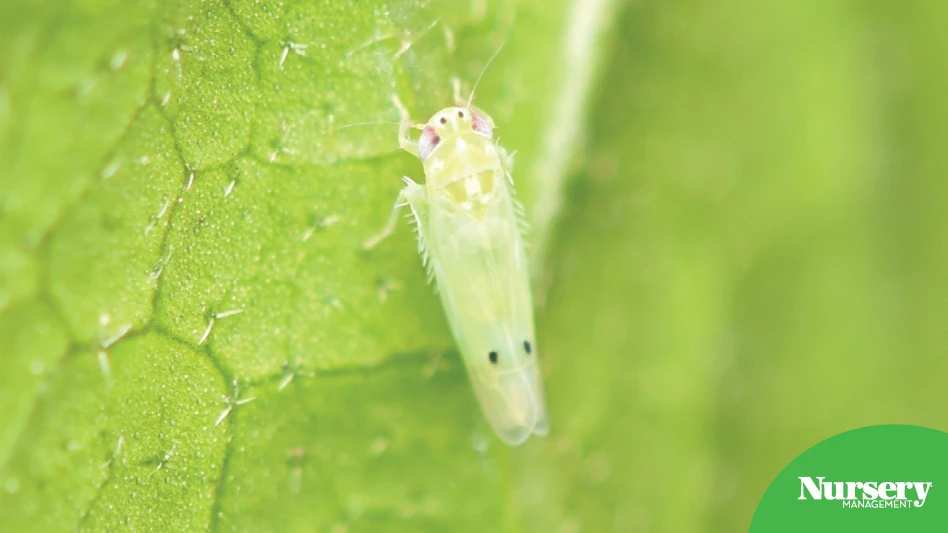
Photo © Julien Karnoub for iNaturalist
The two-spot cotton leafhopper (Amrasca biguttula) is a new invasive pest in the U.S. that is currently threatening agriculture and horticulture in the Southeast U.S. TSCL is mainly a pest of cotton, but also attacks hibiscus. Growers should be aware of this pest if importing hibiscus cuttings from the Southern U.S.
In September 2025, University of Florida scientists at the Institute of Food and Agricultural Sciences (UF/IFAS) warned that the newly detected TSCL was threatening crops across South Florida after spreading from its initial detection in December 2024. The tiny pest, only 2.5 to 3 millimeters long, was reported to cause serious damage to the Florida’s high-value food and ornamental crops including cotton, okra, eggplant, roselle, sunflower, tropical hibiscus and others. It prompted statewide alerts for vigilance among growers and residents.
The pest has spread from Florida to Alabama, Georgia, Louisiana, Mississippi, North Carolina, South Carolina and Texas.

Background
TSCL originates from the Indian subcontinent, and is known to feed on cotton, okra and eggplant. The only recorded ornamentals this pest feeds on are hibiscus and sunflower, but this host list may expand as we learn more about how this pest adapts to North American crops.
Identification
TSCL superficially resembles Empoasca species such as the potato leafhopper, Empoascafabae (Harris).
Adults are tiny green insects. They can be distinguished from Empoasca spp. by a dark spot on each wing and often by two dark spots on the head. The two spots on the wings are nearly always visible and will distinguish this species from other tiny green leafhoppers, especially those related to potato leafhoppers.

Damage
Infestation by this small insect is often noticed only after the “hopperburn” symptom has appeared: green leaves turn yellow, then red, brown, curl and wilt. Females insert eggs singly into leaf veins and midribs, which makes early detection difficult. The seemingly uninfested plants are shipped, which spreads the insects.
Damage is reminiscent of that caused by vascular plant pathogens, but TSCL is not proven conclusively to transmit plant pathogens.
Control and what’s next
A multi-state working group has been created to coordinate response to TSCL, led by Muhammad Z. “Zee” Ahmed, an assistant professor of turf and ornamental entomology at Clemson University’s PeeDee Research and Education Center and including collaborators from South Carolina, Georgia, Florida, Alabama, Virginia, Tennessee, Texas and federal agencies.
To provide ornamental growers with practical solutions, Ahmed’s program conducted the first U.S. nursery pad field trial on hibiscus.
This study evaluated multiple IRAC groups under real nursery conditions and identified Hachi Hachi and Safari as the strongest performers, with Altus and Ventigra also providing sustained suppression. For the full report, go to bit.ly/TSCLtrial.

Explore the June 2026 Issue
Check out more from this issue and find your next story to read.
Latest from Nursery Management
- The Growth Industry Episode 14: Meet Lionel van der Walt, AmericanHort's new CEO
- Growers and suppliers say BFG Supply Co. will close
- Stemmer from BioWorks
- BioWorks introduces Stemmer silicon-based plant health solution
- Silver Fern awarded grant to expand AI-powered demand planning for greenhouse, nursery growers
- All-America Selections announces first three new AAS Winners for 2027
- 2026 Special Recognition Award recipients announced at PPA National Symposium
- [WATCH] July issue recap