Tanner Bigler describes getting into organic food plants as “almost an accident.” His company, Safe Chem Pest (Clearfield, Utah), had been servicing a commercial account for years when the company decided to go organic. They had so much faith in Safe Chem that they asked Bigler to work with them on developing compliant protocols. He did, and now his team doesn’t just continue to service this organic account; they actively seek others as they recognize the revenue and profit potential of organic food plants.
“Nothing that happens in the organic facility is really outside the scope of work that you’re already doing if you’re servicing commercial accounts,” Bigler said. “It’s just about understanding what each account needs and being a little more creative in how you resolve their issues while maintaining compliance.”
In fact, Bigler has found organic customers to be easier to work with than many commercial accounts because they are committed to such high standards of food safety. “They are very collaborative and appreciative of what we do — they’re actually happy to see us, which you don’t always get from commercial accounts,” he said. “If you’re only in the residential space right now, I wouldn’t try to tackle an organic facility as your first commercial account, but if you’re already in the commercial space, I highly recommend looking into organic work.”
DISPELLING MISCONCEPTIONS. Chelle Hartzer, B.C.E., PCQI, 360 Pest Consulting, acknowledged that servicing organic accounts does require an “extra layer” of care — namely, adhering to the rules set by the third-party auditor of the facility. “It can be intimidating because you’re beholden to not just your customer but also their auditor,” she said. Hartzer added that things get easier once you’ve familiarized yourself with those rules and set your program in place, even if you run into a persistent infestation that requires a pesticide.
“One of the biggest myths related to organic accounts is that you can’t use pesticides. You absolutely can, but there’s a process,” said Hartzer. “You start with all-natural products — essential oils. If that doesn’t work, you go to the next tier of approved pesticides. Then, if needed, the next tier. You just need to follow the prescribed hierarchy and document your actions so you have proof for the auditor that you did things by the book. They want to see what products you used, what results you achieved and your rationale for moving to the next tier.”
Of course, with a strong Integrated Pest Management (IPM) plan and solid collaboration from the customer’s sanitation team, you may not need to move to more powerful pesticides, Bigler said. Your best approach is to understand the reporting requirements, the chain of command and the list of approved products, and to put processes in place right from the start. He also recommends assigning a dedicated technician to each account.
“They need to learn the particular requirements of each facility,” he said. “These aren’t accounts where you can rotate people in and out based on who’s available.”
Specialized training, certifications and shadowing can help technicians build their skills. Hartzer suggests reaching out to a friendly local company that performs organic work if you’re just starting out in this space.

“We have had phenomenal collaboration with our clients in this category; they are, understandably, as dedicated to upholding the organic standards as we are.” — Tanner Bigler
“Following along with someone who has done this and who has the knowledge is essential. Call your neighbor and say, ‘Hey, I know you do this organic facility; can I follow you for a couple service visits?’ That kind of on-the-job training can make all the difference.”
STRICT REPORTING. Organic food facilities are audited by U.S. Department of Agriculture (USDA)-accredited certifying agents: private, nonprofit or state organizations authorized by the USDA National Organic Program to ensure compliance with federal organic standards. It’s important to know which of these agencies audit each pest management client because their requirements may be different.
Both Hartzer and Bigler said that the first thing they do when evaluating a new organic customer’s needs is to ask who the auditor is and request their standards. If it’s a larger agency, they may have published standards you can retrieve online. For smaller agencies, you’ll likely need to ask the customer.
Bigler also pointed out that reliable software is essential for keeping information well-organized and accessible. At any time, an auditor may ask to see the pest management company’s legal paperwork, including the business license, pesticide license, insurance forms, product list, trend reports, service records, etc., and, of course, these materials need to be readily available for official audits.
A MEANINGFUL PARTNERSHIP. Perhaps more than any other type of account, organic food accounts require frequent, clear communication between parties and a deep understanding of shared goals. “We have had phenomenal collaboration with our clients in this category; they are, understandably, as dedicated to upholding the organic standards as we are,” Bigler said.
As an example, he shared that during one of Safe Chem’s own audits, he told the facility manager they needed an additional fly light in a space where there was no outlet. The manager wasted no time bringing an electrician in to run an outlet there.
“Organic clients want their programs to work well,” Bigler said. “Comparing these accounts to standard restaurant accounts, we’ve had a night-and-day experience. We provide recommendations and they act immediately.”
Just as it’s important to have a dedicated technician, it’s important to have a dedicated point of contact in an organic account. That point person’s role may be in quality assurance, sanitation or general management. “Whoever it is, make good friends with them,” Hartzer advised. “Talk with them, educate them. They may know everything about their product, but they may not know all the rules behind the facility, because that’s not their job. Helping them understand the circumstances and what needs to happen will greatly improve the process.”
EXCEPTIONAL IPM. How would you rate your service, from inspection through treatment and ongoing monitoring — good, great, excellent? The standard that should come to mind with organic accounts is meticulous. There are more areas to inspect. More conducive conditions to figure out. More considerations to think through as your service technicians remind themselves that the food being produced, processed or packaged at this facility will end up on someone’s table, maybe even their family’s table.
Inspections must be scrupulous. Find the food sources. Identify the sanitation issues. Don’t just check the traps, but also read the data from your monitoring to get the whole story of how and why pests are getting in.
“One thing I see too much of in food facilities is too many devices — bait stations every 20 feet, traps on either side of every door. That’s not thinking about the system. That’s just putting out a lot of devices and hoping it works,” said Hartzer. “Instead, think it through: We’re going to have more problems on the north side of this facility because the area is wooded and rodent pressure will be higher. Or maybe you’re on the inside seeing a door that’s fully sealed. You probably don’t need a device at a door that never gets opened. You can refocus your time and effort to be more strategic.”
Bigler agreed that taking a strategic IPM approach is vital to success. “Conducive conditions are a top concern in these types of accounts, so make sure there are door sweeps, no access at the bay doors, no pooled water, etc. Focus on exclusion. And consider the broad range of tools that are available to you before you consider pesticides.”
To that point, Safe Chem has successfully incorporated fly lights, nonlethal multiple-catch traps, pheromone traps, glue- boards and other non-pesticides into their programs, in conjunction with conscientious monitoring and inspection. Bigler noted that service technicians should always check the space around employee lockers to ensure no one is bringing cockroaches or other pests in from home. His team also ensures incoming shipments are being adequately inspected, sealed and stored. In essence, they give the facility a “mini audit” every time they visit, and they share any relevant findings with their point of contact to keep everyone on the same page.
PREMIUM PRICING. Organic food facilities are high maintenance, and they know they’re high maintenance. They expect to pay more for the extra time and care your team puts in. Bigler’s advice is clear: Charge what your expertise is worth.
“If you price it right, this work is absolutely worth your time,” he said. “Clients are more than happy to pay a premium if you are dotting your i’s and crossing your t’s. You’re taking a potential source of stress off their plate. Any time you can do that, you have the potential to build a strong, lasting relationship.”
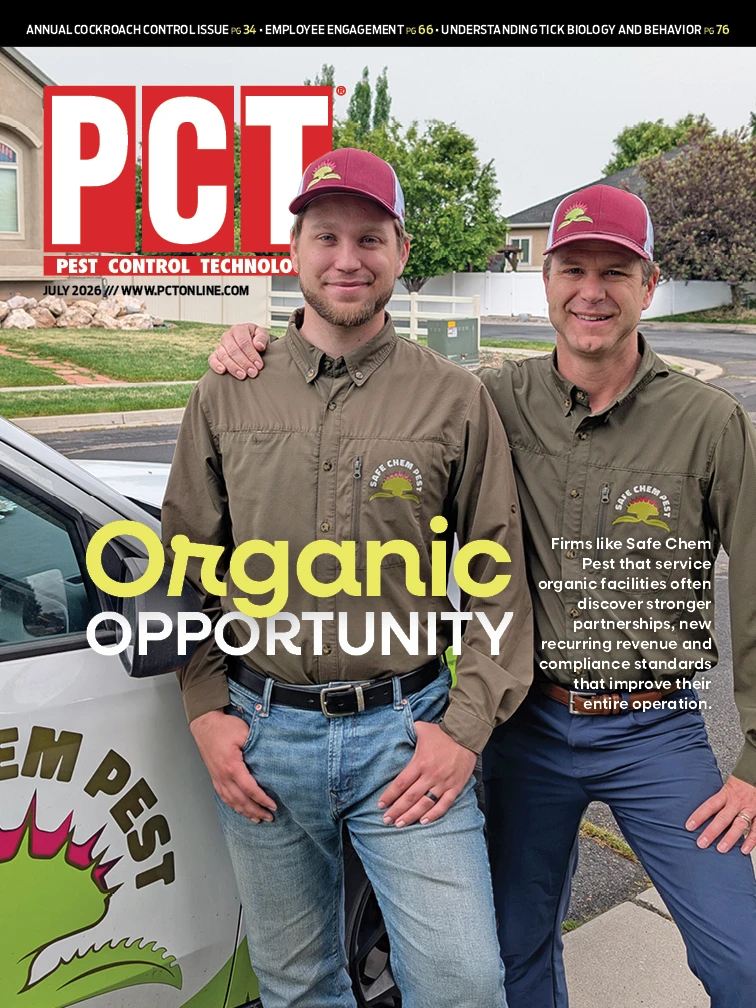
Explore the July 2026 Issue
Check out more from this issue and find your next story to read.
Latest from Pest Control Technology
- Envu Offers Fall Promotion for Horizon Members
- Pest Management Foundation Announces the E. Raymond Crim, III Scholarship
- Tyro Group Acquires Dowell Pest Control
- Podcast: Beyond the Pest | Ep. 14 — Dr. Zach DeVries
- Webinar: The AI-Run Pest Control Company: Hype vs. Reality, What Actually Works (and What Doesn’t)
- Select Exterminating Acquires Three Businesses Across New York and New Jersey
- Catseye Pest Control Acquires Security Pest Elimination and Biologic Pest Control
- Researchers Confirm New York's First Bourbon Virus Case