Those who know Takiyah Ball, Ph.D., call her a lifelong student.
Ball, a food safety microbiologist at Sargento Foods, started her college career with the goal of becoming a veterinarian, but through a winding path defined by her curiosity and passion for learning, she became a food science and safety professional.
Ball’s career began with a bachelor’s degree in cellular biology from the University of Georgia. After that, she stayed in Athens, Ga., earning another degree in microbiology.
“I fell in love with molecular science,” she said. “I love cell biology and everything about the human body and how it works. Animals too. They fascinate me and my curiosity about the world. And the microbes that affect our body are what really got me interested in this line of work.”
While pursuing her degree in microbiology, Ball began working at the U.S. Department of Agriculture (USDA), where she was hired as a temporary full-time employee after graduation. When her term at the agency approached its end, USDA offered to send her to school again, so she returned to the University of Georgia for a master’s degree in animal science.
Ball worked as a microbiology technician at USDA for several years. When agency funding changed and the market crashed, she had to decide on her next step, leading her to Emory University, where she earned her master’s in public health.
“It was a new area of learning that I had not previously been exposed to,” she said. “This path was about answering the question, ‘How is our work helping people? How is it helping our environment? How is it helping animals?’”
The connections Ball made while pursuing her master’s degree led her to seek a Ph.D. in comparative biomedical science. Her boss at the time took a position as head of a population health department at North Carolina State University and asked Ball to be her doctoral student. Ball’s research took her to Uganda, where she worked with officials on antimicrobial resistance surveillance and data analysis.
For her postdoc, Ball returned to government work, this time at the U.S. Food and Drug Administration (FDA) as an ORISE fellow. During a six-week furlough, however, she started considering other industry options.
“That’s when I looked in the industry and Sargento in Wisconsin had the job [opening],” she said. “It was a new role as a food safety microbiologist, and I applied and got the position. But it did take me some time to think, because I’m a Southern girl, so moving to the Midwest was a huge decision.”
QA sat down with Ball to learn more about the lessons learned during her career in academia, government and industry, and why she’ll always be a student.
I’m trying to build relationships in the plants, trying to understand what they do, how they do it, and at the same time, looking for improvements. From a microbiology standpoint, I’m looking for standardization across everything. That’s pretty much my job right now [at Sargento].
I’ve been in government and academia for 16 years. I did bring this up to one of our deans — the thing I wish we would have gotten out of either our master’s or Ph.D. program is the business aspect for those of us who go into business. We are so research focused. So, my transition, I’m not going to lie, it was difficult to go and learn the business part of it and understand it. There’s so many things that went into that, because I moved from the South to the Midwest. I’m a single mom going and doing this on my own, going from government to industry.
I did go back to start school to get an MBA. Sargento has this great reimbursement tuition program, so I was like, why not? They’re sending me back to school. There’s a new program at Lakeland University that’s an MBA with a focus on food safety.
When I came to [Sargento], I started to look at associations related to what we do. I am on the scholarship committee for the Wisconsin Laboratory Association. I love working with students, so I have been on this committee for the past five years and have chaired for one of those years. The Wisconsin Association for Food Protection, that’s the big one that I’m a part of. I did start on a committee and then was nominated to join the board and just recently passed the gavel over to the next president.
As we always say, food safety is not competitive. We have to learn from each other so we can all be better. We all do our best to make sure everyone’s doing well in their food safety roles.
When I think about food safety, I go back to the environment, humans and animals. Humans and animals cannot survive as a species if we don’t have food and water. If they’re both contaminated, we will not survive as a species. We need a good environment, a safe environment, so we can feed ourselves and feed our animals. And that’s the importance of food safety. We need it. We have to have it. It’s how we survive.
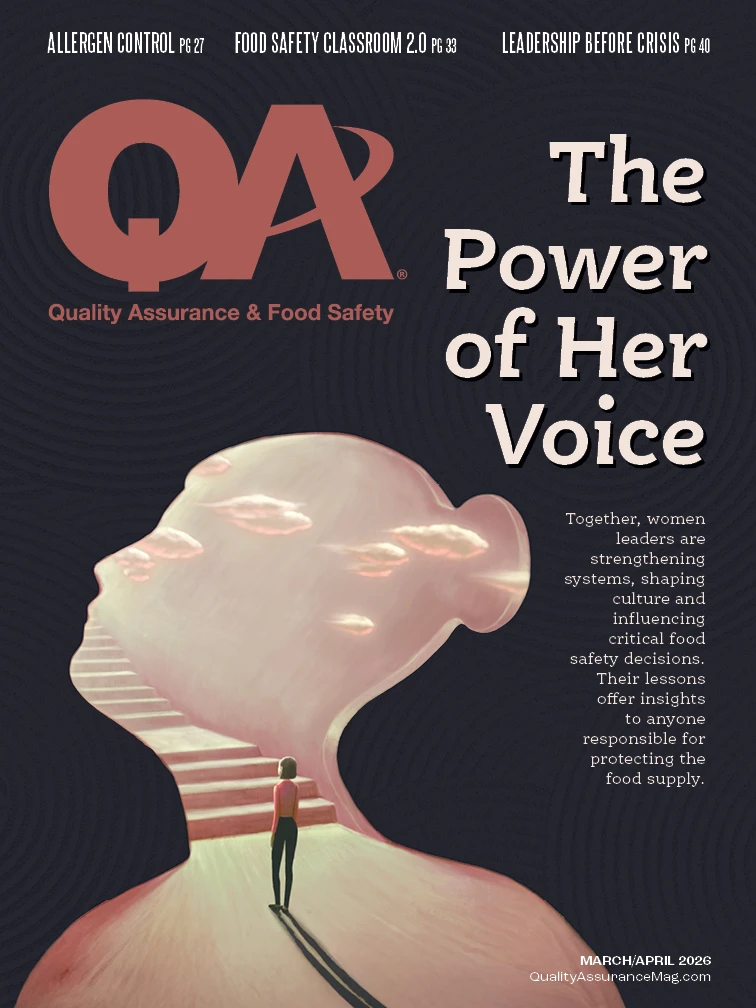
Explore the March/April 2026 Issue
Check out more from this issue and find your next story to read.
Latest from Quality Assurance & Food Safety
- Taylor Farms Removes Iceberg Lettuce Sourced from Mexico Amid Cyclospora Outbreak
- FDA, CDC Tie Multistate Cyclospora Outbreak to Taco Bell Lettuce
- BCG and CGF Release New Report on AI Usage by CPG and Retail Companies
- IntelliAM AI Launches Industrial Intelligence Platform
- QA Virtual Conference to Explore Pest Control Strategies for Food Facilities
- Meat and Poultry Companies Adopt Product of USA Label
- Klobuchar Urges CDC, FDA to Restore Food Safety Funding as Cyclosporiasis Cases Rise
- International Experts Share New Scientific Advice to Support Global Food Safety at 102nd JECFA Meeting