Editor's Note: This article originally appeared in the September 2026 print edition of Greenhouse Management under the headline “A steward’s harvest.”

When Ken Fisher announced last November that he would step aside as AmericanHort’s president and CEO in May 2026, it surprised many people in the horticulture industry. So did the realization that a full decade had passed since Ken stepped into those roles — and helped reshape the association and the industry alongside it.
Perhaps the person most surprised to learn that Ken was nominated and selected to achieve a 2026 Horticultural Industries Leadership Award (HILA) — not for leaving, but for achieving — was Ken himself.
The GIE Media Horticulture Group spoke with him just weeks before his tenure as AmericanHort’s leader ended. Asked about his reaction to his HILA award, he responded with humility.
“For the past nearly 10 years as I walk Cultivate, this Horticultural Industries Leadership Awards has been present. … I always stop by and I see the recipients, and they are some of the people that I respect the most in the industry,” he says. “I was just very humbled and honored, and I’m sort of in disbelief, because my contributions have not been what a lot of these folks have been. I’m very, very honored.”
Jon Reelhorn, owner of Belmont Nursery and former chair of both AmericanHort and the Horticultural Research Institute (the AmericanHort foundation), sums up Ken’s impact: “Ken’s industry leadership has affected every person that attends Cultivate, every member of AmericanHort, ANLA and OFA in a positive way. We are successful as an industry, partly because of his fiscal responsibility, but also because of his team-building skills, his vision of the future and his ability to connect with other leaders to connect the dots to improve our businesses and our industry. We are in a much better place than we were prior to Ken’s hiring.”
Leading with insight and experience
When Ken stepped into AmericanHort in 2016, his selection triggered quite a buzz. His diverse professional background included leadership roles in several major consumer products businesses, including the Coleman Company and Elmer’s Products. Conspicuously missing was horticulture. His appearance as an outsider bothered some people. But the AmericanHort selection committee was looking for a business leader, not an industry insider.
Ken suggests that the naysayers were right about his lack of horticultural experience. He recalls telling some board members: “You have 30 years of horticulture experience. I have one. Next year, you’ll have 31, and I’ll have two. And that’s just sort of how this is going to have to work.”
The underlying truth was that he didn’t know the industry, but he did understand the business owners he was eventually hired to lead. That truth was integral to his ability to lead the association impactfully and personally connect with and lead the people who comprise it.
Ken recalls walking into an early meeting with the search committee. “I looked around and said, ‘Well, I don’t know these people, but I know these people. I grew up with these people … They wake up every morning; they make a living in the soil. I know their values. … At the end of the day, they’re pretty serious about what they do, because this is a family business that they’ve been entrusted with.”
As he stepped into the new role, Ken was drawn not only by the opportunity to bring business acumen and leadership to a horticultural trade association, but by the chance to make a broader impact.
As a kid from Kansas with deep agricultural roots, Ken had turned around companies, both big and small, public and private. In AmericanHort, he saw an opportunity to not just steer a company, but to steer an industry. That transformation began with the people he served.
Leading with integrity and stability
When Ken took the helm at AmericanHort, the organization was not on stable financial footing. Many would agree that it was not on very stable cultural footing, either.
Recalling the early days of his tenure, Ken says, “Part of it was coming in and really trying to stabilize the trade association. But, more importantly, it was really trying to rebuild the trust with the people — both the staff that we have, as well as the members — and trying to establish the trust that AmericanHort is here to help them.”
He made it clear that they were going to run a very tight ship, be very good at what they do and do what they’d say. Integrity of words and actions was critical to his leadership. He expected the same from his team.
As he assembled a team of individuals dedicated to the horticulture industry and the association’s mission, he built a culture around teamwork — a culture built on individual integrity, trust, respect and open communication.
“From a leadership standpoint, what we’ve tried to focus on with our people is what we call principle performance,” he explains. “We’ve got to show a sense of urgency and accountability and ownership, and enough risk-taking mentality that we can really move the association forward.”
A second goal for his staff and anyone in contact with AmericanHort was what he calls potential fulfillment. “We want to make sure that people are finding a way to live up and accomplish and advance their potential as individuals, as professionals, and we really want people to find fulfillment in what they do,” he explains.
Building and leading a team and an association that AmericanHort members trusted and relied upon became a central focus of Ken’s tenure.
Mary Beth Cowardin, AmericanHort vice president of marketing and member engagement and Nursery & Landscape Association Executives executive director, characterizes Ken as a leader who asks smart questions, thinks things through and genuinely wants to understand: “He has a mindset of wanting to do things that will help create improvement and will help a business enhance their bottom line.”
She notes that Ken has coined a strategic phrase: "Perform better; grow faster; prepare for the future."
“I know he believes in that phrase very sincerely, and it has really guided our work at AmericanHort under his leadership. It sounds like a simple phrase, but there’s a lot behind each part of that phrase,“ she adds.

Leading through mentorship
In talking with Ken, one theme surfaced repeatedly: He rarely frames success as an individual achievement. Reflecting on his accomplishments, he is quick to credit others.
“I think anyone who has had any amount of personal, professional success in this world has built it on the shoulders of a lot of people, and I certainly have,” he says, pointing first to his family — his parents, aunts, uncles and grandparents — who instilled values in him growing up.
Second, he notes numerous people who influenced him in his career. As a young professional, he says, he had extremely strong mentors who guided not just the way that he learned about business and customers and financial aspects of the world, but also how to treat, manage and recruit people.
“Sometimes when you don’t know what’s around the corner, you get a phone call or knock on the door, and there’s someone who, for whatever reason, is sort of there to take you to that next level,” he shares.
“It has happened many times prior to AmericanHort, and certainly, as I got here, there have been several key board members, several key stakeholders who have partnered with me, who have been a sounding board, who have really helped me navigate some of the challenges that we’ve had as an industry, to come out the other side. I’m certainly grateful for those people.”
That gratitude is one of the many drivers behind his perspective in supporting his staff and his support of the Horticultural Research Institute Leadership Academy program. “I hope that I’m able to not just provide some professional wisdom and guidance, but also be there as a personal mentor for them as well,” he says.
“We have some very, very talented people in this industry. They wake up every day trying to lead their family, lead their businesses. It’s rough. Anything I can do, anything we can do to help them is, I think, a gain for our industry.”

Leading the industry’s leaders
As Jon Reelhorn reflects on Ken’s leadership, he refers to him as the leader among the industry’s leaders: “He’s the one that is negotiating with them or leading them or directing guys that are really smart and dedicated and powerful and have shaped the industry.”
Reflecting on Ken’s arrival, he notes that the association needed someone to “clean house” and to look at things differently: “The status quo wasn’t getting us anywhere. … Financially, we needed to be on a much more solid ground. And he’s done that. To make Cultivate successful enough and the outside events successful enough to raise money, to have money in the bank, to reinvest in the industry was unheard of.”
A project close to Jon’s heart is the HRI Leadership Academy. “To start the Leadership Academy and take 12 people and spend $250,000 a year to educate them to be better leaders — that’s a big deal. And every graduate from that course, they all just say thank you so much for doing that,” says Jon, who credits the leadership of Ken and his staff in building Cultivate to the point where it can fund this reinvestment in the industry’s leaders.
One example of Ken’s ability to connect with and lead other leaders came when COVID-19 struck. Cowardin recalls that his leadership and stewardship of the association’s resources enabled a response that was integral to the industry in a time of great need.
“We were able to react quickly and … do so in a very calm, confident manner, at least outwardly. I think that’s a really great example of just the kind of person he is in the way he leads,” she says.
Leading with family in focus
Fisher shares a story about a past colleague who worked with many family-owned businesses, who frequently said the toughest job to have is being the third generation in a family-owned business. For Ken, who places a very high value on the importance of family, working with family-owned businesses has left a mark.
“As I have seen the development of these leaders and family-owned businesses, whether it’s first to second (generation), or second to third, or even third to fourth, I’ve really been moved by what happens to a person when they see the next generation is going to come into their business,” he shares. “The day they make that decision, I can see this light flip on … The future all of a sudden becomes very bright.”
He notes that what matters most to AmericanHort members is the family, the people, the customers and the like-minded individuals and professionals who have gotten them (and him) to this point — and will get them to wherever that future goes. And no one wants to see their life’s work turned over to someone who doesn’t appreciate it as much as they do.
“This industry, more than most, is a whole lot about the family relationship and the people side of it … There really is caring for what we do and how we do it, and that rubs off,“ he adds.
“If you come into this industry and don’t have that sort of value and perspective, you don’t have a family focus, and you don’t have a real focus on what the people in this business need, I don’t think you’d make it.”

Leading for a stronger future
As a person known to prefer staying out of the spotlight, Ken notes achievement in terms of “we” and “our” rather than “I” and “my.” He hopes that his accomplishments are about the people who have been impacted personally and professionally during his tenure, and that the foundation of AmericanHort — and therefore the foundation of the horticulture industry — has been strengthened.
“Our job is to build the industry and the association, not for what it is today, but for what it needs to be tomorrow. What I’m proud of is that our team is still going to be there, but we’re going to leave this better than we found it. And I think there’s a much stronger foundation on which to build,“ he says.
Ken calls out several well-known names of past horticulture industry leaders. “These industry greats, we are building on their shoulders, literally and figuratively. Their strong shoulders put this industry in the place that it is today, where we have very successful businesses. We have nearly three million jobs accounted for, half a billion dollars of an industry sector, and but not for those broad, strong shoulders of those men and women, we wouldn’t have this chance,” he says.
“So, what I hope is that AmericanHort is now, 10 years later, in a better place. That now, people can stand on AmericanHort’s shoulders, and it’s a stronger foundation, and we can look forward to the next 10 years to see just where this industry can go, because there’s going to be opportunities and challenges.”
He notes that AmericanHort is financially and strategically strong, as is the team and the board: “I think the association is in a really good place for someone to come in. I don’t think there’s anything to fix, and now it’s just how do we take this yet to the next level?”
Leading in new ways
For anyone who read the November 2025 press release closely, it was very clear that Ken is not retiring. A quote from him included in the release reads, in part, “This transition will also allow me to pursue my next professional opportunity and continue contributing to the industry in new ways.”
Asked specifically what he personally sees ahead, he says he “still has gas in the tank.” But he’s not exploring new opportunities until he sees this one through to the end. He’ll assist in whatever capacity is needed with the full transition to AmericanHort’s next leader: Lionel van der Walt, who was named as the next president and CEO in May and was introduced to the industry at Cultivate’26.
He also makes it clear that he hopes, when that time comes, that the horticulture industry holds more opportunities for him.
“I will continue to either work full-time or part-time, in either capacity, in this industry or one of the others I’ve been in in the past. I enjoy helping businesses grow and succeed. I’ve done a lot with acquisitions. I’ve done some with exits, and some of the small businesses and large businesses, and public and private equity. So yes, I certainly hope that there’s an opportunity to work with businesses in this industry,” he says.
“It has been truly an honor, a privilege, to serve in this industry, to serve alongside these people: People who just wake up every day really wanting to grow great plants and have great businesses and be around their favorite people. That’s been a real privilege and an honor,” he says.
Even as he looks toward the next chapter, Ken returns repeatedly to the people and relationships that shaped his time at AmericanHort.
“Anything that I’ve been able to do to make their world better, to make our industry stronger, to help grow more leaders for this industry, to make somehow AmericanHort and the industry stronger — that has been just a pleasure. I am very grateful for all the people who have invested in me and all the work that I’ve been able to do …. (They) have just been just such a meaningful part of my career.”
Ken reiterates that he has at least another part of a chapter to write in his career, but he adds, “This one will be certainly one of the best that I’ve had, and I’m just grateful for all of it.”
Watch a video of Ken from the Horticultural Industries Leadership Awards at Cultivate'26 here.
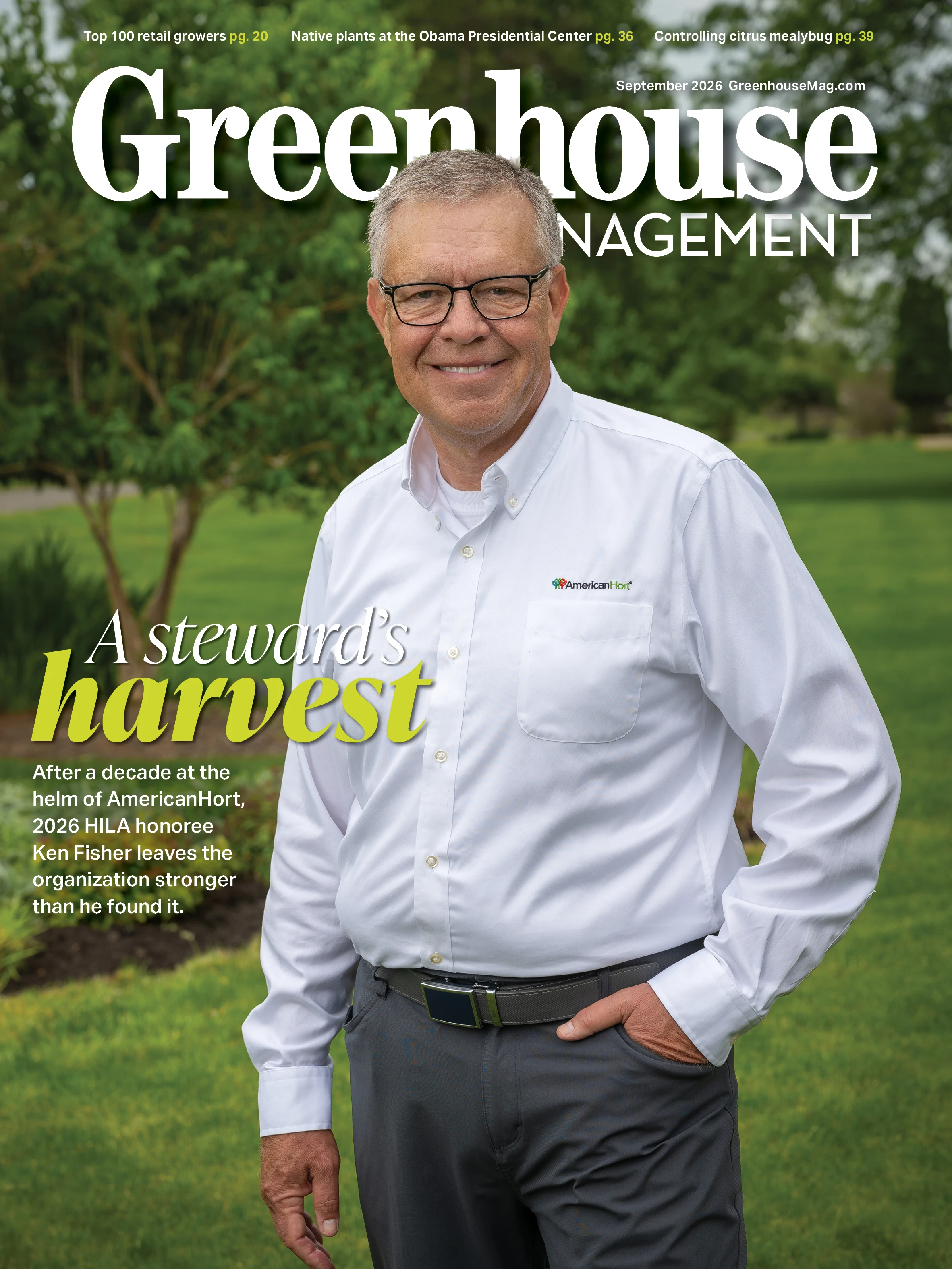
Explore the September 2026 Issue
Check out more from this issue and find your next story to read.
Latest from Greenhouse Management
- The Growth Industry Episode 17: Investing in IGCs with WorryFree® Plants
- New UF study sheds light on the hidden toll of back pain among horticulture workers
- 2026 Irrigation and Automation Market Report: Tradition rains
- Empowering the Future of Precision Cultivation: Resource Efficiency, Root-Zone Science and Scalable Automation
- Oasis Grower Solutions hires plant scientist Timothy Frey
- New green industry leadership development program for women now available
- Clean production protocol
- Jiffy hosting Microgreens Grower Day