Photos courtesy of Russell's Garden Center
For 150 years, people have trekked to a store in Wayland, Massachusetts — a store with the Russell name out front. Today, the location in Boston’s MetroWest is home to Russell’s Garden Center, #42 on Garden Center magazine’s 2026 Top 100 Independent Garden Centers List. With a century and a half of history, the destination continues to leave its mark, drawing new generations to an experience only Russell’s provides.
Founded as Russell’s Provisions in 1876 by farmer and butcher Samuel Russell, the business has endured through five generations, shifting with the times and its customers’ needs, from meats, vegetables and fresh-cut flowers to a garden center extravaganza with extensive plant offerings, carefully curated gifts and decor. Through it all, it remains on the same farm where it all started, about an eighth of a mile from the original store.
For Elizabeth Russell-Skehan, fourth-generation family member and company president, her husband and business CEO Tim Skehan, their children Dan and Carly, and the Wayland community, the 150th anniversary represents more than endurance. Russell’s has translated longevity into an experience customers across the generations still choose.
Cornerstones of commitment and meaning
As the family leadership at Russell’s reflects on its history and the keys to its success, commitment and adaptability are recurrent themes.
The business has survived the Great Depression, two world wars, the Great Recession, devastating floods, shifting retail trends, the COVID-19 pandemic — the list goes on. Through it all, Russell’s leaders have remained dedicated to the business, the family and the employees and customers that help the IGC thrive.
Carly Skehan Winsor, a fifth-generation family member who joined the company as a buyer in 2022, emphasizes that hard work is a given. But work alone isn’t enough for sustained, long-term success, unless it’s paired with commitment to serving customers.
While Russell’s always has a plan in place, Carly explains that the business stays flexible enough to scrap that plan, build a more effective one based on new conditions and adapt to serve its customers better than before. That holds true even when something happens outside the family’s control — especially an economic event. “When we need to make changes to our business, we do so without compromising our commitment and service to our customers,” she adds.
Another integral factor in Russell’s Top 100 success comes from the nature of the business itself. It’s what Dan Skehan, the IGC’s CFO, refers to as “the innate joy” and meaning that humans get from plants, an experience in sharp contrast to time spent in front of smartphone and computer screens.
“My grandfather always said you don’t garden for the results. You garden because you need to do the work. It has meaning. It’s a passion,” Dan explains.
Of course, as Tim notes, “location, location, location” hasn’t hurt. Samuel Russell’s fortuitous site selection now sits on the nation’s longest highway. Placement in the floodplain of the Sudbury River (documented by Henry David Thoreau for its propensity for spring floods) helps keeps property taxes on the “unbuildable” ag property low, too.

Experiences built around people
Longevity itself sets Russell’s Garden Center apart from the crowd, but one of its greatest competitive advantages is its staff. With seasonal labor, Russell’s employs more than 100 people. But roughly half of them are permanent, year-round, benefits-eligible employees.
“We find ways to make that work in our industry, to carry those people on payroll benefits over the winter season, which is unique to us,” Dan says. “What that does is that allows us to keep excellent employees — extremely dedicated, knowledgeable individuals who have a passion for plants and a passion for customer service — and that’s something that you need to curate over time.”
One Russell’s employee has worked there more than 50 years. Many others count their time with the IGC in decades instead of days. Those treasured employees provide the horticultural expertise Russell’s is known for, with a specialist in every department of the store.
Dan explains that his grandfather always encouraged family members to go outside the business, diversify and learn a valuable skill. Family members followed that advice but — like Elizabeth, Dan and Carly — eventually chose to bring their new skill set back home and add value to the Russell’s team. (Elizabeth and Tim joined the business together in 1986.)
Enhancing the customer experience is a constant quest at this IGC. “We started as a farm stand. Now, we’re a retail garden center with a gift shop, toy shop and bird shop,” Carly says. “We sell everything from soil to planters to clothing to toys and art supplies, and a million more things in between.”
If that selection sounds random, it isn’t, she says: “Everything I bring in to sell is with our customers and their families in mind. When our customers walk through our store, I want them to feel like they can find something unique that was put there just for them, because it was.”
As far as plant categories, top sellers include annuals and foliage plants. Native plants, from perennials to shrubs and trees, have shown significant growth. There’s steady demand for Russell’s-grown certified organic vegetables and nonorganic specialty vegetables, too.
From knowledgeable workers and quality plants to extensive product offerings and creative displays, experiential retail is integral to Russell’s appeal. Elizabeth sums it up: “It's kind of like the Disneyland of garden centers.”

A foundation of family and community
Any business that navigates the challenges and opportunities of 150 years has core strengths that carry it through. Through the generations, Russell’s has survived without abandoning its identity or family ownership. Dan points to the family as one of the business’ primary strengths.
While it does surprise some people, he says, he enjoys working alongside his family members. “I think growing up in it makes it much more feasible, because you’re just kind of exposed to it already. I didn’t start working at Russell's full-time until 2019, but I’ve been pulling carts around and planting since I was 6 years old.”
Elizabeth says that family strength extends to community. “We’re very steeped in our community, and one of the ways … is to support the surrounding local, independent business owners. When you do that, your community sees that you’re not just there for yourselves; you’re there for the whole community.”
Not surprisingly, the concept of family circles back to Russell’s staff and their depth of knowledge that completes the vision for community and customer care.
“Our employees are deeply passionate about their departments and provide knowledge that our customers can’t get elsewhere,” Carly says. “Whether it’s advice on what shade perennials will work best in an acidic soil, what insect is eating your apple tree or what to buy your 12-year-old nephew for his birthday present, our employees have the answers and care about each customer that comes in front of them.”
One of the biggest strengths is the store itself. “Russell’s has been a staple in Wayland for 150 years … We have a colonial charm to our store that can’t be manufactured today,” Carly adds. “Some of that charm comes from our buildings and infrastructure, but most of it comes from nostalgic traditions our customers have made over the years.”
Formulas for relevance and growth


As Russell’s fourth and fifth generations look ahead to the next 150 years, Carly says, “Our priorities for the future are the same as they’ve always been: serving our customers the best way we possibly can.”
Dan explains that the family is not trying to be disruptors or take over an industry, but to sustain their success for the long term.
“The goal is being relevant in here for another 150 years. That’s the primary goal, and the way to do that is by keeping up with the times, changing with the customer demands,” he says. “I think continuing to offer a retail experience — not just a store where there’s products to buy — is huge. That is something we’ve kind of always done, but I think it’s more quantified and defined than it has been.”
That perspective is in keeping with Russell’s success to date. “Just growing slowly, methodically over time, with a keen sense towards the long-term horizon is really the ultimate goal,” Dan says.
While the inputs and outputs change, the formula remains basically the same. “Because we’re a grower and a buyer and a retailer, we do whatever we need to do to figure out what’s going to meet the customer demand, and we do it to the best of our ability, for the highest quality, for the most active customer, and they really respond to that,” he adds.
Lessons, lemons and fulfillment
Previous generations of Russell’s leadership have focused on topline sales, Tim says. But technical advances, budgeting and expense controls have been priorities for current leaders.
In the past, the greenhouses, equipment and sales were basic — and manual — from unloading trucks and monitoring greenhouse conditions to making change out of apron pockets. The addition of equipment, such as flat fillers, heat curtains and more efficient energy systems, paved the way for greater growth. The addition of a POS system in the early 2000s proved to be more critical than they realized at the time.
“That transition for small mom-and-pop shops can sometimes put them out of business, and it felt like that for maybe a little while,” Tim says. “But once we got it implemented, the real data we were getting were extraordinary. … During COVID, if we were without a POS system, we would have been not able to function.”
The lingering impact of the global pandemic reaches far beyond the POS. It’s clearly felt here, especially when talking with Elizabeth, but for reasons beyond what you might expect.
An award-winning feature-length film, “Growing through COVID-19,” chronicled the Russell’s pandemic experience. Per the film, the pandemic put the business $1 million into debt during required business closures at its start, and the family seriously considered shutting down. But they were able to make changes, including offering curbside service, and reopen.
The film ended up being a portrayal of triumph — and helps explain why Russell’s is still in Top 100 IGC form as it hits 150 years old this year.
Elizabeth shares that the years have taught her that unpredictable things happen. She advises other IGC owners to stay able to react quickly, and don’t drag your feet when the time comes. “Do what you do well at, get rid of what you don’t do well at and pay attention to what’s going on around you,” she says.
Carly echoes that thought: “I’ve learned that every year, something on a macroeconomic scale will happen that will threaten small businesses. … No matter what the economy throws us, we can still get creative and find the best solution possible for our customers. When a big problem is thrown at us, we tackle it piece by piece and turn lemons into lemonade.”
Dan advises IGC owners — especially those new to the industry — to think about the long term, work toward sustainable growth and understand that “massive double-digit growth” triggered by COVID is not normal for this industry. But you can still be successful as normalization returns.
“The great thing about Russell’s is that, for the most part, everyone who is there wants to be there. It is a choice,” he says, noting the multi-generational families he saw fill the IGC this Mother’s Day.
“You’ve got the grandparents, the parents and the grandchildren, and everyone’s having a wonderful time running about the yard, selecting plants that they think are beautiful,” he adds. “It really just is a truly wonderful experience to be a part of that.”
Meet more of the 2026 Top 100 IGCs:
No. 32: Chalet Home + Garden
No. 76: Buchanan's Native Plants
No. 92: Bayview Garden
No. 97: Wallace's Garden Center
The full list: 2026 Top 100 Independent Garden Centers List
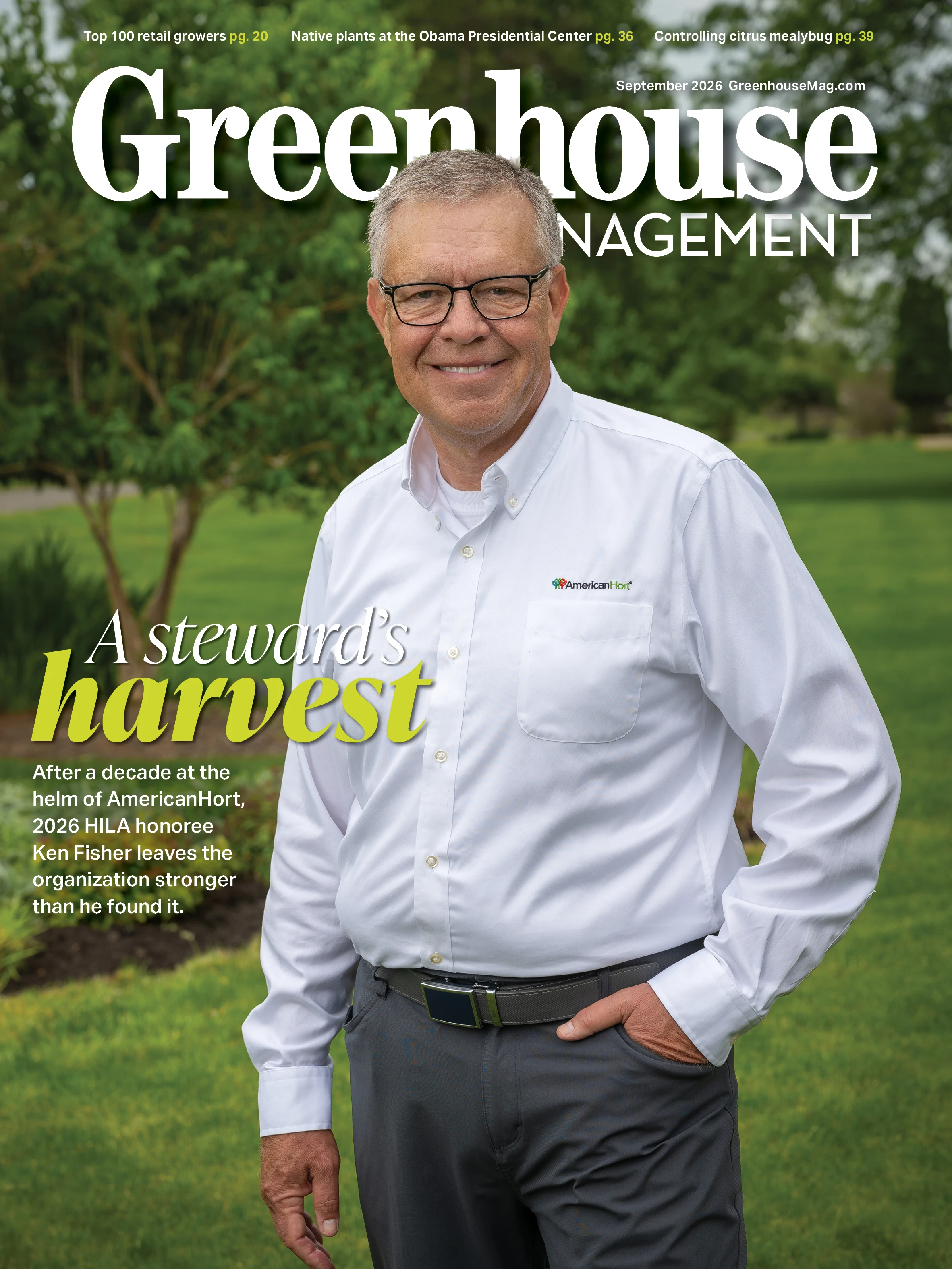
Explore the September 2026 Issue
Check out more from this issue and find your next story to read.
Latest from Greenhouse Management
- The Growth Industry Episode 17: Investing in IGCs with WorryFree® Plants
- New UF study sheds light on the hidden toll of back pain among horticulture workers
- 2026 Irrigation and Automation Market Report: Tradition rains
- Empowering the Future of Precision Cultivation: Resource Efficiency, Root-Zone Science and Scalable Automation
- Oasis Grower Solutions hires plant scientist Timothy Frey
- New green industry leadership development program for women now available
- Clean production protocol
- Jiffy hosting Microgreens Grower Day