Editor's Note: This article originally appeared in the September 2026 print edition of Greenhouse Management under the headline “One grower’s ‘lightbulb’ moment.”

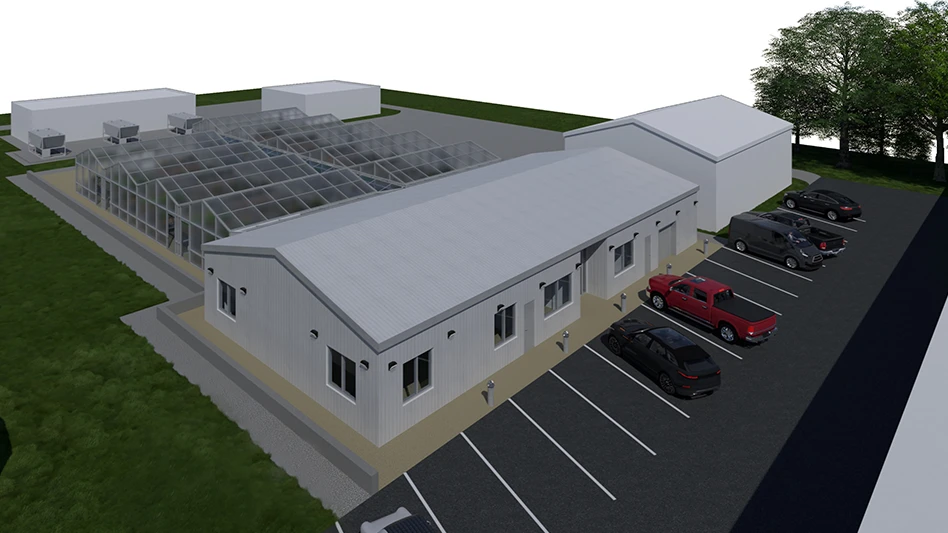
John Bonner does not take research and education lightly. He built a fully functional research greenhouse to find out whether LEDs could live up to the touted promises.
When John started Great Lakes Growers, he did most everything himself, from sales and marketing to maintenance and growing. And he learned the hard way what a Northeast Ohio winter does to leafy greens in a greenhouse lit by high-pressure sodium fixtures, which were the industry standard at the time.
“We had big opportunities and had lined up customers. We would do great in the spring, summer and fall. And then winter would come, and our production would drop 30% or more,” he says.
For a company whose business plan was built on year-round production, John began researching how to combat that wintertime dilemma. It was around that time he started hearing about LEDs. He called Philips — now Signify — and a team came in and made the pitch. He didn’t jump on the switch right away. He had some more research to do.
Then John noticed that electricity prices were climbing, and he recalled how the Signify team said he could grow more product in the winter and reduce the cost of electricity. Instead of taking the data about LEDs that existed at the time at face value, he built a research greenhouse and in 2015 began a controlled trial. In this trial, he compared a Philips LED toplighting linear fixture against HPS with the exact same production setup.
“The only difference was the light. And we were able to track the electrical usage of both types of fixtures,” he says.
After observing crops during the fall, winter and spring, John was convinced.
“By April, I had seen everything I needed to know that this was the best product for our future,” he says.

Despite rising electricity prices driving him to do more research, that’s not what sold him. “The electrical usage became the eighth most important reason why we did it,” he says.
Instead, the big takeaway was the product improvement. “We saw that the physiological stress on the plant was far less with the LEDs. The color was way better. The compactness of the plant was better. And the reduction in product during the winter was no longer 30 or 40%; it was 10 or 15%,” he explains. “We really got behind the use of LEDs. We were one of the first people to champion it in America.”
LED technology has moved considerably since John built the research greenhouse. Dimmable fixtures, integrated with a Priva environmental control system, now let his team ramp intensity against conditions in the greenhouse. He has stayed with passively cooled fixtures because “when you do all the maintenance in a greenhouse, you don’t want another fan to work on.”
John’s original LED installation continues to light leafy greens.
“The longevity has been a huge plus. We would have to change 10% of the HPS bulbs every year. We haven’t even had to change out 10% of the LEDs from the first installation in 10 years,” he says.
Grow light LED technology has evolved quite a bit since his last installation, and last year, John chose to install color-controllable 1040W Philips LED toplighting force luminaires with newly specialized optics.
John says working with the Signify team for the past decade has been like a partnership.
“It’s been a two-way street,” he says. “They listen and help us solve problems. It’s a great relationship.”
Explore the September 2026 Issue
Check out more from this issue and find your next story to read.
Latest from Greenhouse Management
- The Growth Industry Episode 17: Investing in IGCs with WorryFree® Plants
- New UF study sheds light on the hidden toll of back pain among horticulture workers
- 2026 Irrigation and Automation Market Report: Tradition rains
- Empowering the Future of Precision Cultivation: Resource Efficiency, Root-Zone Science and Scalable Automation
- Oasis Grower Solutions hires plant scientist Timothy Frey
- New green industry leadership development program for women now available
- Clean production protocol
- Jiffy hosting Microgreens Grower Day