Photo © Adobestock
Automation has revolutionized the greenhouse industry.
The ability to integrate a variety of sensors and atmospheric data with environmental control systems has reduced labor and made lighting and heating more efficient and less labor intensive.
But according to Greenhouse Management magazine’s reader-submitted data for the inaugural Irrigation and Automation Market Report, one task in controlled environment growing remains a frontier for automation: irrigation.
Over half of growers responding to the survey reported they do not use automation for watering tasks. A full 85% say they continue to water by hand as at least one method of irrigation, keeping them tied to the watering wand and traditional methods for irrigating greenhouse crops.
Who is all-in on automation, and who is still skeptical? The results of this market report, sponsored by ThinkGrow Powered by TrolMaster, reveal the fascinating interplay between possible tech-forward futures and the continuing reliance of literal hands-on irrigation methods.
Read TrolMaster's sponsor letter here.
Survey methodology
Greenhouse Management surveyed more than 80 of our most engaged readers who are greenhouse owners, operators or managers primarily growing bedding plants, annuals, perennials and/or herbs and vegetables. Survey responses were collected in September 2026.
Editor’s note: Not all percentages add up to 100% due to rounding, non-responses and some questions allowing respondents to select multiple answers.
Click here or on the image below to view the PDF version of this report, or scroll down to read the digital version.
Photo © Adobestock
Who took our survey?
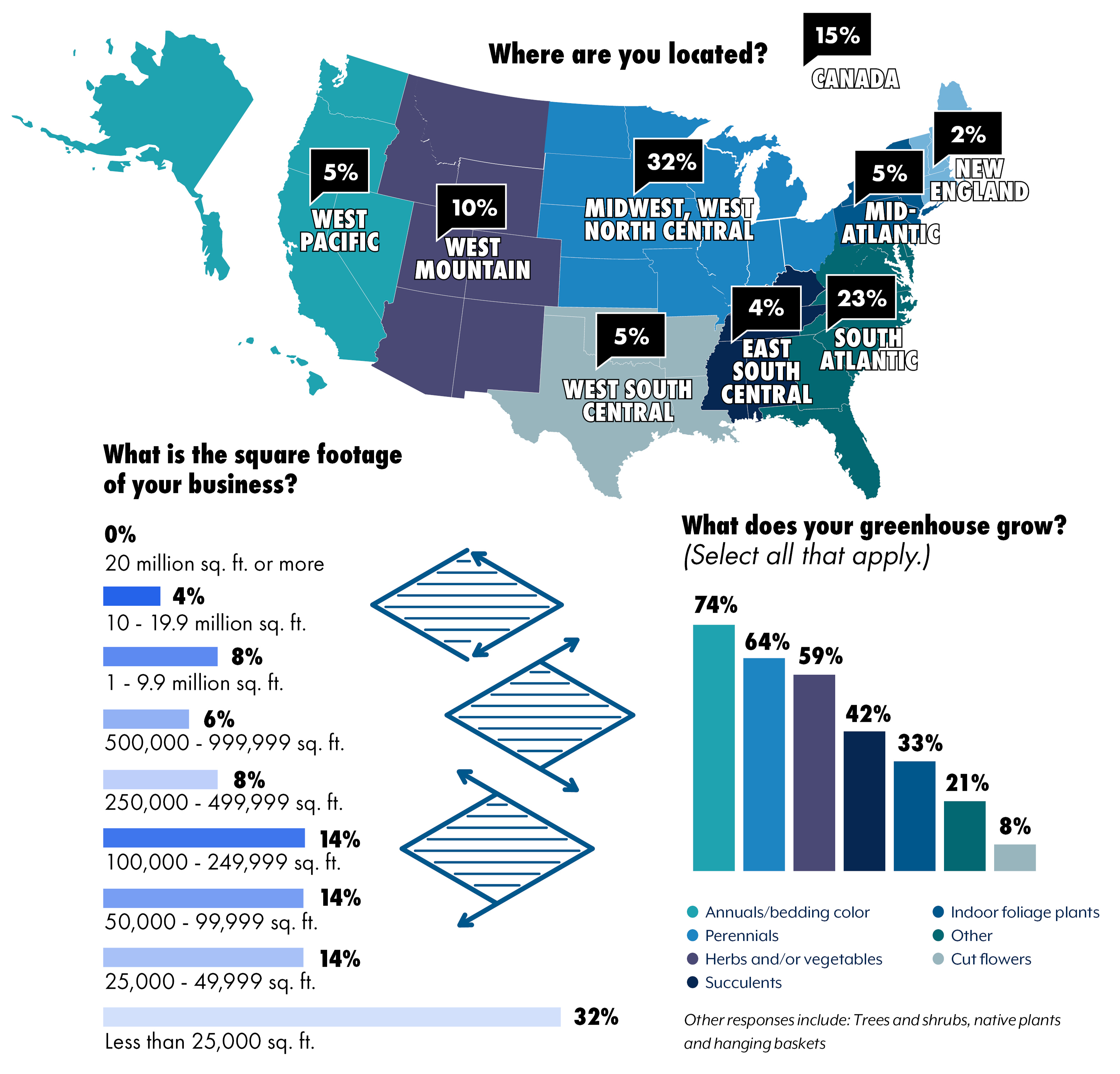
Survey respondents were largely located in the Midwest and South Atlantic regions, followed by those from Canada and the West Mountain region, representing a wide diversity of climates and irrigation needs.
In terms of crops requiring watering, nearly threequarters of respondents said they grow annuals, followed by perennials (64%) and herbs/vegetables (59%).
Less than half of reporting growers said they cultivate succulents, indoor foliage plants or cut flowers. Some added that they also grow trees and shrubs, native plants and hanging baskets.
The size of the reported growing operations are mostly under 250,000 square feet. Only about a quarter of respondents grow in larger areas. The moderate size of the reported operations likely plays into watering tactics and infrastructure.
Inputs, irrigation and monitoring
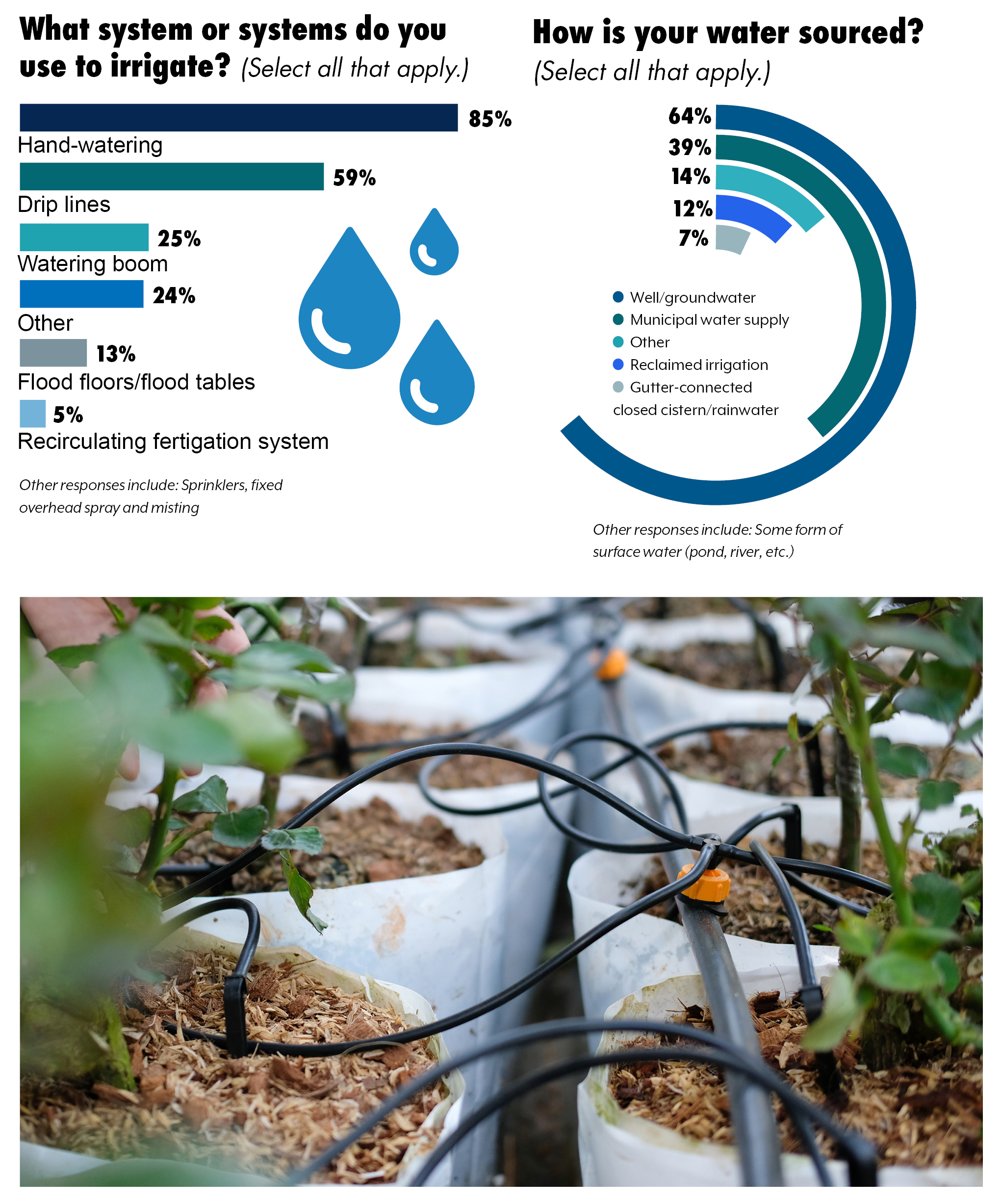
Most growers in the study use well or groundwater as their primary source for irrigation, while nearly 40% tap into the municipal system. Those who chose the “other” option reported using some form of surface water, representing 11% of respondents. Reclaimed irrigation and gutter-connected cisterns to catch rainwater appear to be used less.
Digging deeper into the responses, 11% of groundwater users also reclaim their irrigation. The percentage of those who reclaim irrigation and also use municipal water is slightly higher at 12%.
All the data suggest irrigation systems are as important for fertilization as they are for watering. So, what was the predominant system? A full 85% of responding growers said they water by hand.
Respondents could choose all methods they used, so while the vast majority water by hand, about 58% also use drip lines. However, watering booms are far less common, with only 24% of hand-waterers also using boom systems.
Drip line users are only slightly more likely to also use boom systems, with 28% saying they have both systems in place.
And hidden within the self-reported “other” category are 15% of growers who report also using sprinklers for irrigation.
There are some connections between growing area and choice of irrigation system. While hand-watering does appear ubiquitous among most growers, it is most common for those growing in under 250,000 square feet.
Small to mid-size businesses most often chose drip lines, but businesses over 500,000 square feet are the most likely to use watering booms, flood floors/tables and recirculating fertigation systems.
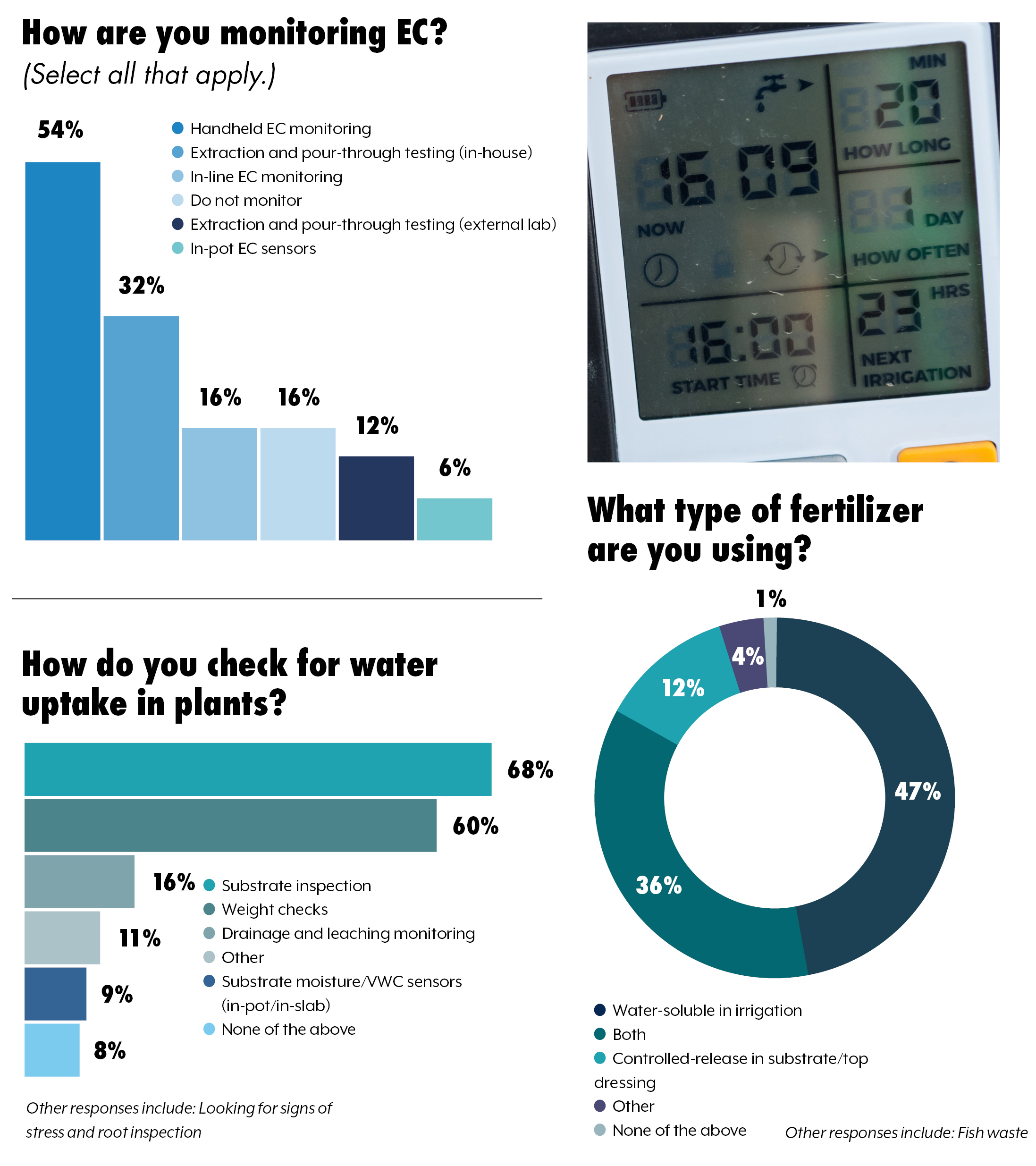
Sixteen percent of growers who took the survey said they do not monitor EC at all, while over half of growers reported using handheld EC monitors.
While 44% use extraction and pour-through methods, only 12% use an external lab to attain their findings. Only 16% of responding growers report using in-line EC monitoring, while only 6% report using in-pot EC sensors.
Monitoring water uptake data is also revealed to be largely a hands-on task. Direct substrate inspection is the method 68% of growers choose to understand water uptake of their plants. Weight checks are used by 60% of survey-takers.
Meanwhile, drainage and leaching monitoring are only used by 16%, with even fewer (9%) relying on higher-tech sensor technology within their pots or slabs.
The most prominent type and application of fertilizer reported by growers as an exclusive choice was water-soluble fertilizer applied via irrigation (47%).
Controlled-release fertilizer, applied in substrate or as top dressing, was reported as the exclusive choice for just 12% of growers.
But many growers sought balance, with 36% of growers using both water-soluble and controlled-release fertilizers.
Automation
Over 80% of growers responding to our survey report that triggering an irrigation cycle is largely based on manual or visual inspection. The second most common method is a fixed timer or scheduled clock.
Far fewer rely on substrate moisture/VWC thresholds or the accumulated solar radiation likely provided by sensors.
Only 46% of growers responding to the survey say that their irrigation is automated. Most (54%) report no automation linked to watering systems.
For those who do have automated irrigation, only 19% have it linked to environmental control systems.
The likelihood of automation is linked to the size of the operation. Operations larger than 250,000 square feet are more than twice as likely to report having automation.
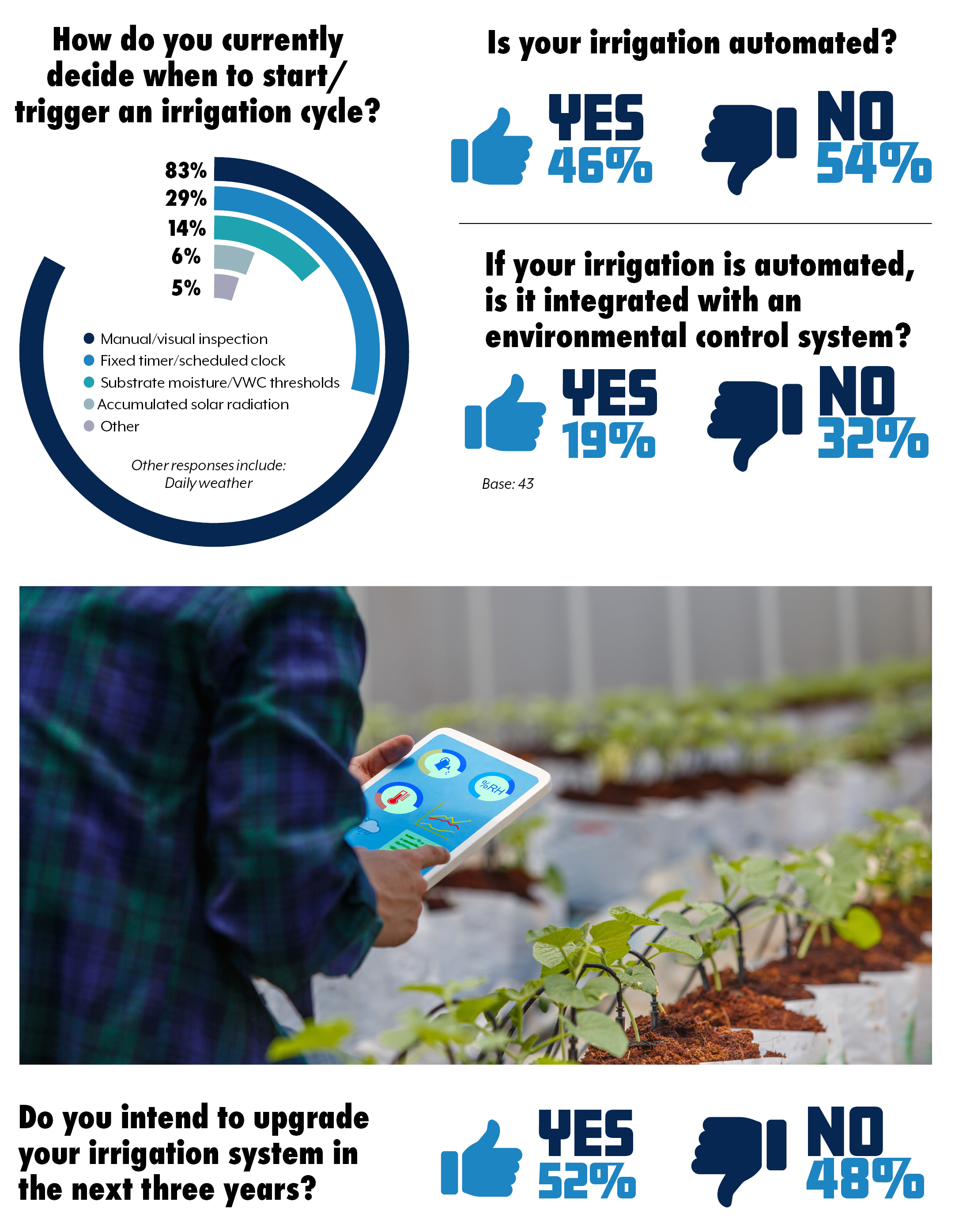
Just over half of respondents say they plan on upgrading their irrigation system in the next three years, giving them an opportunity to invest in alternate watering systems and automation, including the possibility of offsite controls.
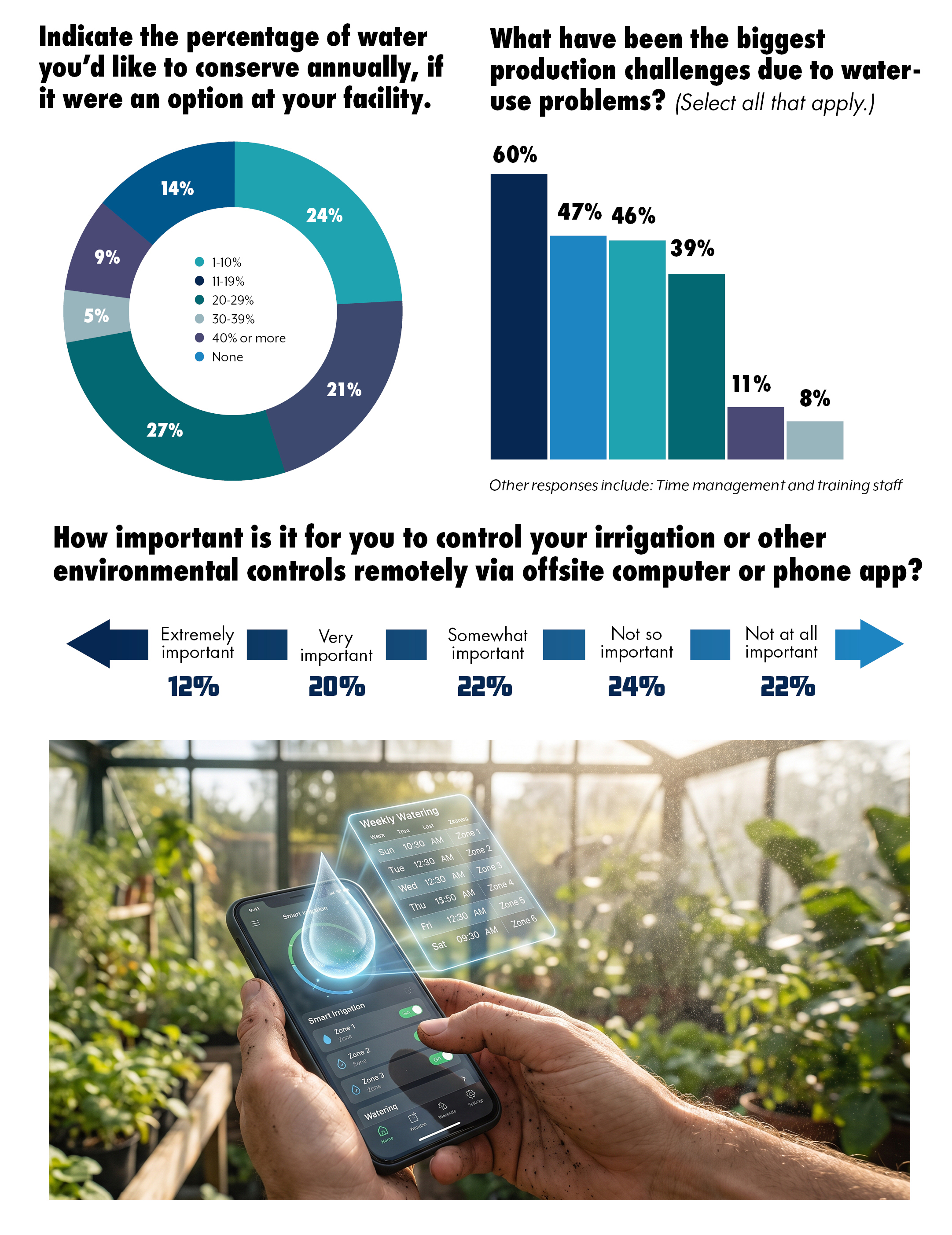
When asked how important growers consider remote control of irrigation or environmental controls via computer or phone, 54% say it’s somewhat to extremely important. The remaining 46% report offsite control as not so important to not at all important.
Irrigation challenges and labor
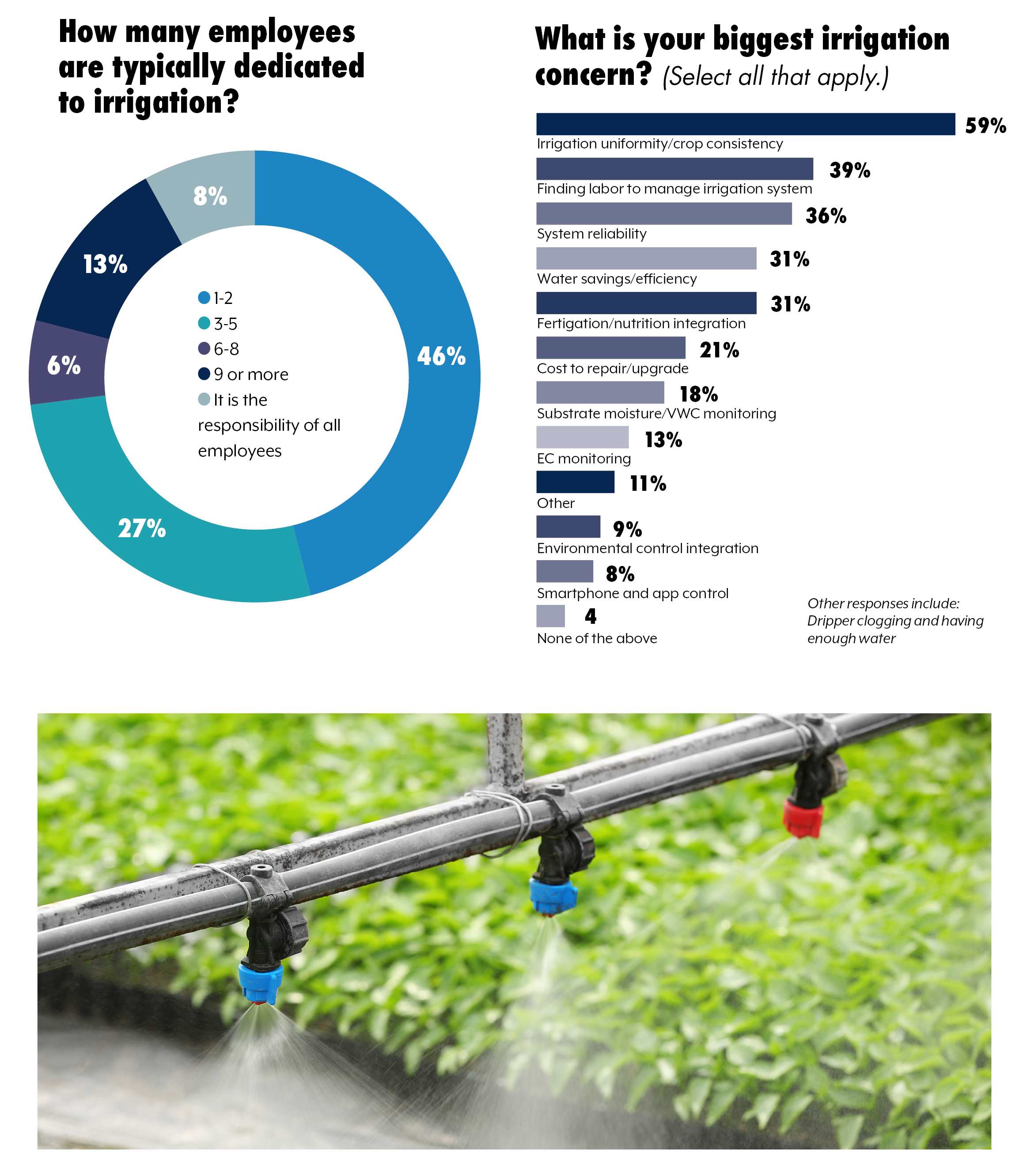
Close to half (46%) of all responding growers say there are only one to two people responsible for irrigation. Another 46% of growers report that three or more people are dedicated to irrigation, while the remaining 8% say it’s the responsibility of all employees.
While irrigation uniformity and crop consistency take the top spot among irrigation concerns (59%), labor is the second-largest concern (39%).
That changes when the question is viewed through the lens of those who do and do not have automated irrigation systems. For those who do have automated systems, only 28% cite labor as a concern, while 48% of those without automation consider labor a concern.
There are two other areas of contrasting concerns between those with and without automation. For 51% of growers using automated irrigation, system reliability is a concern, compared to 24% of those without automation.
The concern over environmental control integration for those with automation is more than triple compared to those without automation (15% and 4%, respectively).
The desired amount of annual conservation of water is fairly diverse but seems to have a distinct upper limit between 20% and 29%.
Water use is never without problems, regardless of the system used. Growers responding to the survey note root health (60%), algae growth (47%) and foliar plant health (46%) are the three biggest production issues related to water-use problems.
2026 Irrigation and Automation Market Report Conclusion
It’s clear from survey data that automation is an investment that becomes more prevalent the larger a grower gets, and investing in automation changes growers’ concerns.
But for now, traditions remain. Hand-watering is still the most common practice among all growers, big and small, despite labor concerns.
Tradition and hands-on growing continue to dominate this important growing system.