Editor's note: This article originally appeared under the heading "Cutting Off Fly Survival."

Editor’s note: The following is an excerpt from the “Flies, Gnats & Midges” chapter of the recently published Mallis Handbook of Pest Control, 11th edition, and was written by Thomas V. Myers, B.C.E. Order the book by calling the PCT store at 800/456-0707 or online.
Management of filth fly populations in and around urban structures should be firmly based on Itegrated Pest Management (IPM) principles. Knowledge and good communication skills are critical components of fly suppression programs, but correct identification (Fig. 1) of the offending fly species is foremost. Due to differences in biology, behavior and habits of synanthropic flies, management strategies should be tailored to specific species. Knowledge and experience acquired over time should enable a pest professional to carefully assess and evaluate a fly infestation to design an efficacious and long-term suppression program.

If filth flies are gaining entry into buildings, the first question to be asked is, “How are they getting in?” With few exceptions (e.g., blow flies in a carcass), house flies and other large filth flies rarely breed within structures. Careful and meticulous inspections of buildings are needed in order to locate and identify fly entry points and conditions around the building allowing these flies to breed on-site.
Facilities where food is handled, prepared, processed, served, packaged, stored, held and displayed for sale are critical places where the tolerance for flies is very low. Given the potential of filth flies to cause contamination, limiting flies inside buildings is important. Keeping flies to a near-zero level takes commitment and cooperation on the part of the facility. Without such cooperation, fly populations can grow to significant levels despite the best efforts of the pest professional.
A seven-step IPM program for managing filth fly populations should include: (1) sanitation, (2) exclusion, (3) cultural measures, (4) mechanical control, (5) legal issues, (6) insecticide treatment and (7) communication. The following excerpt explores why addressing sanitation and cultural measures are critical as part of this seven-step IPM program.
SANITATION. Sanitation is the first and foremost step in managing fly populations. A professional integrated fly management program will not and cannot ignore sanitation. In discussing fly control strategies, Hedges (2001) stated: “Nothing — NOTHING — is more effective at limiting fly infestations than sanitation.”
A lack of proper sanitation is often a major contributor to flies. Adherence to regular cleaning schedules eliminates organic materials flies use for breeding and as food. Environmental sanitation removes the food supply (breeding source) for the larval stage and eliminates odors that attract adult flies (Fig. 2). Regular removal (at least once a week or more frequently if necessary) of outdoor trash, garbage, rubbish, organic waste, dog feces, rotting fruit, grass clippings, etc., reduces the attractiveness of an area to adult flies and eliminates breeding sites.
Garbage, restaurant waste and other organic materials should be placed in plastic bags and kept in fly-proof containers until removal. In some cases, it may be necessary to double-bag the trash. Trash can liners should be secured to prevent leakage and deny pests easy access to garbage when the bags are placed in outdoor dumpsters.

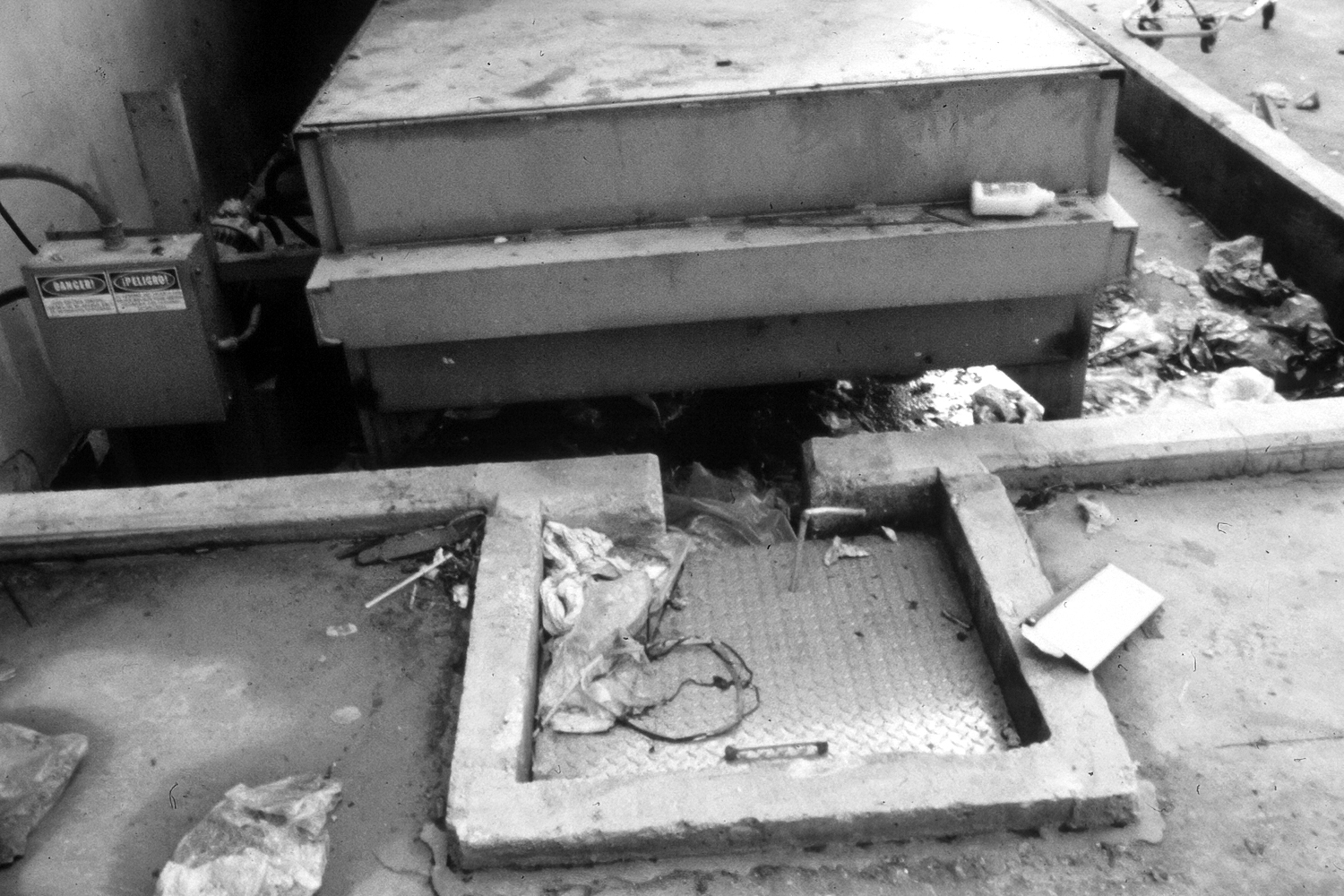
Outdoor trash containers should have spring-closing, push-back lids to deny access by flies. Dumpsters and other trash receptacles should have tight-fitting lids, and they should be placed as far from building entrances as is practical (Fig. 3). Snyder (1991) recommended that dumpsters be placed at least 50 feet or more from the building. Dumpster lids need to be kept closed at all times except when depositing trash. Missing or bent dumpster lids should be repaired or replaced. Dumpsters that were placed next to the delivery doors of restaurants often serve as the sources of fly problems in a facility (Fig. 4). In some cases, due to persistent human scavenging for recyclables in dumpsters, it may be necessary to use locks to secure dumpster lids, especially overnight and on weekends.

Dumpsters and other trash receptacles should be cleaned and sanitized each time they are emptied to prevent the buildup of encrusted liquid and solid food materials on surfaces. Steam cleaning may be necessary for some heavily soiled dumpsters. Decay and fermentation odors emanating from dumpsters are major magnets for filth flies. Dumpster wash water should be allowed to run into a sanitary sewer and not accumulate on the ground or hardscape as this will attract flies. Dirty dumpsters are an indication that food waste is not being handled properly. Empty food containers should be rinsed before being deposited in garbage receptacles/dumpsters. Recycling efforts are commendable, but recyclables containing food remnants can breed flies if held for long periods. Recycling bins should be cleaned and emptied at least twice a week. Recyclables held for a protracted period should be rinsed out and kept in pest-proof containers, preferably outside. Sanitation efforts should be escalated during warm weather when fly activity is usually at its peak, with the goal of attracting as few flies as possible to the building.
CULTURAL MEASURES. Howard and Bishopp (1926) and Axtell (1994) noted that most adult house flies remain near their breeding habitat where ample larval food and adequate oviposition sites were present. However, wind can channel flies from a breeding site, such as a poultry facility, into residential areas some distance away. A dedicated schedule of regular outdoor cleaning and general maintenance will reduce a property’s attractiveness to flies. Turfgrass around buildings should be mowed regularly and kept short. Water should not be allowed to accumulate in puddles on the property. Shrubs and trees should be periodically trimmed and thinned. If sap-sucking insects are present on greenery near the premises and they are producing honeydew, they must be controlled as adult flies can be attracted to honeydew. Nectar and pollen produced by certain types of flowers are highly attractive to some adult flies.
Animal Manure. Animal excrement from dogs, cats, and other companion and domestic animals kept outside of buildings are common sources of filth flies around structures. Animal feces around facilities should be promptly removed. Structures located near livestock facilities are often inundated by filth flies generated from those premises.
Snail Control Programs. In some areas of the U.S. when garden snails are controlled by molluscicides, their carcasses are often used as food by certain filth flies. Wear protective gloves when picking up dead snails and place them in sealed plastic bags before disposing them in the trash.
Adjacent Properties. Filth flies creating nuisance problems at certain premises often originate from off-site breeding sources. Local code enforcement agencies and vector management districts can sometimes assist with fly problems originating from off-site animal facilities such as dairy and poultry farms and recycling and trash sorting centers.
References
Hedges, S.A. — 2001. “Motivating,” what are flying insects attracted to? Pest Control Technology 29(6): 24, 25, 28, 29.
Snyder, P.O. — 1991. Food service fly control. Hospitality Institute of Technology and Management. 5 pp. http://www.hi-tm.com/Documents/Flypaper.html
Howard, L.O. and F.C. Bishopp — 1926. The housefly and how to suppress it. USDA Farmers’ Bull. 1408.
Axtell, R.C. — 1994. Flies: A Primer. Pest Control Technology. 22(8): 82-109.
Explore the June 2026 Issue
Check out more from this issue and find your next story to read.
Latest from Pest Control Technology
- Envu Offers Fall Promotion for Horizon Members
- Pest Management Foundation Announces the E. Raymond Crim, III Scholarship
- Tyro Group Acquires Dowell Pest Control
- Podcast: Beyond the Pest | Ep. 14 — Dr. Zach DeVries
- Webinar: The AI-Run Pest Control Company: Hype vs. Reality, What Actually Works (and What Doesn’t)
- Select Exterminating Acquires Three Businesses Across New York and New Jersey
- Catseye Pest Control Acquires Security Pest Elimination and Biologic Pest Control
- Researchers Confirm New York's First Bourbon Virus Case