Editor's Note: This article originally appeared in the April 2026 print edition of Greenhouse Management under the headline “Off-track bedding.”
The Kentucky Derby Winner’s Circle at Churchill Downs is composed of red geraniums and a dusty miller border planted in a horseshoe-shaped flower bed. Triple Crown-winning horses like Justify and American Pharoah have stood among them in triumph before making history.
These flowers are the backdrop of sporting legend. But they have their own race to run every year. The sprint begins three months before the first Derby Day julep is poured, roughly four furlongs from their distinguished destination, in a humble greenhouse on Wizard Avenue. Jockeying them toward victory is Churchill Downs Director of Horticulture Matt Bizzell.
A greenhouse ready to gallop
On a March morning, rain pelts the two glass peaks of the gutter-connected, 12,000-square-foot Churchill Downs greenhouse. The whir of the fans fills the air with the fuzz of white noise. Most of the benches are empty, anticipating a delivery of 9,000 vegetative cuttings and plugs that will be potted up and eventually planted in and around the storied grounds of the 151-year-old racetrack.
The only real color in the greenhouse on the dreary day is a full bench of Patriot Bright Red zonal geraniums. There are 800 of them. That’s enough for two plantings of the Winner’s Circle over the racing year: one prior to Derby Day, and another to replace plants sacrificed beneath hoof and heel once festivities have ended.
Bizzell sits in a work-worn office that opens to the greenhouse. Despite the fact that he and his team are essentially at the starting gate for a fast-paced growing season, he is calm and relaxed. He wears a beard that could rival any Kentucky colonel, white at the chin and increasingly dark as it proceeds north. He strokes it occasionally as he thinks.
“We’re pretty old-fashioned,” he says with a slight smile.
He’s talking about his greenhouse. Constructed in 1990, the structure is the third built on the grounds over a little more than a century. The only automation controls the louvres and the fans, but that’s about as high-tech as it gets. There are no watering booms; there is no supplemental lighting, aside from some sulfur lamps that are occasionally used to interrupt the flowering cycles of fall blooming crops. It’s a very hands-on environment.
“It’s all hand watering,” Bizzell explains. “So, for Derby, we grow about 24,000 5- and 6-inch annuals. And we’re growing about a hundred varieties. With that many varieties in such a small area, it really needs somebody to lay eyes on it and say, ‘This needs water, and this doesn’t need water.’”
Bizzell and his team of nine grow every annual, perennial, tropical and tree at the track, from Angelonia to Tradescantia and everything in between. It’s a year-round effort.
Horse racing at Churchill Downs runs from April through November, and when the ponies aren’t running, the facility operates a museum and is open for special events 363 days a year. Therefore, the growing season begins the second week of January for Derby color, takes a brief break sometime in May and begins again with a fall crop in June.
While the Winner’s Circle may be the most beloved planting, there are many more areas that require year-round color. That includes 120 hard-to-reach window boxes and a high-profile bed around the paddock, a breezeway of hanging baskets behind the old grandstand, and any little corner of dirt where plants will soften the concrete and paver stones that surround the twin spires.

Efficiency is the inside track
With so many plants and so little time to grow and deploy them across roughly 200 acres, efficiency is the name of the game. For instance, to make use of every inch of space, some plants that can tolerate shade are shuffled under the benches to make room on top.
Currently, the space under the benches is occupied by papyrus and a row of pink variegated philodendron that will eventually go into the Turf Club. There is a trick to the practice, however: Plants are cheated to one side to capture the most sun as it traverses the greenhouse. This is not an environment where a grower can be fussy.
That includes how the plants are grown. Everything goes into the same “well-draining, generic, one-size-fits-all” growing media, no matter what it is. That same media is used to fill the beds and planters. That includes giant concrete 48-inch containers supporting Alaskan weeping cedars and, Bizzell’s favorite, massive 8-foot-tall, cast-iron urns, reportedly originating from the 1893 Chicago World’s Fair, which he plants annually with vivid combos.
Fertilizer is applied to all plants equally via a proportioner. All-purpose is important here, too, so Bizzell uses an NPK 20-20-20 fertilizer at 300 ppm once per week.
There are also some additional water treatments. The alkaline limestone-filtered water of Louisville is great for bourbon, but plants, like bourbon drinkers, may start looking ragged and yellow if they have too much. To balance the pH, citric acid is occasionally added to the water.
Additionally, to fight pests and keep his staff in the greenhouse, Bizzell eschews chemical pesticides for beneficial insects.
“We use a triple blend of nematodes that we mix in our fertilizer when we pot stuff up. We use Hypoaspis miles (Stratiolaelaps scimitus), the predator for fungus gnats. We use Bacillus thuringiensis that we mix in our fertilizer also to take care of worms. We use a thrip predator when it gets warmer and the thrip pressure becomes more available. And then if we have an aphid infestation, we will let ladybugs go in here,” Bizzell says.
Venerable versatility
Aside from growing, Bizzell’s team plants, mows, trims, mulches, weeds, sprays and fertilizes all of the green areas around the facility. On Derby Day, they pick up trash in the massive parking lot. There are no specialists on his crew. Everyone does a bit of everything.
And what’s true for his team is true for Bizzell himself. He acts as head grower, landscape designer, grounds crew supervisor and arborist.
None of these skills was developed in a classroom. He graduated from Indiana University Southeast with a B.A. in molecular biology. He did work at a local garden center while he was in school, but that was the only horticulture on his radar. His first job after graduation, at 22 years old, was on the very landscaping crew he now manages.
Working his way up from the bottom has helped him manage his crew, Bizzell says. “I think they know that I have the work’s best interest and their best interest. So, I try to encourage them to talk to me about what they want to do and how they want to do it. I also let them do what they feel is right to do in most situations,” he explains.
Communication is key. That’s because knowledge about how to run horticulture at Churchill Downs is passed down via practice and oral history.
Bizzell had to work in the greenhouse to understand its particular quirks and tricks. He had to plant and experiment within the grounds to find out what plants worked best where and which trees could adorn the courtyards with seasonal interest while thriving in planters and surviving Louisville winters.
He’s been at it for 22 years. All the knowledge — about what works best where, his catalogue of trees from the parking lot to the backstretch of the track — is all in his head.
He ponders that reality for a moment. Strokes his white beard.
“It would be very difficult for somebody to come just land in this job and pick it up,” he says. “But once you know it, it’s not that big of a deal.”
There are no manuals. There are no pretty landscape architecture maps with which to plan the annual plantings. Like most things at Churchill Downs, there is primarily history, tradition and luck.

Cold, colts and cremains
Making Churchill Downs floriferous is not all thoroughbreds and roses. The hard reality of planting anything at the track for the Kentucky Derby is that it has to be in the ground before Louisville’s traditional last frost.
“We actually start planting the second and third week of April, when it’s really cold,” Bizzell says. “So, how early we can start depends a whole lot on the weather. We always have frost issues.”
He and his crew do ensure they grow an extra 5,000 plants for replacement. But that’s not enough to replant everything should a hard frost fall.
In dire cold situations, the team has moved what can be moved into the tunnels that go under the track to the infield. But the obvious solution, frost blankets, is verboten. Why? Because racehorses are very specialized, very focused and very jumpy.
“There’s a possibility that the wind would get ahold of a frost blanket and scare a horse,” Bizzell explains. A scared horse could easily injure itself or a jockey.
For the same reason, much of the landscaping and planting can’t be done between 6 and 10 a.m., when the horses are working out. Sudden movements or noises could spook the horse. During the morning workouts, the track is deeply hushed, save for the sound of hooves and hot horse breath.
While the racers and climate dictate some of the how, when and which plants are selected, the other major consideration is history.
The Winner’s Circle, for instance, has been red geraniums and a dusty miller border for over 70 years. But history can be a hinderance, too.
Every year, in association with the Christ Chapel at Churchill Downs located behind the stables, people once drawn to the grandeur of the Derby have their ashes interred in the Winner’s Circle. Bizzell and his crew are supposed to get notice of these scattered ashes, though he admits it’s spotty.
“If we get a notice that somebody’s going to be interred in there, we will go out after their ceremony and water the cremains into the ground just to spread them out, because they’re a lot like fertilizer,” he notes. “It is very similar to fertilizer or bone meal. It’s got lots of phosphorus and lots of potassium. So, in the right amount, it’s good for the soil. But in piles or heavily sprinkled in there, it’s bad for the plants.”

Front-running flowers and triumphant trees
Every planter and bed at Churchill will be planted once with multiple varieties, though a few places are touched again in the fall prior to the popular Thanksgiving weekend events. Not only do the annuals need to flourish early and stay showy in the cold, but they also need to remain attractive into the early summer, when plants like coleus or ornamental black pearl peppers can take over visual interest.
“Once we plant something, we hopefully do not have to come back and replant it,” Bizzell says. “I also like that it changes throughout the season. If people come here multiple times throughout the year, it looks different each time that they come to see it.”
There are Churchill Downs stalwarts that find a place in the landscape every year. Bizzell calls out Alternanthera brasiliana ‘Purple Prince’ as a standout for long-term appeal from April to September. Dragon Wing begonias are a favorite, as are Angelonia angustifolia ‘Alonia’ for its early blooming and height for combo planters. For heat tolerance and hard-to-water areas, he swears by Kalanchoe luciae ‘Flapjacks,’ a colorful succulent with a green heart and an orange flare on its paddle-shaped leaves.
Bizzell also loves trees and has chosen ones that are able to thrive in their giant planters, which are moved as needed for the Derby and other events. White oak, weeping redbud and magnolia are useful, as are the evergreen weeping Alaskan cedars.
But these aren’t his favorite on the property. That honor goes to a couple of trees that likely don’t receive much scrutiny.
Touring the grounds, Bizzell turns his truck down Taylor Boulevard, which runs northeast in front of the track. It’s bordered by a narrow strip of land, owned by the city but maintained by Bizzell and his crew.
“I’ve turned that into my own personal arboretum,” he says. “So, I’ve been planting neat stuff out there for years.”
He points to a tree with drooping skeletal limbs — they bend architecturally toward the ground, bare of leaves this early in the spring. It’s a weeping bald cypress, a “deciduous conifer” and not particularly common. There are two more like it on this patch of ground.
“They don’t look that big driving by, but when you’re walking underneath them, they’re quite a big tree,” he says with a grin.

The sun shines bright in the old Kentucky home
As he drives his truck around the grandstands, Bizzell stops in front of a duo of men rendered in bronze. He gestures to the figure on the left.
“Colonel Matt Winn was the president of Churchill Downs years and years ago,” he says. “He is the one that took the Kentucky Derby from being a horse race to being a national treasure. Over a hundred years ago, he thought that the grounds were very important here, and he brought in the first professional horticulture crew and built the first set of greenhouses here. So, what I do today is a direct result of him wanting professional horticulture here a hundred years ago.”
There is a sense of reverence in his voice. You can tell he takes the legacy of Matt Winn very seriously. And Bizzell isn’t just focused on all of the camera-ready blooms in the Derby Day limelight. You can tell he’s concerned about the entirety of the grounds.
He walks the infield and points out two evergreens planted across from one another. They might be some of the oldest trees on the property. During the Derby, a camera might sweep past them. Perhaps a jovial race fan might lean up against them or take shelter under their canopy, but otherwise they likely remain unnoticed.
For Bizzell, these dwarf Norway spruce that are “so old they don’t look dwarf” are important. They speak to the thought and work of his predecessors. He sees Churchill’s history represented in the unique bends and joins of their gnarled trunks, and he takes great care in ensuring they remain healthy.

He’s also left his own legacy in the Winner’s Circle — one which speaks to the history of Kentucky’s green industry legacy. Framing the Bugler’s Pagoda, next to the Winner’s Circle horseshoe, Bizzell planted two Swiss stone pines about 15 years ago.
Those who know the tree likely won’t recognize the football-shaped variety, their tops bent slightly northeastward, thanks to a constant wind. That’s because the pines were cultivated and selected by Kentucky nurseryman Theodore Klein.
Anyone who works with plants in the Louisville area will know Klein’s name. He was the breeder of an amazing variety of trees, and his former home is now the popular Yew Dell Botanical Gardens. And now, thanks to Bizzell, Klein’s work is seen annually as part of Kentucky’s greatest tradition.
“This is a facility and a way of life that’s rooted in the past,” Bizzell says. “But in order to stay alive, it has to move into the future. And I think both horse racing and Churchill Downs is trying to do that.”
Bizzell is part of that movement. And on Derby Day, if you look closely, you might see him on the final stretch, standing right at the infield rail, looking to the twin spires and taking it all in. It’s a multimillion-dollar view that very few get to see.
And as he watches the spectacle to see who will receive the garland of roses in the Winner’s Circle, he’ll smile, knowing that his geraniums got there first.
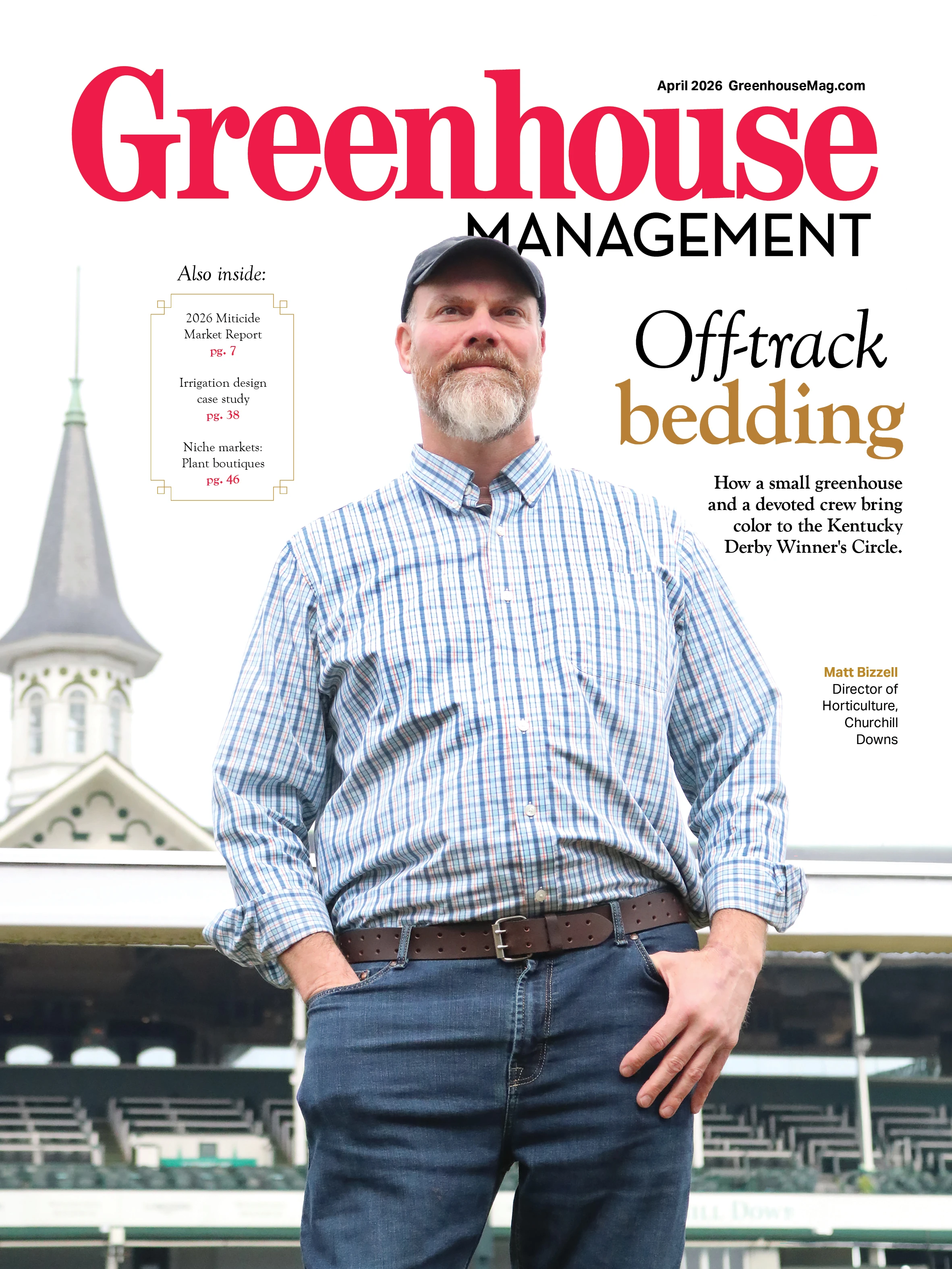
Explore the April 2026 Issue
Check out more from this issue and find your next story to read.
Latest from Greenhouse Management
- The Growth Industry Episode 17: Investing in IGCs with WorryFree® Plants
- New UF study sheds light on the hidden toll of back pain among horticulture workers
- 2026 Irrigation and Automation Market Report: Tradition rains
- Empowering the Future of Precision Cultivation: Resource Efficiency, Root-Zone Science and Scalable Automation
- Oasis Grower Solutions hires plant scientist Timothy Frey
- New green industry leadership development program for women now available
- Clean production protocol
- Jiffy hosting Microgreens Grower Day