Editor's Note: This article originally appeared in the July 2026 print edition of Greenhouse Management under the headline “How to grow a dollar.”

The corporate headquarters of Petitti Garden Centers is a short walk across a parking lot to the first store Angelo Petitti ever opened in Oakwood Village, Ohio. As the 79-year-old owner crosses the asphalt from the humble brick building that holds his office to the large glass retail store that bears his name, he spots an abandoned cart at rest against a curb.
Without breaking stride, he snags the cart handle in a big fist and begins pushing it to where it belongs. The action looks second nature — a fluid, subconscious series of movements done so many times that it requires no thought. He doesn’t even stop his conversation with the photographer who has come to take his picture.
He does not stop to ask who’s responsible for shagging carts in the parking lot, because he knows everybody is, including himself. There was no need to pass it by, blocking a valuable parking spot at the tail end of May, and tell someone less important than himself to go take care of it, because there aren’t any people at the store that he’d consider less important.
In fact, back in his office, he’d just been saying that there’s never been a separation between the owners and the employees.
“I’m with them every day. My son AJ is with them every day. We’re not distant. Anybody can approach us. We’re in the stores working with the people all the time. And I think that’s the difference. You’re not distanced from them; you’re with them. And I think that sends a very loud message,” Angelo says.
As Angelo traverses the store that was the seed of an Ohio garden center legacy, it seems clear the message has been received. As an owner and leader, his presence prompts easy, genuine smiles from the employees he passes and greets. No one is trying to look busy. They are busy. And happily so.
There have been hundreds of leaders in hundreds of industries who have claimed that working for their company makes you “part of a family.” Petitti’s may just be one of the rare cases where that’s actually true.
You’re nothing without your people
In 1963, Angelo arrived in the United States after emigrating from Italy with his mother. He was 16 years old and had a single dollar in his pocket. But while he was undeniably poor in currency, he was rich in a few things that would matter more. He had a solid primary education and dreams of building something that would be his own.
“America was the dream country,” he says. “I always worked 14, 15, 16 hours a day, whatever it took. When there was opportunity to make money, I just went out and learned and did. So, it became very evident that the opportunity was endless.”
Once settled in the Cleveland area, Angelo enrolled in high school to learn English and began flexing his entrepreneurial muscle. He sold pots and pans. He sold knives. He sold books. Each experience helped him build his business knowledge.
At 19, he became a business leader when he started Petitti Landscape Company. It was a family business from the outset, as he was joined in the venture by his brother Domenico. But he needed more than a sibling to be successful, so he hired a couple of his peers, paying them hourly wages. The arrangement felt natural to Angelo. Leadership felt natural, even at 19.
“I’m a people person. I like people. I like to treat people well. I like to be treated well,” he says. “You’re only going to treat people the way you want to be treated. For me, it just comes natural. You’re firm, clear and make sure that you communicate what the mission is. If they accomplish it, fine. If they don’t, then you look for somebody else. The leadership part, that just comes; you either have it, or you don’t. You’re not going to succeed in business unless you have that.”
At the time, horticulture outside of landscaping wasn’t in his plans. The only knowledge he had about growing plants was from being raised in a community of “survival food” farmers. He’d picked up ideas from his uncle, who was an avid gardener. And he was concerned about how the plants on his clients’ properties looked, of course.
Maybe it was this amalgam of influences that helped him recognize an opportunity in Oakwood Village, where the garage for his landscaping company was located. Along with his equipment, Angelo and his crew used the garage to stage plants they were planning to install. The plants attracted passersby who wondered if anything was for sale.
In 1971, Angelo answered the community by opening the first Petitti Garden Center at the garage site. He acknowledges that the move was a big step and says that he had to put everything on the line to move forward. But he notes that while he was driving the vision and laying down the mission, nothing would have happened without a team.
“You’re nobody without your people,” he says. “It doesn’t matter how good I am. It doesn’t mean a whole lot without having the whole team being a big part of it.”
Embracing adversity, learning to grow
Opening his first garden center was a risk. But so was opening his second location. So was creating seasonal Petitti Garden Centers in the parking lots of multiple Sears stores. So was ultimately closing down the landscaping services in 1989 to focus entirely on the garden center business.
Angelo says each of these changes arrived with a learning curve. They also arrived with a fair amount of adversity that he had to tackle. He learned quickly the business was “not for the faint of heart,” largely because buying, building and owning garden centers requires an intense amount of capital.
“I’ve definitely had a lot of years where I didn’t know whether I was going to make it or not,” he admits. But it never stopped him from taking the necessary risks to continue to grow his business.
One of his biggest risks came after realizing that to succeed, he had to control the supply line of plants into his ever-increasing footprint of stores. He had to become a grower.
“I was not a grower. I never grew anything in my life, and I am getting into the growing business to grow annuals, perennials,” Angelo says. “Then the following year, I get a nursery started, and really, I had no experience in any of them.”
To close that knowledge gap, he hired a grower to run a modest growing facility built adjacent to his first store. He notes that his first head grower “failed miserably.” Some of that was because Angelo was not sure, at first, what kind of person he needed. Some of it was because the grower simply didn’t have the capability needed to set up and run the operation.
“Probably the first couple years, I dumped more than I sold,” he says. “But that was part of the price. I wasn’t going to give up. I actually went ahead and built more. I became very knowledgeable about plants because I had to, because I had to make sure the grower was doing the right thing. I started to learn what to look for, what made plants good, what made them great.”

Big risks and the dollar bill
This is Angelo’s pattern for success: Take the risk head on, and then learn from whatever comes. Failure may occasionally be the price for risk, but there is no giving up.
Angelo’s son AJ, now the acting president of the company, has seen his father take those risks. “More than several times, he’s pushed all of our chips in the middle,” he says.
He saw it when his father opened the store in Strongsville, Ohio. Until that point, the garden centers had been what AJ calls “old-school.” But Angelo had been visiting garden centers in Britain and had marveled at their massive, glass-covered shopping structures that made modern American garden centers look decades behind the times.
Again, Angelo went all-in on the British model, building a store with a soaring central glass atrium that was unlike anything else in Northeast Ohio and perhaps in the U.S. It defined the look and feel of all future Petitti locations and gave the company its defining aesthetic.
“The courage it took to execute that vision and have the confidence that we’ll be able to pull it off …,” AJ says. “It was a bumpy road the first years, but that set us up for where we are today.”
AJ remembers that after he returned home from college in 1996, his father drove him to Columbia Station, Ohio, where they pulled up in front of 426,219 square feet of glass greenhouses. “He said, ‘We just bought this,’” AJ remembers. “To me, that was the most massive facility I had ever seen in my life. I didn’t know what we were going to do with it.”
What they did with it was create Casa Verde Growers, now a state-of-the-art growing facility that, along with the collection of nurseries that comprise Petitti Family Farms, grows and supplies all their plants for retail. It’s a realization of a vision that could not have succeeded without risk.
AJ has also learned from his father’s tolerance of risk, so much so that the risks have become much more calculated. Manageable.
”America was the dream country... It became very evident that the opportunity was endless.” -Angelo Petitti, founder, Petitti Garden Centers
“We have a lot more experience. We’ve learned a lot. It’s still important to take risks and take advantage of opportunities and grow and stretch,” he says. “But not the same way we had to, where you’re pushing all your chips in the middle every time.”
For Angelo’s part, he talks about the risk experiences in a muted, casual way. His easy, matter-of-fact tone makes the risks sound less like risks that could have buried the company and more like Sunday drives in the country. It’s as if there was nothing to lose. And in some way, maybe there really wasn’t.
“The thing that I had going for me was that when I got off the boat, we got to New York, I had one dollar, and I mean literally one dollar,” he says. “So, I never had really a whole lot to lose. So, every time the adversity came, I looked back at what I started with.”
While Angelo grew that one dollar into a thriving business, he also cultivated a circle of friends that he says were crucial in overcoming the risks and hurdles.
“I’ve been blessed to have many friends,” he says. “Whenever I reached a point that was tough, I had people to lean on that could help get me through.”

Finding family
Spend any time talking with Angelo about his business, and there are a few things that become very clear. For one, he has a crystal-clear vision and mission and has put everything he has into the business choices that enable success. He also expects his team to commit themselves just as completely to their own responsibilities. In return, they receive the consideration, respect, development and care one might expect from a family.
That’s by design. It’s an essential part of Petitti’s culture that contributes to its high retention rates. When employees are welcomed into the Petitti family, they tend to stay.
“The culture of the company is really what drives the people that want to be there or don’t want to be there,” Angelo says. “If you’re a caring company, if you care for your people, if you feel that they’re part of your family, that’s all part of that culture.”
Ken Zawicki, Petitti’s vice president of operations, started at the company when he was 17. Now, 28 years later, he fondly remembers the summers collecting carts and loading bagged topsoil into cars.
Zawicki says he met Angelo on his first day because the owner was commonly around, walking the aisles and chatting with employes. One day, Angelo asked Zawicki to meet him at the Oakwood store. There, they had a casual interview in Angelo’s car, and Ken was offered a job as an assistant manager. It was a huge responsibility for a kid just out of high school, and maybe another kind of risk for Angelo.
But then again, he’s worked hard to make his business a place where people want to stay.
“There’s certain expectations,” Angelo says. “If you meet them, we recognize that right off the bat, and then we’ll develop you. If you don’t fit, then you just don’t fit.”
Zawicki fit. Now, as an executive, he speaks about Angelo with a kind of awe. He’s seen the high bar that Angelo has set and wants to meet him there. He strives to follow Angelo’s example of being hands-on, working closely with employees and being inside the stores on a daily basis, side by side with the staff.
“He genuinely cares for all the employees. He goes out of his way to give hugs, handshakes, and he sets the tone for everybody else. He wants the family culture; he wants the family business,” Zawicki says. “That’s the expectation of myself or anybody else on the corporate team: to be approachable, to have an open-door policy, cellphone always accessible, available. That’s the way they want to operate, and I completely agree with it.”
The family culture of Petitti’s is more than a line item in a mission statement. Angelo and his son AJ live the ethos, giving their time and attention to the important moments in their employees’ lives, the way you might expect family members to do. They step up.
They celebrate new unions at weddings. They mourn and support at funerals. They offer tangible help in moments of adversity.
Zawicki remembers Angelo and AJ attending his own wedding. He also remembers how crucial the Petitti family was when his own family suffered a devastating loss.
“My mother passed away 14 years ago,” he says. “I was just a store manager at the time, but Angelo, AJ, their whole family came to my mother’s wake. My dad had been out of work, taking care of my mom. At the wake, Angelo offers my dad a job with the company. My dad’s working today. He’s still here.”
In fact, there are three generations of Zawickis who have joined the Petitti family. Both Ken’s father and his children now work in the stores.
AJ is unequivocal about the value of caring for people built into the business by his father.
“It’s something that we just believe in: Take care of everybody like they’re family,” he says. “Everybody has times where they need different kinds of help. Outside of the month of May, we’re fortunate in our industry that we can be flexible with time or with resources or whatever you might need. We try hard to accommodate as much as we can. We’ve had a number of people who unfortunately get sick or get cancer, and we just make sure that they don’t go without a paycheck, just try to help them out as much as we can.”

Leading with humility
If you walked into the office that Angelo shares with his son AJ, looking for the place where the owner and the president do their work, you might feel as if you’d made some kind of mistake. It’s a purely utilitarian space. There are no trappings of executive luxury. There are greenhouse parts and documents. The whiteboard is filled with children’s doodles (one reads: “I love my family!”), and the primary decorations appear to be children-made thank you cards and art.
Other than that, the leaders’ desks look like they spend most of the time unoccupied. This is a space to land briefly before heading back into the greenhouse or the stores. It’s a humble space that speaks to the natural servant leadership style of Angelo. He wants to be in the mix, whether it’s in the greenhouse at Casa Verde or collecting carts from a parking lot. It’s important to be beside his employees, enmeshed in the fabric of the business.
“I think it’s a beautiful thing,” AJ says. “Imagine if it’s your first job, and you’re out there and you see the owners out there working just as hard as you or harder. It sets a tone, and you’re teaching the next generation how to be a leader as opposed to them seeing some guy in ivory towers with white gloves on. Real leadership is out there with the team, so they know where to walk.”
Angelo made sure that when AJ started working in the stores as a kid with his siblings, there was no special treatment to allow their egos to inflate. He says his kids were mopping floors and cleaning bathrooms and picking up trash. It didn’t matter that their last name was on the sign out front.
“I would let them do that so that they would learn humility,” Angelo says. “Sometimes it’s not easy for the son of the owner. By creating that environment of humility, AJ never had that issue of (not) being respected, because he never acted like he was above them.”
A great deal of that ethos is rooted in the fact that Angelo started with nothing. When talking about the arc of his business, he continually refers to that single dollar in his pocket when he stepped off the boat. He says he often tells his wife that if he had to, he could go back to living on $100 a week. His pride is not in how much he’s earned; it’s in how much he’s built and how much he can give back to the community.
Giving it away every day
The power of Angelo’s leadership is in being a humble example to all his employees. It’s also in his engagement with the community. After all, if it weren’t for the people his stores serve, he wouldn’t have been able to build his dream.
“We’re very involved in the community in every which way,” Angelo says. “We give stuff away every day. It’s my responsibility to give back to the community every way we can. And that’s something that not just I do, but the whole company. That’s something that we just do naturally over here. That’s part of the culture.”
That ethos is reflected in charitable donations to organizations like Cleveland Clinic Children’s and the Make-A-Wish Foundation. It’s reflected in the quarterly round-up for charity program at the stores’ checkout lines, where cashiers encourage customers to round up their receipt, with the proceeds going to a regular rotation of children- and family-centered charities.
Zawicki notes that there is an office position that is solely dedicated to charitable giving.
“We’ve got one lady in the office, and her job is to review donation requests,” Zawicki explains. “AJ always tries to do something. We can’t always accommodate their full list. But any type of charity, any type of golf outing or whatever it happens to be, AJ’s always giving gift cards or plant donations, things like that.”
But Zawicki notes community care is also reflected in the way Petitti’s treats its customers. There is a sense of compassion and understanding when it comes to customer needs. In the broad view, there is a tendency toward making sure the customer is happy above all things and that they walk away with a good feeling when it comes to the Petitti name.
Zawicki remembers one of the few times Angelo gave him some serious coaching, all to do with a $20 pair of pruners.
“A customer gave them as a gift at Christmas time. And then six months later, the customer’s complaining the pruners don’t work,” he remembers. “I wouldn’t give them the refund. It’s been six months. Sorry. And they got to Angelo, and then Angelo kind of let me have it, rightfully so. ‘It’s a $20 pair of pruners. Come on. What are you doing? That’s not helping that customer. It will cost you way more to replace that customer than it will to take care of them and make them happy.’”

Money is just a number
Angelo is adamant that building wealth has never been at the core of his leadership. He notes that if Petitti’s was built for bringing down massive profits, he wouldn’t do business the way he does: making sure that every part of it receives the best of what it needs.
“The whole goal is building, not accumulating money. That was never, never part of the goal, because money is a number that doesn’t do a thing for me,” Angelo says. “But building something, building something that you can look at, that people can enjoy, that you can use, that means something.”
The future for Angelo is in continuing to build and help his son build. A good deal of his time is spent on the growing side, as he oversees production at Casa Verde. He notes that he doesn’t really need to work, but he still does, six days a week, walking the greenhouse to catch issues or stopping into stores to see how they are doing.
He continues to take risks: investing in the latest and most groundbreaking greenhouse technology, or supporting his son building their newest, most expensive store in Bath Township, Ohio, on a hill that literally looks down into a Lowes’ big-box gardening section.
“It’s been a real honor to be part of the community, and this only happens in America, by the way. It doesn’t happen anywhere else,” he says. “I feel very privileged to be welcomed over here as an immigrant, and it’s just been quite an incredible ride.”
Watch a video of Angelo from the Horticultural Industries Leadership Awards at Cultivate'26 here.
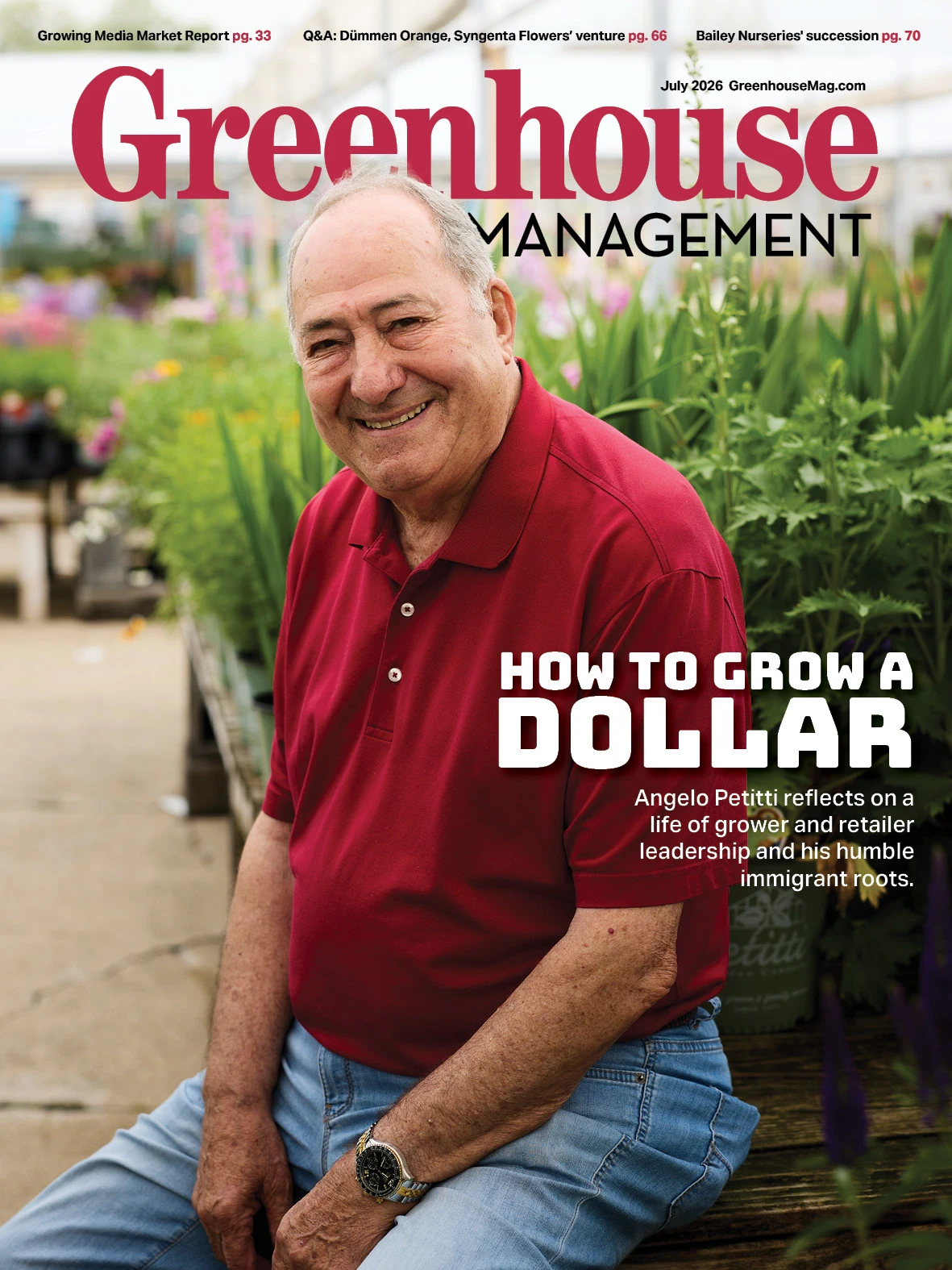
Explore the July 2026 Issue
Check out more from this issue and find your next story to read.
Latest from Greenhouse Management
- The Growth Industry Episode 17: Investing in IGCs with WorryFree® Plants
- New UF study sheds light on the hidden toll of back pain among horticulture workers
- 2026 Irrigation and Automation Market Report: Tradition rains
- Empowering the Future of Precision Cultivation: Resource Efficiency, Root-Zone Science and Scalable Automation
- Oasis Grower Solutions hires plant scientist Timothy Frey
- New green industry leadership development program for women now available
- Clean production protocol
- Jiffy hosting Microgreens Grower Day