Anyone who grows plants deals with root diseases. From the subtle to the obnoxious, these diseases are often overlooked until it’s too late.
Specialists in the sneak attack, some of the most notorious root rot pathogens fly under the radar, silently spreading until weakened, infected plants start tapping out. Early symptoms include chlorosis of foliage and stunting. More severe symptoms include significant root rot, wilting, dieback and collapse.
Phytophthora, Pythium and Fusarium are heavyweight champions, but Cylindrocladium and Berkleyomyces (Thielaviopsis has a new name) headline from time to time. All are capable of a knockout when conditions are right. They are also all capable of producing survival structures that can withstand extreme conditions, which makes management extremely difficult in certain situations where these pathogens have become established in production areas.
Leveling up your root defense means accepting that curative control of root and/or crown rot is not a good strategy, and the only effective means of managing these pathogens is through a combination of preventive fungicide applications and good sanitation practices. That means trash the diseased plants — truly throw them away or, more effectively, burn them.
Intrinsic Power Pairs
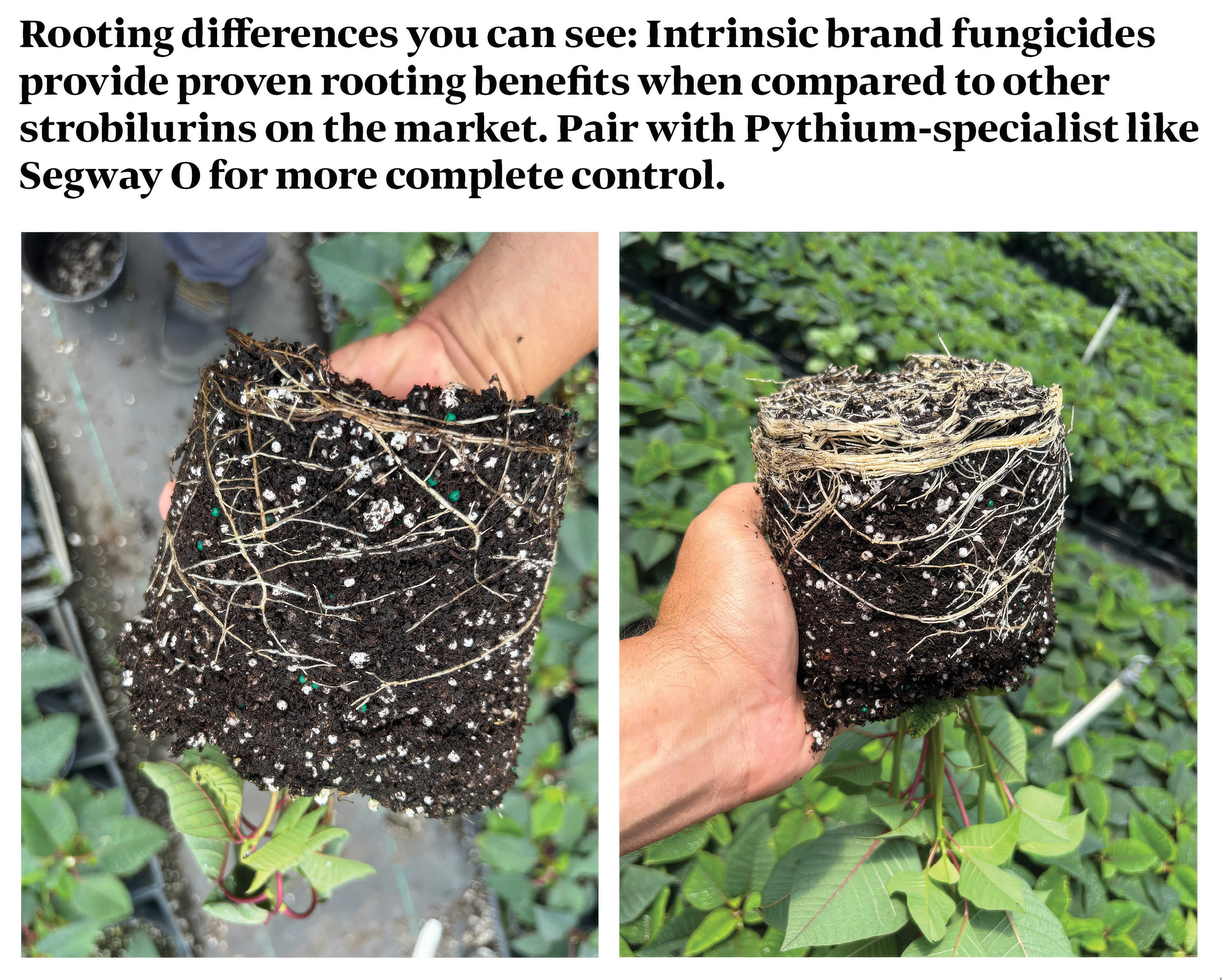
To produce healthy, high-quality plants, first you need to grow good roots. We use Intrinsic® brand fungicides as the foundational building blocks of disease management programs because in addition to killing pathogens, these fungicides have proven plant health benefits. And more specifically, we’ve shown that these products help grow better roots.
Spraying Intrinsic brand fungicides during propagation promotes faster callous formation and faster rooting times. Spraying Intrinsic brand fungicides after transplant leads to dramatically longer, denser root systems while also protecting roots from pathogen attack. To combat root diseases, pair Intrinsic brand fungicides with targeted specialists to maximize control and enhance root growth = Intrinsic Power Pairs.
Title Holders
Phytophthora and Pythium are fungal-like organisms called oomycetes and usually require specialist fungicides for the most effective control. These watermolds produce motile, swimming spores, called zoospores, that are actively attracted to roots. Flood irrigation and recirculating water can be a major means of spread.
Disease hotspots usually show up in poorly drained areas or whenever plants are kept too wet. Both pathogens have very wide host ranges and can attack most greenhouse crops. Certain crops like poinsettia, mums, geraniums and Easter lilies are known to be Pythium magnets.
Intrinsic Power Pair for Phytophthora: Rotate Orkestra® Intrinsic brand fungicide and Orvego® fungicide.
Intrinsic Power Pair for Pythium: Tank-mix Empress® Intrinsic brand fungicide + Segway® O fungicide.
Complete Fighter
Fusarium is an all-round threat. Capable of causing leaf spots, root and crown rot, damping off and even vascular wilt — Fusarium is one of the most difficult pathogens to control. Oftentimes, Fusarium is introduced on infected propagative material. Fusarium wilt is a major disease on chrysanthemums, where it becomes systemic and breaks down stem tissue as it colonizes the vascular tissue and spreads upward. Bright yellowing of the foliage and wilting on one side of the plant are classic symptoms to watch out for.
Intrinsic Power Pair for Fusarium: Rotate Pillar® SCIntrinsic brand fungicide and Avelyo® fungicide.
Wild Cards
Cylindrocladium and Berkeleyomyces are not as common, but when they do show up, they’re real threats. Berkeleyomyces causes black root rot on many bedding plants, with pansy and calibrachoa being common hosts. Early symptoms include minor stunting and chlorosis — these symptoms are often confused with nutritional issues. Upon closer inspection, you’ll find blackened root tips and lesions full of dark-colored spores.
Cylindrocladium commonly causes root and crown rot. Common hosts include Spathiphyllum and woody ornamentals like azalea. It’s characterized by dark gray-to-black lesions on infected tissue that eventually girdles infected roots or stems. Spores are sticky and easily splashed dispersed.
Intrinsic Power Pair for Cylindrocladium, Berkeleyomyces and Rhizoctonia: Rotate Pageant® Intrinsic brand fungicide and Avelyo fungicide.

Explore the July 2026 Issue
Check out more from this issue and find your next story to read.
Latest from Greenhouse Management
- The Growth Industry Episode 17: Investing in IGCs with WorryFree® Plants
- New UF study sheds light on the hidden toll of back pain among horticulture workers
- 2026 Irrigation and Automation Market Report: Tradition rains
- Empowering the Future of Precision Cultivation: Resource Efficiency, Root-Zone Science and Scalable Automation
- Oasis Grower Solutions hires plant scientist Timothy Frey
- New green industry leadership development program for women now available
- Clean production protocol
- Jiffy hosting Microgreens Grower Day