When it comes to artificial intelligence (AI), the future is here for many innovative software providers and other suppliers in the pest control industry. PCT wanted to learn how these companies are using artificial intelligence and what the future may hold for the use of AI in pest management.
In the following Q&A, these experts shed light on this top-of-mind topic: Antoni Hoshino, founder, PestAI; Carly Best, marketing manager, PICA; Thomas Lundberg, founder and CEO, Sellify AI; Christopher Brodowski, CEO and co-founder, Solea AI; David Libesman, senior vice president and general manager, AI and Data Analytics, WorkWave; and Finn Forshaw, strategic business manager, FORSHAW.
Their insights highlight how AI is streamlining operations, improving customer engagement, enhancing pest detection accuracy and more.

Antoni Hoshino: Pest AI is a specialized AI agency built for the pest control industry, focused on engineering and implementing AI-driven sales systems. Rather than offering one-size-fits-all software, Pest AI integrates artificial intelligence directly into a company’s sales and customer communication processes. The integration begins with a full analysis of the existing sales funnel, from lead capture to final booking. AI tools are then deployed to automate and optimize each stage, including lead qualification, natural language conversations through SMS and web chat and automatic appointment scheduling. This ensures every lead receives an immediate response 24/7, reducing missed opportunities while supporting human teams and driving consistent revenue growth.

Carly Best: Skyhawk Trapmate integrates AI to transform growing volumes of field data into operational intelligence. Our remote monitoring ecosystem captures activity, environmental conditions and device performance across multiple locations, where AI analyzes inputs to identify patterns, anomalies and emerging trends. Built on high-quality data and structured pipelines, Trapmate enables exception-based servicing so technicians focus only where attention is needed — supporting the transition from reactive service to predictive, prevention-focused operations.

Thomas Lundberg: Sellify AI integrates artificial intelligence as the operating layer of its platform, enabling pest control companies to automate large volumes of customer communication and operational work. Instead of relying solely on office staff, the platform uses AI across voice and SMS to handle conversations with customers while simultaneously executing actions inside CRMs such as FieldRoutes and PestPac. The AI can answer inbound calls, qualify leads, book appointments, run SMS upsell campaigns, reactivate cancelled customers, confirm or reschedule visits and process service requests. By completing the operational tasks behind each conversation, Sellify AI allows pest control companies to scale customer engagement and revenue without scaling administrative staff.

Christopher Brodowski: Solea AI integrates artificial intelligence directly into the daily operations of pest control companies, allowing customer communication and scheduling to run continuously in the background. AI agents manage phone calls, text messages, and website inquiries 24/7, enabling customers to book services through voice, SMS or an AI-powered website widget without waiting for office staff. The platform also uses AI to optimize scheduling and technician routes by evaluating travel time, technician skills, service rules and existing appointments simultaneously. In addition, AI supports sales by following up on quotes, recommending additional treatments and running automated outreach campaigns, helping companies generate consistent bookings and revenue.

David Libesman: We believe AI is only as good as the data fueling it. Our Wave- lytics Data Factory acts as the foundational “clean room,” centralizing and normalizing fragmented data from the field, office and finance. In tandem, we’ve integrated Decision Intelligence, a suite of predictive and prescriptive actionable metrics, and our natural language interface, Ask WAIve. Instead of just showing historical trends, our AI predicts trends and outcomes, including course-corrective actions to avoid high customer churn or drive higher route completion rates.

Finn Forshaw: A practical example from FORSHAW is ForeSight, where an AI chatbot streamlines daily operational decisions. The platform provides truck-level inventory visibility, automated replenishment planning and improved forecasting to maintain proper stock levels without overordering or delays. AI identifies usage patterns, flags inconsistencies and surfaces insights that would otherwise take hours to analyze. It also supports workflows through an assistant that answers process questions and reinforces standard procedures. The goal is not to replace human judgment, but to support it with clearer information and faster access to insight. With better visibility, teams operate with greater confidence and consistency.
PCT: What measurable impact have businesses seen after adopting your company’s AI solution(s)?
David Libesman: The impact is both immediate and structural. By leveraging the Wavelytics Data Factory, companies are saving up to 80% on engineering and data-wrangling costs, as they eliminate the need to manually build custom data warehouses. Beyond back-office efficiency, customers see significant margin gains through higher CAC/LTV ratios. Operationally, our AI route optimization consistently reduces fuel costs and travel time by 20–30%, allowing for more billable stops per day while maintaining a smaller administrative footprint.
Finn Forshaw:The most immediate benefits are time savings and operational clarity. Companies using ForeSight report fewer inventory surprises, fewer last- minute supply runs and less time reconciling spreadsheets or locating products across trucks and branches. Technicians spend more time servicing customers, while managers gain visibility without constant manual reporting. Businesses reduce overordering and product waste, and supply planning becomes more predictable. Reducing excess inventory, emergency shipping and spoilage supports a more sustainable supply chain. Efficiency and sustainability often go hand in hand, improving both operations and long-term business performance.
Christopher Brodowski: Solea AI integrates artificial intelligence to improve cost efficiency, operations and revenue generation for pest control companies. AI agents handle large volumes of customer phone calls and routine inquiries, allowing businesses to operate without large call center teams and significantly reduce staffing costs. This automation frees existing staff to focus on higher-value work rather than routine customer service tasks. Solea AI also includes an advanced route optimization engine that analyzes technician availability, travel time and service schedules to increase route density, enabling companies to complete significantly more jobs with the same workforce. In addition, AI sales agents generate new revenue by autonomously engaging prospects and converting opportunities into booked services.
Thomas Lundberg: Sellify AI focuses on revenue-generating customer conversations, not just automation, which allows pest control companies to see fast financial impact. NineFold, a large operator with multiple national brands, used Sellify to cross-sell mosquito services to about 20,000 existing customers. In a single season, the campaign generated $620,000 in new revenue, 1,700 service accounts, and 1,100 mosquito subscriptions, converting roughly 5-6% of customers with minimal staff involvement. EnviroGuard, operating across 20-plus branches, saw similar results: Sellify’s AI sales agent produced 769 new service accounts and over $500,000 in revenue in Q1 and Q2. In both cases, AI engaged thousands of customers simultaneously and generated revenue without adding headcount.
Carly Best: Businesses using Trapmate’s remote monitoring are achieving measurable operational gains, particularly in labor efficiency and service prioritization. Customers report faster response to verified issues, more efficient technician utilization and greater visibility across multi-site accounts. Importantly, this data enables providers to demonstrate reductions in pest activity and refine exclusion strategies — elevating the technician’s role from routine trap checks to proactive risk management while supporting more consistent, data-backed service delivery.
Antoni Hoshino: Pest AI helps service businesses capture more leads by ensuring every customer inquiry receives an instant response. By eliminating missed calls and delayed follow-ups, companies convert more inquiries into scheduled jobs. The system automates key stages of customer engagement, including responses and follow-up, allowing staff to focus on higher- value work such as complex customer support and relationship building. This improves lead management and increases customer lifetime value. Clients report both higher revenue and a more efficient sales process. Because the AI can handle large volumes of inquiries simultaneously, businesses can scale their operations and manage fluctuating demand without increasing staffing proportionally.
PCT: How do you see the pest control industry/pest management firms best using AI in the next one to three years?
Thomas Lundberg: The biggest shift in pest control won’t be new AI tools, but AI becoming integral to daily operations. Companies already have valuable customer bases and years of service data, which AI can leverage to scale efficiently. AI will transform three areas: customer communication, handling calls, confirmations and routine inquiries automatically; revenue growth, enabling cross-selling of services like mosquito, termite or rodent treatments to thousands of customers personally and consistently; and operational efficiency, coordinating appointments, technician prep and service notes to reduce administrative work. Early adopters will operate faster, capture more revenue and run more efficiently than competitors relying on manual processes.
Christopher Brodowski: Solea AI is transforming service businesses by embedding AI directly into daily operations, enabling 24/7 customer engagement and instant booking via calls, texts or web widgets. AI handles scheduling, route optimization, quote follow-ups and lead re-engagement, increasing completed jobs by about 30% and generating an average 12% revenue lift. This reduces the need for large office teams, shifting staff toward high-value roles like strategy, growth and complex customer support. Early adopters gain a competitive edge by meeting rising customer expectations for instant, convenient service while scaling operations efficiently. AI allows faster growth, lower operational strain and more revenue from existing resources.

David Libesman: The next frontier is agentic AI — moving beyond chatbots to autonomous “agents” that handle complex workflows. In the next few years, AI won’t just flag an aging lead; it will automatically initiate a personalized outreach campaign or re-optimize a day’s worth of schedules in seconds based on real-time traffic and weather. We will see a shift toward “prescriptive navigation,” where the software tells the owner exactly which lever to pull to maximize profitability, effectively democratizing high-level business strategy.
Antoni Hoshino: The pace of technological change is accelerating, and pest management companies may face some turbulence as AI adoption grows. The firms that succeed will focus on preparation rather than chasing every new tool. The priority is building a strong operational foundation through structured data and well-documented processes. This includes consistently recording customer interactions, service histories and sales data, as well as standardizing workflows such as technician dispatch and customer follow-up. Companies that invest in clean data and clear processes today will be best positioned to adopt future AI tools quickly and effectively. With the right infrastructure in place, they can integrate new technologies faster and gain a competitive advantage.
Finn Forshaw: In the coming years, AI will play its most valuable role in improving visibility and operational discipline. Rather than replacing expertise, it will help operators identify patterns faster, forecast demand more accurately and maintain consistency as businesses scale. For pest management companies managing multiple branches, fleets and technicians, small efficiency gains can improve labor productivity, inventory accuracy and environmental impact. At FORSHAW, we believe the best technology works quietly in the background, strengthening systems that help people succeed. Pest management will remain grounded in strong people, trusted partnerships and disciplined performance, with AI supporting those strengths.
Carly Best: As connected technologies become standard across the industry, PCOs will have access to far more data — from activity trends and historical patterns to weather and building conditions that signal risk. AI will be essential in translating these inputs into actionable insight, enabling earlier detection of seasonal shifts, predictive risk scoring and targeted prevention strategies. AI will not replace operational expertise — it will amplify organizations that have built strong digital foundations.
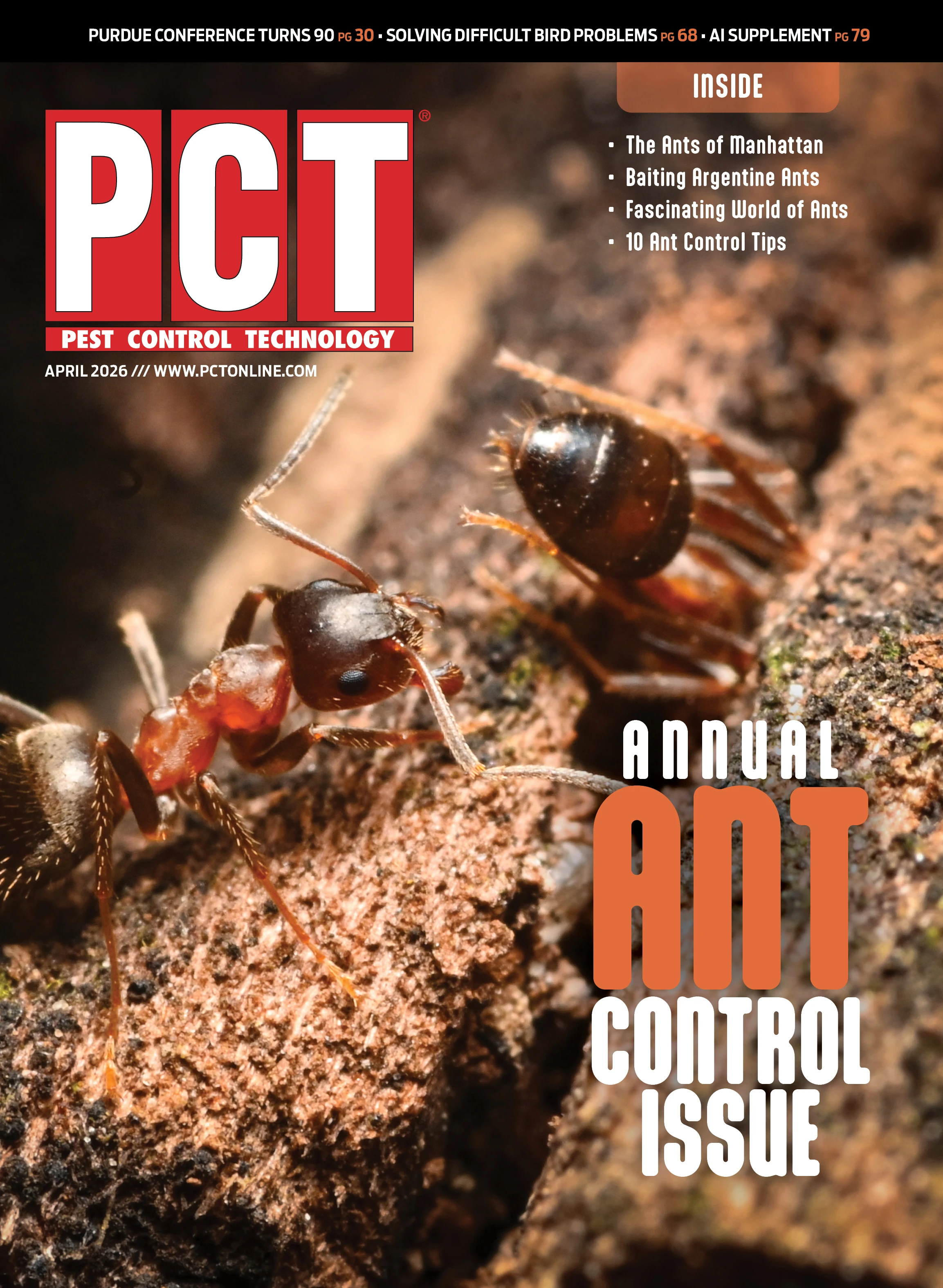
Explore the April 2026 Issue
Check out more from this issue and find your next story to read.
Latest from Pest Control Technology
- Envu Offers Fall Promotion for Horizon Members
- Pest Management Foundation Announces the E. Raymond Crim, III Scholarship
- Tyro Group Acquires Dowell Pest Control
- Podcast: Beyond the Pest | Ep. 14 — Dr. Zach DeVries
- Webinar: The AI-Run Pest Control Company: Hype vs. Reality, What Actually Works (and What Doesn’t)
- Select Exterminating Acquires Three Businesses Across New York and New Jersey
- Catseye Pest Control Acquires Security Pest Elimination and Biologic Pest Control
- Researchers Confirm New York's First Bourbon Virus Case