Who doesn’t want to look appealing to their customers when doing an ant job? It’s great to get new customers, but callbacks aren’t the best look. If you want to have customers falling head over heels for you, do these 10 things!
1. STOP CHASING THE WRONG ONE. There are plenty of fish in the sea, and thousands of species of ants in the world. Finding the right one is important. Different species have different food preferences, behaviors and habitats. If the species is correctly identified, you can impress the customer by focusing your inspection and finding underlying conditions quickly. Carpenter ants may have a satellite colony nesting in a rotten door frame with the main colony in an old stump far away from the structure. Maybe it’s odorous house ants that are nesting in a wall void. Knowing the species also helps with treatment. Aside from making sure the species is on the product label, different formulations and active ingredients may work better or worse. If an ant problem is misidentified, treatments (including sanitation and exclusion) can be ineffective and the callbacks will start up.
2. SHOW YOUR SOFTER SIDE. When starting a new relationship, communication is key. Customers need to know what conducive conditions are present and why they need to address those. Whether it’s a dirty recycle bin where ghost ants are foraging or a bag of grass seed attracting harvester ants, customers don’t see those like pest control folks see them. On this first date, tell them what your plans are. Explain what you did and let them know when you will return for a follow up.

3. BE THEIR SAFE SPACE. No one likes being ignored or talked over, so let them tell their story. While customers don’t know what you know, they can help point out where they have seen issues. They could see trails leading outdoors when pavement ants are foraging inside. Or they only may see ants at night because carpenter ants are nocturnal. Something caught their eye, and that’s why they called for your help. This information could point to species, food sources, exclusion points, and more that help you deal with the problem.
4. USE YOUR MUSCLES. Nothing is more desirable to a customer than finding the problem fast. This means getting into areas that customers don’t regularly access: lifting items, climbing, getting down low and doing some crazy yoga poses to twist into hard to reach areas. That trail of ants represents only a small fraction of the nest, and if the main colony isn’t addressed, the problems persist and so do the callbacks. This can be a real challenge. Those pharaoh ants may be nesting behind an unreachable electrical panel, or those fire ants may be nesting on the neighbor’s property. Finding them makes you look like a million bucks not finding them could cost you.

5. ACCESSORIZE WITH PURPOSE. You can be even more alluring to customers when you have all the right tools for the job. The best accessory you can have is a bright flashlight to light up their life. Besides that, there are gel baits, dusts, liquid residuals, granulars and many more products to treat most species of ants. Just one isn’t always enough. Combining treatments and putting them in the right places is the difference between a planned follow up visit and a callback. Don’t forget PPE to protect yourself; being bitten and stung by Asian needle ants isn’t pretty.
6. LOCATION, LOCATION, LOCATION. It is not just about the tools you have, it’s how you use them. Baits are excellent options, but if they aren’t near the foraging pathways, ants are unlikely to feed on them. Liquid residuals are good options to keep ants out, but if they are already inside, treating the door sills won’t help. Outdoors, for species like pavement ants, treatments need to be near enough to the colony to be impactful. Think in 3-D: Liquids are going to generally be applied low at floor level. Baits can be used higher up and in small areas. This is great for that colony of ghost ants that are hidden behind an upper cabinet.
7. GIVE ‘EM WHAT THEY WANT. The ants, that is! It’s important to remember that only around 20% of the individual ants are out of the colony foraging. When ants encounter the bait, they take it back to the main colony to share with others. If too little bait is being used, those few foragers that get some only share with a few others and not enough of the colony workers are affected. A good example is Argentine ants that can form huge colonies and have multiple queens. All of them need that alluring bait. For tricky situations when the location of the main colony isn’t known, using more than one bait is a gorgeous idea. That means different active ingredients and different tastes. For ongoing ant problems, don’t forget to rotate baits so resistance isn’t an issue.
8. LOVE AT FIRST SIGHT. Once ants find a food source they are fond of, they don’t forget it. Ants use pheromone trails to help them get back there and they call in all their friends to share the love. Finding the sanitation issues at a customer’s house and having them remove it is important. It makes baits more attractive because they are the only food source nearby. Cleaning the area disrupts their trails and makes them explore again. Remember, the food source could be more “natural.” Crazy ants are typically found herding and feeding off of sap-producing insects like aphids. Acrobat ants find feeding on other arthropods and carrion alluring.
9. COMMUNICATE. Chances are, the ant problem didn’t start yesterday when the customer noticed it, and chances are it won’t be solved in a day. Be charming and set expectations. They may continue to see ants for a few days, especially when using bait, since baits are slower acting. If ants like false honey ants are swarming in the area, they may still see those winged alates. Let them know to keep tracking where they see ants for the follow up visit. Tell them where you treated and make sure they don’t clean those areas and remove any treatment that was put down. If customers know what to expect, they are less likely to call back before treatments even have a chance to take effect.
10. ASK FOR THAT SECOND DATE. Ant issues can be a one-time service. Fire ants can often be taken out in one treatment if the nest is treated. There are many other species that are going to require a second visit. Crazy ants are notorious for having huge colonies and don’t respond well to a single treatment. Leafcutter ants are targeting plants and getting treatment to them isn’t easy. It can help to plan that second visit and let the customer know when it’s going to be. That way, they know you won’t ghost them. Even if a second visit isn’t warranted, it’s a great time to explain why regular service is important to prevent future issues.
BONUS TIP: MASTER THE ALL-NATURAL LOOK. There are plenty of customers wanting an “all natural” or “green” look to their ant solutions. There are numerous products containing botanicals or other ingredients considered “all natural.” When going for this option, remember that non-chemical means of pest control become much more important. Finding the food sources and excluding the pests from the structure lessens the risk of ants and limits their populations. That will make them more susceptible to the selected products. The more the underlying conditions are addressed, the fewer repeat visits that will be necessary. The goal is for sparks to fly in a good way, not sparks from angry customers. Hit it off with your customers by eliminating ants quickly. It’s a match made in heaven when the customers do their part with sanitation and exclusion, and you do your part with finding the ants, the conducive conditions and treating. You will have them wrapped around your finger instead of getting clingy and calling you back for retreats.
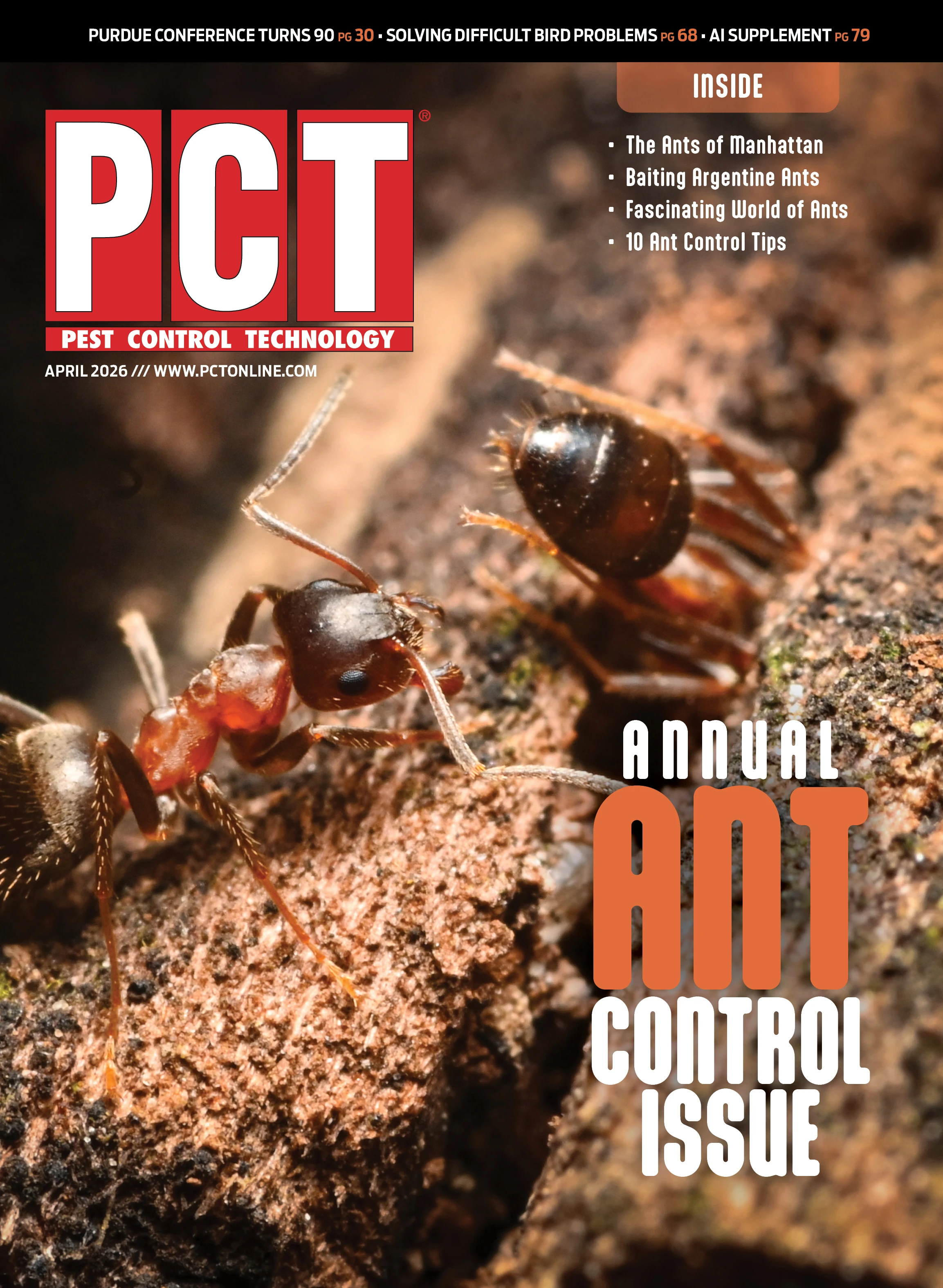
Explore the April 2026 Issue
Check out more from this issue and find your next story to read.
Latest from Pest Control Technology
- Envu Offers Fall Promotion for Horizon Members
- Pest Management Foundation Announces the E. Raymond Crim, III Scholarship
- Tyro Group Acquires Dowell Pest Control
- Podcast: Beyond the Pest | Ep. 14 — Dr. Zach DeVries
- Webinar: The AI-Run Pest Control Company: Hype vs. Reality, What Actually Works (and What Doesn’t)
- Select Exterminating Acquires Three Businesses Across New York and New Jersey
- Catseye Pest Control Acquires Security Pest Elimination and Biologic Pest Control
- Researchers Confirm New York's First Bourbon Virus Case