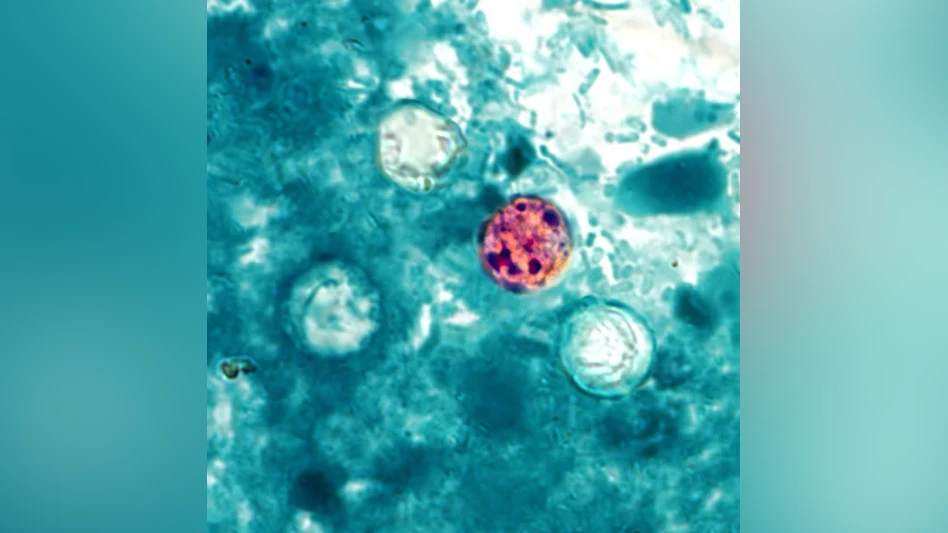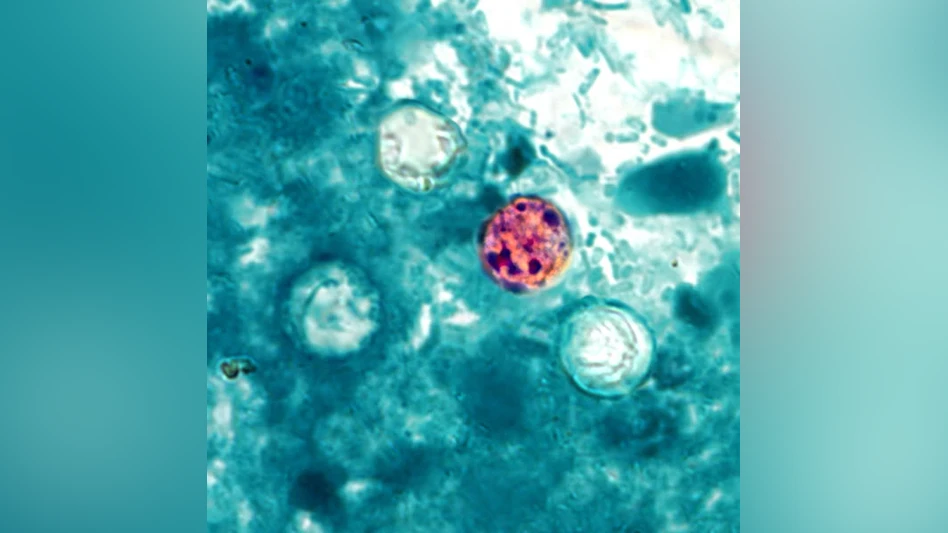
CDC/DPDx - Melanie Moser
TUCSON, Ariz. — Cyclospora is a microscopic intestinal parasite that spreads through contaminated food or water. Swallow it on a piece of produce and, days later, it can cause watery, often explosive diarrhea, along with nausea and fatigue that can last for weeks. The illness it causes, cyclosporiasis, turns up most summers.
This year, it arrived earlier and spread further than usual, with cases across dozens of states running above recent seasons as public health investigators work to find the source.
Gerardo “Jerry” Lopez, an associate professor and extension specialist in STEM, food safety and environmental microbiology in the University of Arizona School of Animal andComparative Biomedical Sciences, has spent years tracking how the parasite gets into agricultural water and onto fresh produce. Part of FDA's Cyclospora task force, Lopez spoke about why the parasite is so hard to trace, how people can protect themselves and what most people get wrong about it.
Q: What makes an outbreak like this so hard to trace back to a source?
A: It's a complicated process. It can take two to 14 days for someone to start showing symptoms: the diarrhea, the nausea, the fatigue. So, by the time people are sick, investigators have to work backward and figure out what someone ate and where, whether it was at a restaurant or what they purchased at a grocery store. Then they must trace that product back to its source, determine if there are packages or produce left and test it for Cyclospora.
Q: Is this year's outbreak actually worse, or are we just better at detecting it?
A: We don't know yet. The testing we're doing now is pretty much the same testing we've had the last couple of years, so it isn't that we suddenly got better at detecting it. Why there's been such an early uptick this year, and why in certain regions, we're not sure. One thing we're looking at is the heat. Cyclospora is temperature dependent. It needs warmth to mature, so with the heat exposure this year, we're asking whether that happened sooner. Those are the questions our Cyclospora task force is going to work on with the FDA, the CDC, other university experts and fresh produce industry stakeholders.
Q: What does your lab at the University of Arizona actually do with this parasite?
A: I'm an associate professor here, and I have an extension role doing STEM outreach. I've tied that outreach to my Cyclospora research by giving undergraduates real research experience. In my lab, working mostly with undergraduate and graduate students, I partner with industry to collect irrigation water samples from produce growing regions across the U.S. and Mexico. We take the methods the FDA and CDC have developed and apply them to those environmental samples to gain a better understanding of the prevalence of Cyclospora in various produce growing regions across the U.S. and Mexico. Our lab also provides cyclospora fresh produce testing services for distributors interested in determining if their commodities are contaminated with Cyclospora. I also sit on the FDA's cyclospora task force, where academia, agencies, produce companies and diagnostic labs work together to stay ahead of these outbreaks.
Q: What's the best way for people to protect themselves?
A: The parasite isn't very susceptible to household chemicals, so it comes down to careful handling. Washing is the best tool we have, but you have to do it right. Rinse produce cleanly, and don't let the water coming off one item run down onto the rest. Wash one piece at a time, set it aside, and rub it as much as the product allows. Don't use soap or detergent. There are good resources out there on how to rinse vegetables properly. Watch for cross-contamination on your counters too. Remember to use good hand hygiene practices by washing your hands before and after meal preparations. And while the outbreak is going on, it's reasonable to be a little cautious about what you order at restaurants. A lot of them are already taking steps to lower the risk. The good news is people generally don't die from this. … The main thing is to stay hydrated, and if it lasts more than a couple of days, see a doctor or go to urgent care.
Q: What do people most often get wrong about Cyclospora?
A: The biggest one is that people think it's bacteria. Bacteria like Salmonella, Listeria, E. coli and Campylobacter multiply, even in your refrigerator, which is what makes them so dangerous. Cyclospora doesn't work that way. It can't multiply on your lettuce. If it's there, it's already there. It only becomes infectious after an infected person sheds it in their stool and it sits in the environment for a while, about two weeks, and that depends on temperature. Cyclosporiasis isn't a simple fecal-to-mouth infection. Cyclospora has to mature in the environment first. That sets it apart from other parasites like Cryptosporidium and Giardia, which are infectious right away.
Latest from Quality Assurance & Food Safety
- IFPA Urges Broader Approach to Cyclospora Investigations in Recommendations to CDC
- Ergodyne Introduces Two New Thermal Workwear Options
- Bipartisan Bill Would Expand Major Food Allergen Labeling to Barley, Rye and Oats
- FDA Finalizes Food Safety Guidance for Ready-to-Eat Fresh-Cut Produce
- FDA Proposes Mandatory GRAS Notifications as Agencies Advance Ultra-Processed Foods Definition
- Taylor Farms Recalls Products Made with Jalapeños Amid Salmonella Outbreak
- ‘When You Have 16,000 People Sick, It’s Hard to Ignore’: Marler, Detwiler Discuss Cyclospora
- Thermo Fisher Scientific Releases Thermo Scientific InstaFlux