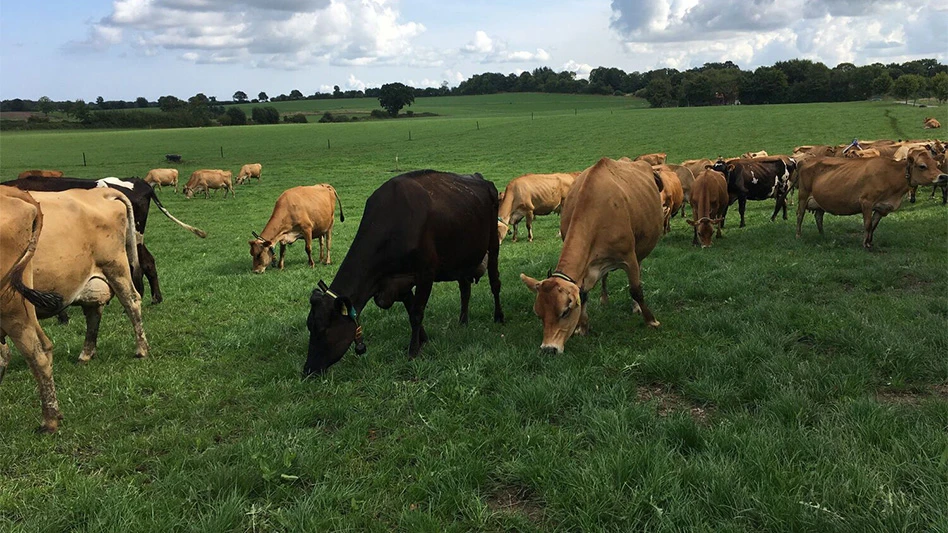
Photo: Martin Komainda
GÖTTINGEN, Germany — Allowing dairy cows to graze on fresh grass in open pastures for a significant proportion of the year seems more natural and sustainable. And there are proven advantages for the environment: stable grasslands promote biodiversity, protect the soil and support carbon storage. However, farms face challenges, as they are heavily dependent on the weather and the time of the year, said the University of Göttingen. Farming is more productive when the pastures have a wide variety of different grasses, herbs and legumes, such as clover and chicory, according to new research from the university.
A research team at the University of Göttingen analyzed this strategy using a meta-analysis of a number of studies. The analysis showed that the diversity of pastureland has no effect on milk production or on emissions of the greenhouse gas methane, which cows emit mainly when they burp. However, a higher proportion of legumes can promote milk production. The results were published in the journal Food and Energy Security.
In this meta-analysis of 16 studies, researchers compared grasslands with diverse vegetation and less species-rich pastureland and considered the effects on milk production and methane emissions, as well as the nutritional value of the feed.
The fact that no clear correlations could be identified may be due to methodological reasons, as lead author Dr. Martin Komainda at Göttingen University’s Institute of Grassland Science explained: “Ten of the studies lasted ten days or less. However, the productivity and nutritional value of grassland areas fluctuate within seasons and between years. To better account for this, more year-round and multi-year studies are needed.” Plant species that could affect methane emissions were also rarely found in the pastures studied.
However, the study does reveal one trend: the more legumes growing in the pasture, the higher the cows' milk yield, said the University of Göttingen. The species-rich pastureland did not have significantly higher proportions of these plants than the less diverse reference grasslands, but the researchers emphasize that biodiversity in pastureland is worthwhile, nonetheless: “Farms should consider the benefits of diverse grassland areas in terms of overall productivity and benefits to the ecosystem, rather than expecting immediate improvements in milk production or methane reduction.”
The study was funded by the Federal Ministry of Food, Agriculture and Home Affairs.
Latest from Quality Assurance & Food Safety
- Taylor Farms Removes Iceberg Lettuce Sourced from Mexico Amid Cyclospora Outbreak
- FDA, CDC Tie Multistate Cyclospora Outbreak to Taco Bell Lettuce
- BCG and CGF Release New Report on AI Usage by CPG and Retail Companies
- IntelliAM AI Launches Industrial Intelligence Platform
- QA Virtual Conference to Explore Pest Control Strategies for Food Facilities
- Meat and Poultry Companies Adopt Product of USA Label
- Klobuchar Urges CDC, FDA to Restore Food Safety Funding as Cyclosporiasis Cases Rise
- International Experts Share New Scientific Advice to Support Global Food Safety at 102nd JECFA Meeting