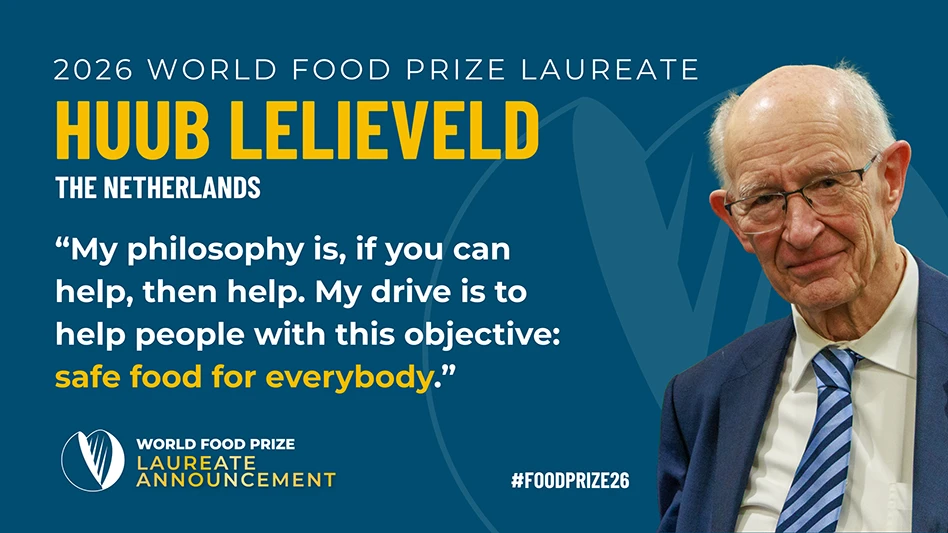
Courtesy World Food Prize Foundation
Huub Lelieveld, a humanitarian and food safety expert from the Netherlands, was named the 2026 World Food Prize Laureate in recognition of his work across 113 countries to deliver scientific evidence for modern regulations, legislation and international standards that safeguard the world’s food supply.
The announcement of this year’s World Food Prize — a $500,000 global award for food and agriculture — was held at the Council on Foreign Relations in New York.
“Lelieveld lives by his conviction that access to safe food is a universal right — a philosophy shared by the late Dr. Norman Borlaug,” said World Food Prize Foundation President Mashal Husain. “Through his lifelong commitment to harmonizing regulations, he has lowered trade barriers, prevented the unnecessary destruction of safe food, promoted innovative food safety technologies worldwide and reduced the risk of foodborne illness outbreaks.”
Through six decades of research, institution-building and advocacy, Lelieveld has united scientists, industry leaders and policymakers around a commitment to safe and nutritious food for all, said the foundation in a March 25 release.
The Global Harmonization Initiative.
Unsafe food causes 600 million foodborne illnesses and 420,000 deaths each year around the globe. At the same time, inconsistent or politically-driven food safety standards disrupt trade by delaying shipments, destroying safe produce at borders and raising trade costs, undermining food supply — especially in import-dependent countries.
In 2002, reports confirmed that Southern Africa was rapidly descending into famine. The need for emergency aid was immediate, as millions faced severe food shortages and acute hunger. As officials deliberated the safety of genetically modified food products, thousands perished, while life-saving food aid sat in ports. Bureaucratic hurdles and regulatory barriers had stalled delivery.
Rather than retiring at age 60 after a 40-year career as a food scientist for Unilever in the Netherlands, Lelieveld set out to prevent similar crises. In 2004, he established the Global Harmonization Initiative (GHI), a global food safety organization that today connects more than 1,600 volunteer experts across a network of countries to advance science-based food safety and reduce barriers to the safe distribution of food worldwide.
Under Lelieveld’s leadership, GHI efforts have streamlined food trade and enhanced food security and access around the world. In Kenya, GHI recommendations were adopted into national legislation in 2023, requiring food companies to employ certified food safety professionals. GHI has also played a key role in standardizing and depoliticizing food irradiation — a technology that prevents foodborne illness cases while reducing food waste by extending shelf life.
A Food Safety Pioneer.
Born in The Hague during World War II, Lelieveld’s first job was working in his father’s Indonesian-style food products factory. After earning a degree in electrical engineering from The Hague University of Applied Sciences, he joined Unilever as a researcher. Over the course of his career, he challenged conventional food safety practices — pioneering automated hygienic production methods, developing equipment that reduced the need for frequent sterilization and chemical preservatives and advancing non-destructive techniques for testing food products.
Lelieveld’s innovations reduced food waste, contamination risks and the reliance on excess salt, sugar and preservatives, establishing industry-wide standards still in use today. His work resulted in 11 patents and more than 1,000 contributions to Unilever’s scientific database.
“I grew up right after the fearful years of Nazi oppression came to an end, in a liberated country with a renewed spirit of solidarity,” said Lelieveld. “There was much work to be done, and no time to complain. Besides a hands-on, optimistic approach on life in general, I developed some life-long rules, like a focus on helping others — instead of serving yourself.”
Going Global.
Lelieveld had already built a career as a food safety researcher, innovator and founder of several international professional associations when he launched GHI. Drawing on his expertise and global network, he created a volunteer organization of thousands of scientists working to build international consensus on food standards and facilitate the safe and efficient flow of trade. While GHI’s ultimate goal is to harmonize legislation worldwide, it has also invested in capacity building through briefs, case studies, reports and webinars, training more than 4,000 professionals to lead safe food production in their own countries.
“Companies, large and small, as well as all consumers are negatively affected by unjustified differences in regulations,” said Lelieveld. “The Global Harmonization Initiative, therefore, strives not only to reach scientific consensus but also to ensure that findings are accessible to everyone, requiring simplification without compromising scientific accuracy and translation into local languages.”
Lelieveld has also led a series of initiatives addressing urgent challenges in global food systems. He spearheaded the creation of an international alert and whistleblowing network that enables experts in more than 100 countries to detect and respond to emerging food safety threats within 48 hours — helping protect consumers before isolated incidents escalate into broader crises. In the aftermath of the 2008 Wenchuan earthquake in China, he mobilized GHI to develop a food safety manual for disaster zones, shaping emergency response protocols used in multiple regions.
Through the same network, he also championed practical, community-based solutions. These include the Safe Cassava initiative, which reduces toxin-related neurological disease in children in sub-Saharan Africa, and pilot projects introducing atmospheric water generation in eight countries to expand access to safe drinking water.
“Lelieveld was selected for translating food safety science into global regulations, legislation and practice, a movement spanning dozens of countries," said National Medal of Science Recipient Dr. Gebisa Ejeta. “His initiatives are estimated to have benefited millions of consumers worldwide.”
Lelieveld has authored and co-authored 16 widely translated books that have influenced curricula and regulatory reform and are used by universities and food companies. His contributions to food safety and security earned him an honorary doctorate from the National University of Food Science and Technology in Kyiv, and the title of Officer of the Order of Orange-Nassau from the Dutch Royal House for outstanding international public health service.
“Lelieveld could have retired after a remarkable career, but instead, he chose to dedicate himself to the world’s most pressing food safety challenges,” said World Food Prize Foundation CEO Tom Vilsack. “He has saved countless lives and ensured that safe, nutritious food can reach people who need it most. His vision and persistence continue to transform food systems worldwide.”
Latest from Quality Assurance & Food Safety
- Taylor Farms Removes Iceberg Lettuce Sourced from Mexico Amid Cyclospora Outbreak
- FDA, CDC Tie Multistate Cyclospora Outbreak to Taco Bell Lettuce
- BCG and CGF Release New Report on AI Usage by CPG and Retail Companies
- IntelliAM AI Launches Industrial Intelligence Platform
- QA Virtual Conference to Explore Pest Control Strategies for Food Facilities
- Meat and Poultry Companies Adopt Product of USA Label
- Klobuchar Urges CDC, FDA to Restore Food Safety Funding as Cyclosporiasis Cases Rise
- International Experts Share New Scientific Advice to Support Global Food Safety at 102nd JECFA Meeting