Adobe Firefly
Accurate inventory is essential for nursery production. Growers rely on inventory information for sales, harvest planning, obtaining crop insurance, labor allocation and shipping. Yet obtaining reliable inventory data remains one of the most labor-intensive management tasks in nursery production. Many nurseries still rely on crews walking rows and manually counting trees and estimating caliper and canopy size. While straightforward, this approach can require substantial labor because production blocks often contain thousands of trees spread across large acreages. In other operations, inventory is updated during harvest and grading. Although effective, this approach provides information after the fact rather than a real-time picture of what is available in the field. In both cases, data still need to be entered into a computer for recordkeeping.

Through the Labor, Efficiency, Automation, and Production (LEAP) project, a nationwide transdisciplinary collaboration of researchers, extension specialists, industry partners, stakeholder organizations and growers is evaluating automation technologies to improve labor efficiency and nursery management. One such technology is TALI, which stands for Terrestrial, Autonomous Laser-based Inventory, and is a management system that counts trees, measures caliper and compares annual canopy growth being developed by Dr. Heping Zhu at the USDA Agriculture Research Service station in Wooster, Ohio, as well as other collaborators.
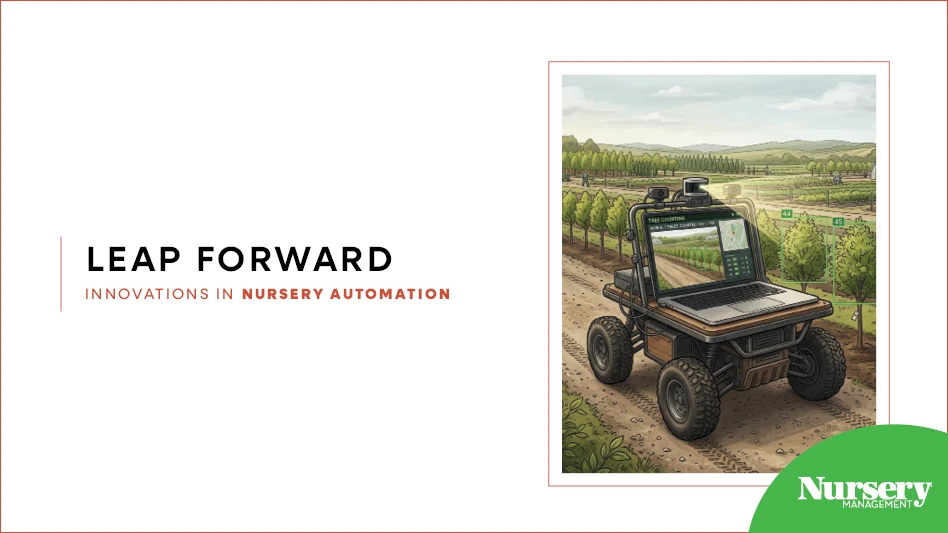
TALI combines light detecting and ranging (LiDAR) sensing, positioning systems and automated data processing to identify and count nursery trees under commercial nursery conditions. LiDAR works with a specially designed computer program by sending laser pulses and measuring the time required for reflected light to return to the sensor, creating a three-dimensional representation of nursery rows and plants. Mounted on a utility vehicle, a robotic platform or a tractor, the system can travel through nursery rows while collecting inventory information.

One challenge is that computers do not see nursery crops the same way people do. Experienced nursery workers can quickly distinguish a tree from a stake, support structure or neighboring plant. Computers must be explicitly trained to make those same distinctions. Nursery environments contain trees of different sizes and ages, colorful foliage, overlapping canopies, support stakes and irrigation infrastructure. This visual complexity makes it difficult to collect the vast amount of highquality training data needed to develop automated inventory systems.
LEAP researchers report that TALI can now identify trees but still cannot filter out non-tree objects such as stakes and support structures. It cannot be used for container-grown plants. Current testing is evaluating accuracy of counting trees and measuring tree sizes across different crops and growth stages. Zhu’s team has also observed that inventory is generally accurate when trees do not have overlapping branches or during winter when branches are bare and individual trees are more distinct. During the growing season, overlapping canopies can create additional challenges, occasionally causing them to be counted as an additional tree.

TALI builds upon years of research developing LiDAR-guided precision sprayer technologies. In those systems, LiDAR was used to identify plant canopies and direct pesticide applications where needed. TALI applies similar sensing principles to a different nursery challenge: inventory management. This summer, researchers will continue refining the system based on field tests and offered a demonstration at Cultivate’26 (see photo). TALI will be deployed at collaborating nurseries in Ohio, Oregon, Tennessee and North Carolina in spring 2027. LEAP researchers and collaborators will continue evaluating TALI as a tool that may improve inventory accuracy while reducing the labor required to collect inventory information.

Explore the August 2026 Issue
Check out more from this issue and find your next story to read.
Latest from Nursery Management
- Plantpeddler announces results of Variety Day 2026
- Get to know Marcus Jansen
- Stat of the Week: Companies with a customer experience mindset drive revenue 4-8% higher than others
- SmartPlant offers market intelligence for horticulture industry
- Monrovia presents garden design trends for 2027
- Elusive blue
- American Floral Endowment announces 2026-27 educational grants
- Cities may be the ultimate training grounds for invasive species, UF/IFAS researchers say