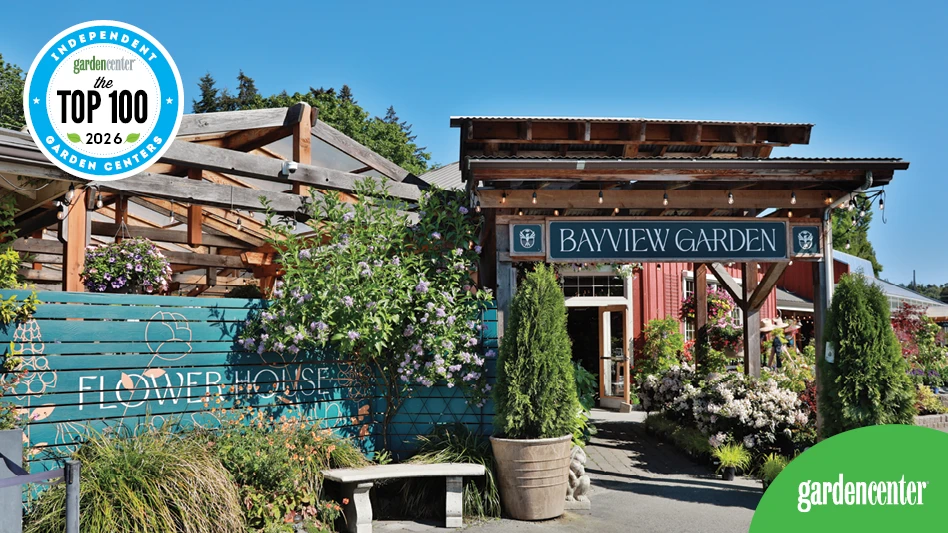
Photos © Michael Stadler
Nestled in Puget Sound, about 30 miles north of Seattle, Bayview Garden sits at historic Bayview Corner on Whidbey Island. Steeped in agricultural roots, the island is an idyllic Pacific Northwest paradise spanning 37 miles long as the crow flies. Its diverse landscape features a rugged coastline, old-growth forests and a charming mix of forage and grain farming, heirloom-crop growers and grazing livestock.
But what has really brought the island into its own is a thriving tourism industry. Each year, thousands of experience-seekers cross from the mainland via the Mukilteo-Clinton ferry or the Deception Pass Bridge, drawn to Whidbey’s vibrant arts scene, agritourism, parks and coastal landmarks.
At the heart of this island community is Bayview Garden, #92 on Garden Center magazine’s 2026 Top 100 Independent Garden Centers List.
At the family-owned and -operated garden center, visitors sate their landscaping desires, discover unique treasures in its gift shop or indulge their culinary desires at the Flower House Cafe. The property’s centerpiece is the Laburnum Arch. This stunning, living archway of golden chain trees explodes each spring into thousands of cascading, wisteria-like, golden flowers.
William Shakespeare famously declared that all the world’s a stage. At Bayview Garden, retail is performance. The IGC treats every detail as a curated production, from hiring employees with natural interpersonal warmth to designing spaces that embrace visitors like a warm hug. The result is a retail experience that has transformed a simple greenhouse into a must-visit destination.


The main stage
Maureen Murphy founded the business in 1993 as a wholesale greenhouse growing operation on 10 acres. In its earliest years, it focused on cultivating plants and transporting them to major mainland retail garden centers. However, the logistical challenges of mainland deliveries and the environmental reluctance to clear old-growth cedar trees for short-season crops prompted Murphy to pivot toward a more localized retail model.
“The local feed store guy, whom I’d known for many years, offered me the space behind the store,” Murphy recalls. “He said, ‘Make me an offer,’ and I did. So, we set up there, and we’ve been growing exponentially ever since.”
Murphy eventually absorbed the feed store as well, but she quickly realized that the island’s demographics were shifting, and she needed to adapt to survive.
“People weren’t keeping animals as much as they used to,” she says. “Whidbey Island is all about tourism, and that’s our No. 1 industry. So, over the years, I’ve gradually retooled, tooled and retooled my business to respond to the demographics that were changing all around us.”
Murphy drew inspiration from British garden centers, which she visited during numerous trips to England.
“They were, and still are, the best in the world,” she says. “I brought back a lot of different plants because going through their perennial aisles was like being a kid in a candy store. There were so many (plant varieties) that we didn’t have here (in the U.S.).”
Murphy shaped Bayview Garden’s identity to reflect the sophisticated, multi-faceted nature of those British garden centers. She also sought to eliminate the traditional seasonal drop-offs by creating a year-round destination supported by the island’s temperate Pacific Northwest climate.
“I always meant (Bayview) to be a year-round garden center. I don’t know how those garden centers work that close in the winter; my hat’s off to them,” Murphy says. “We are fortunate to have a temperate climate. It never gets really, really hot, and it rarely gets really, really cold, so you can plant things pretty much year-round.”
Central to Murphy’s business model is the Flower House Cafe, launched over a decade ago. Managed by Murphy’s daughter, Nekoda Acosta, a pastry chef trained at the San Francisco-based California Culinary Academy, and her son-in-law, Manuel Acosta, a professional chef, the cafe features a simple, fresh menu, along with an outdoor courtyard, special events and rotating floral displays, which Nekoda arranges from flowers grown in her own garden.
“I’m really super proud of (Nekoda and Manuel) and how integrated (the cafe) is with the rest of the business,” Murphy says.
Complementing the cafe, Murphy’s vision was for an on-site gift shop that eschewed generic garden novelties in favor of a more unique guest experience.
“This is not to diss anybody in our industry, but you go to a garden center, and you see the same old little cheap tinkly dragonfly wind chimes and these lame little flower stakes you stick in something, and that wasn’t my idea of a beautiful store,” she says. “We sell a lot of books, but most are not gardening books. There are some coffee table gardening books and (books about) gardening in the Pacific Northwest, but mostly we sell a lot of cookbooks. We also offer a lot of children’s books and toys, jewelry and unique personal care products.
“It’s a gift shop that you wouldn’t necessarily know you’re in a garden center,” Murphy explains, adding that Nekoda manages the gift shop, too.
As a final component, the business is sectioned into highly specialized zones, including a dedicated tropical glasshouse for houseplants and a main greenhouse that transitions from seasonal annuals to a fully transformed Christmas display in winter. It’s managed by Murphy’s son, Sam Rowley, the general nursery and retail manager.
The supporting cast
Bayview has around 50 employees, prioritizing rigorous hiring standards that favor top-tier communication, high emotional intelligence and strong interpersonal skills. For Murphy, exceptional customer service begins with candidates who naturally engage visitors. Hires must be fast learners with an enthusiastic zest for life and a fundamental understanding of the natural world.
Operating on an island limits Bayview’s local labor pool, presenting a formidable operational challenge. But guided by Murphy’s leadership philosophy of quality and harmony, the company has cultivated a vibrant, mature and engaging workplace.
“I have the most amazing staff,” Murphy says. “My big focus is hiring quality people that know how to smile, know how to make eye contact, have good people skills and understand the value of a team dynamic. (Bayview employees) know how to do that, and they know how to generate love and happiness.”
Internal workplace policies strictly prohibit toxic employee behavior, ensuring that the positive organizational culture in the back of the house translates directly into a premium, welcoming customer experience at the front.
“I have rules about negative back talk. You don’t get to trash your coworker behind their back,” Murphy says. “I have fired people for that. That’s toxic. We can’t have that environment because, at the end of the day, what we sell is love, joy and happiness. That’s our offering to the community, and if we can’t generate that in the back of the house, that will not be felt in the front of the house.”


Setting the stage
Bayview navigates rapid, micro-seasonal shifts that require seamless collaboration across the entire organization. To maintain cohesion, Murphy gathers employees every Tuesday morning to discuss operational goals and plan the upcoming week’s events.
This rigorous routine ensures that the fast-moving demands of the retail environment are met with collective readiness and alignment. Murphy says it’s key to establish strict boundaries around what does and doesn’t fit the Bayview Garden aesthetic, which helps the brand remain cohesive and instantly recognizable.
“I figured out a long time ago that if I was going to grow my company, then everything needed to be part of a system,” Murphy says. “Everything needed to be part of an organizational repetitive — here’s what we do and how we do it. It doesn’t mean we won’t alter, adjust or evolve it. But we can’t be reinventing the wheel every day. It’s too exhausting. We have to be organized, because we have a tiger by the tail here, and you can’t let go. You need systems to contain it.”
Sustaining success as a consumer destination depends on an operational philosophy that emphasizes strict adherence to a cohesive brand identity, including exact color palettes, specific sourcing and a clean visual standard.
“Training the staff about the brand has been a big thing for me,” Murphy says. “This is our brand, and this is the kind of stuff we have here. I’ve been pretty fierce about that.”
Murphy’s commitment to Bayview’s visual excellence culminated in the establishment of a dedicated visual merchandising department, which uses storytelling, color theory and strategic customer traffic flow to inspire and enthrall customers.
By centralizing and distributing responsibilities, the operational stress on Bayview’s departments has decreased significantly, says Nekoda Acosta. For instance, when a massive shipment of shrubs arrives, the nursery crew focuses entirely on off-loading, tagging and establishing proper plant care. Once that initial processing is complete, the visual merchandising department steps in to design and execute the final arrangement, ensuring an attractive display.
“This visual merchandising department has actually really helped us,” she says. “They’ll ensure that a display stays beautiful. So, when you come in here, you’re just surrounded by beauty; everything is a wow factor.”
“You really feel like it’s one experience as you walk through,” Rowley adds. “This is especially true with the seasonality of the plants, how all the color schemes and textures interact together to create a visual experience.”
Significant time and investment went into transforming Bayview’s nursery yard from a chaotic retail space into a highly organized, themed environment. By categorizing inventory into distinct, problem-solving sections, Bayview directly addresses localized gardening challenges.
The yard features dedicated areas for windswept coastal and seaside environments, deer-resistant varieties for unfenced properties and budget-friendly hedging and screening options tailored for privacy. A specialized kitchen garden consolidates herbs, small fruits, berries and vegetable starts into a single accessible location.
Murphy has moved the business away from traditional landscape hardware and broad-inventory nursery items, leaning instead into high-margin, high-turnover categories that maximize both retail space and labor.
Text-heavy product descriptions, long ignored by guests, have been replaced by a streamlined, standardized signage system featuring clean typography, specific color palettes and concise, high-impact messaging.
“People don’t read,” Murphy says. “I see these signs at garden centers … How many people do you see standing in front of that sign reading it? Zero. Nobody is going to stand at that sign and read that whole thing.”
These standardized templates also assist Bayview employees with inventory management, enabling them to restock thematic benches more efficiently while maintaining operational consistency across the entire property.
Overall, the design philosophy treats Bayview Garden not merely as a retail space, but as a destination dedicated to creating sensory experiences, peaceful environments and lasting memories for every guest.
“People come, and they just want to get lost,” Nekoda Acosta says. “They use our business for a sense of calm and therapy, a place to retreat to. We work very hard to create this beautiful environment for people. So, it is a lot like theater.”
“They stay because they want to be here,” Rowley adds. “We’re trying to extend their time here through thoughtful displays, these little vignettes that change and tell a different story every 100 feet or so.”


The director
Murphy views Bayview’s physical layout and atmospheric design as its primary strengths, creating a premium sensory experience from the moment a customer arrives.
“When the customer comes in from the parking lot, everything their eyes see, their ears hear, their nose smells, their tongue tastes, anything they touch must be beautiful,” she says. “And if it’s not, it must be fixed and made beautiful.”
This high-end sensory curation justifies the garden center’s premium pricing and distinguishes Bayview Garden from big-box competitors.
“We are not a Home Depot, and we are not a hardware store,” she adds. “And we don’t pretend to be.”
At 70, Murphy has begun planning for the future, including transitioning the business to Nekoda and Sam, though she admits she’ll always play some role at Bayview Garden.
In the meantime, she remains driven and refuses to stop innovating. Survival in the industry demands a scrappy, agile approach. To stagnate is to fail. Had she failed to evolve over the years, Murphy notes, the constantly shifting commercial landscape would have driven her out of business.
A successful operator never settles into a fixed routine or assumes they have completely figured out the market or their customers’ tastes. Continuous curation requires a delicate equilibrium between satisfying existing demands and introducing unexpected, fresh elements.
Striking the right balance requires a proactive process. While listening to customers ensures that Bayview Garden meets expectations, relying solely on established preferences risks stagnation.
“People do comfort shopping at garden centers,” Murphy says. “There’s so much complexity in life. People are overwhelmed by the details of modern life and all of the things they’re supposed to be figuring out.
“They go to the garden center, and it’s their happy place,” she adds. “And we hear that all of the time. So, all of those little surprises we offer them give them special moments. And for us, that’s setting the tone.”
Undoubtedly, a new stage is being set, and Bayview Garden’s faithful fans anxiously await the garden center’s next curtain to go up.
Meet more of the 2026 Top 100 IGCs:
No. 32: Chalet Home + Garden
No. 42: Russell's Garden Center
No. 76: Buchanan's Native Plants
No. 97: Wallace's Garden Center
The full list: 2026 Top 100 Independent Garden Centers List
Explore the September 2026 Issue
Check out more from this issue and find your next story to read.