Editor's Note: This article originally appeared in the September 2026 print edition of Greenhouse Management under the headline “The citrus mealybug situation.”

Mealybugs are destructive and economically important insect pests of many greenhouse-grown horticultural crops, including ornamentals and vegetables. They feed within the vascular system (phloem sieve tubes or food-conducting tissues), removing plant fluids.
Consequently, the damage associated with mealybug feeding includes leaf distortion, plant stunting and plant wilting. Mealybugs tend to feed in cryptic (concealed) areas on plants, such as leaf undersides, plant stems, beneath leaf sheaths and the juncture where the petiole meets the main stem, which makes control difficult with spray applications of insecticides.
The citrus mealybug, Planococcus citri, exhibits what is known as “behavioral” or “natural” resistance based on its ability to avoid contact with insecticides due to the waxy covering on the body of later life stages, which prevents insecticides from contacting the cuticle (skin).

Biological control agents that have been utilized by greenhouse producers to manage citrus mealybug populations include the predatory ladybird beetle, Cryptolaemus montrouzieri, commonly known as the mealybug destroyer; green lacewings, such as Chrysoperla carnea and Chrysoperla rufilabris; and the parasitoid Leptomastix dactylopii.
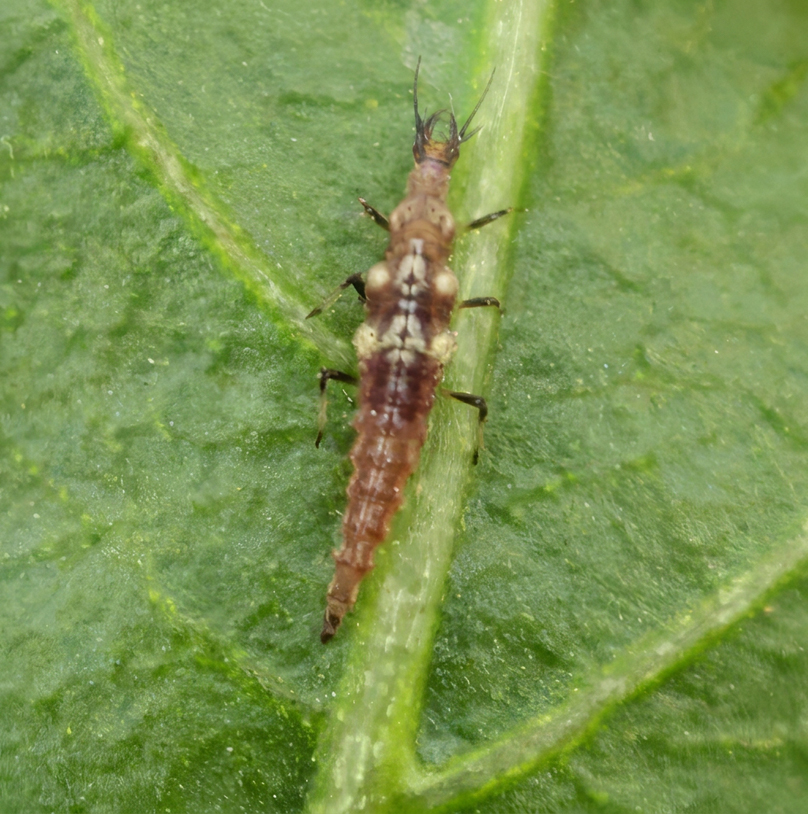 A Green lacewing larva.
However, the commercial availability of biological control agents for use against citrus mealybugs is currently limited. For example, Leptomastix dactylopii is no longer commercially available. The parasitoid Anagyrus vladimiri (formerly Anagyrus pseudococci), is commercially available from several biological control suppliers, including BioBee (BioAnagyrus), Biobest (Anagyrus-System) and Koppert (Citripar). However, products can only be purchased for use in California.
Increased availability of biological control agents would provide greenhouse producers with additional management options to maintain citrus mealybug populations below plant-damaging levels. Biological control of the citrus mealybug, as well as other mealybug species, can be a challenge because the water-repellent covering and waxy protrusions surrounding the body protects mealybugs from biological control agents.
In addition, citrus mealybugs feed in concealed areas on plants, which protects them from being attacked or fed upon by parasitoids or predators. Furthermore, biological control agents generally do not maintain mealybug populations below plant-damaging levels, which may be associated with greenhouse temperatures that are either above or below the optimal activity range of biological control agents.

Explore the September 2026 Issue
Check out more from this issue and find your next story to read.
Latest from Greenhouse Management
- The Growth Industry Episode 17: Investing in IGCs with WorryFree® Plants
- New UF study sheds light on the hidden toll of back pain among horticulture workers
- 2026 Irrigation and Automation Market Report: Tradition rains
- Empowering the Future of Precision Cultivation: Resource Efficiency, Root-Zone Science and Scalable Automation
- Oasis Grower Solutions hires plant scientist Timothy Frey
- New green industry leadership development program for women now available
- Clean production protocol
- Jiffy hosting Microgreens Grower Day