Growing up, one of the questions that followed me most was, “Can you talk?”
In school, I was quiet — the kind of kid who preferred to observe rather than raise my hand or jump into conversations. At home, I was a different girl: more boisterous and opinionated, the mischievous counterpart to my younger sister’s goodie-two-shoes. But under the pressures of school, I hadn’t yet found the confidence to be that version of myself. My silence became a running joke.
My first earnest attempt at finding my voice was also my first step toward journalism: the morning announcements on my school’s TV broadcast. In seventh grade, I raised a shaky hand and volunteered to be an anchor. At first, my voice trembled, and some mornings I woke up with a nervous pit already churning in my stomach. Even so, I agreed to a new segment called “Word of the Week.” The assignment: act out vocabulary words for classmates to add to their lexicon.
The next thing my classmates knew, I was rolling into frame decked out in a trench coat and shades, muttering into a walkie-talkie, acting out the word “incognito” while the “Mission: Impossible” theme blasted from my boombox. While I by no means transformed into the class chatterbox, I never heard my least-favorite question from classmates again.
Those early experiences didn’t magically transform me into a confident speaker. Finding my voice has been a lifelong endeavor — one that’s required repeatedly putting myself in situations that felt uncomfortable at first.
With practice, speaking up starts to feel less like an obstacle and more like an opportunity — or just plain fun. I still surprise myself, like last summer when the annual AFDO conference kicked off with live band karaoke and I ended up on stage belting out my rendition of Eurythmics’ “Sweet Dreams.” No, I will not be providing the video footage.
A session I attended at last year’s Food Safety Summit helped connect this idea directly to food safety. The discussion focused on confident communication and the role women’s voices play in leadership. The room was packed, and the message was clear: Speaking up isn’t just a leadership issue. It’s a food safety imperative.
Food safety and quality assurance professionals work at the intersection of production pressures, regulatory requirements and business priorities. Raising a concern, asking a hard question or slowing down a decision long enough to examine risk can feel uncomfortable in the moment, but prevention often starts with one voice. Food safety culture teaches us that failures often happen when concerns aren’t raised, questions aren’t asked or expertise doesn’t shape the decision.
In this issue, we explore how women are strengthening food safety systems through leadership, communication and community. Their stories show what happens when more voices are heard and people have the confidence to use them.
For me, that journey started with a trench coat and a school broadcast. It’s continued ever since. Finding your voice isn’t about becoming the loudest person in the room. Sometimes, it starts with a simple act — raising your hand, asking a question or sharing an idea — and grows into the confidence to speak up when it truly matters.
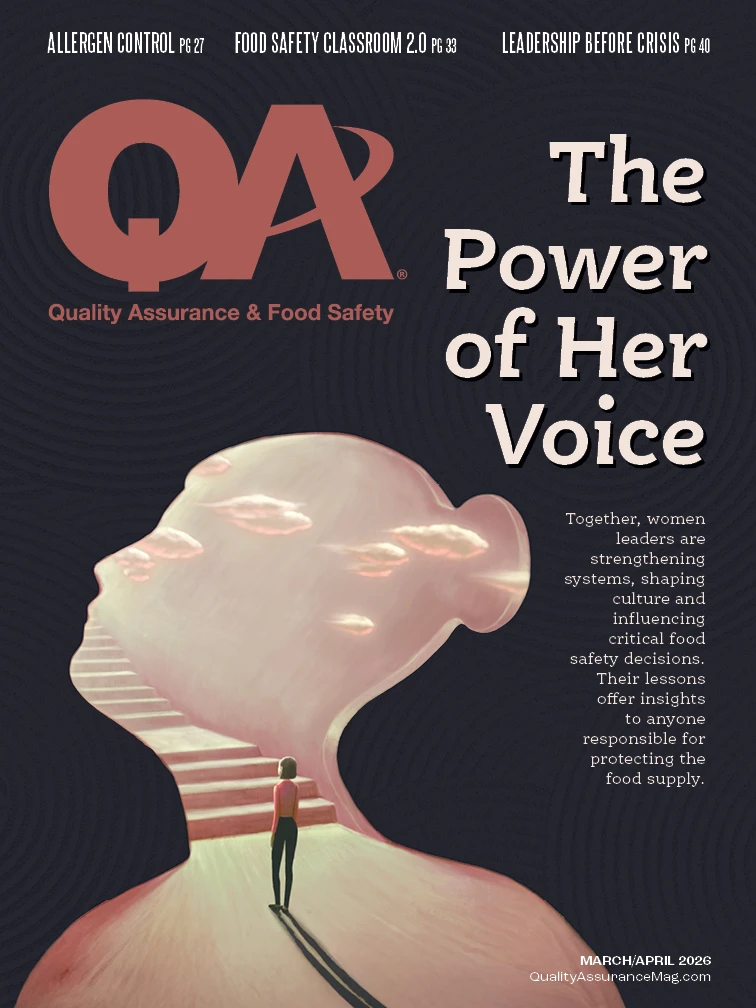
Explore the March/April 2026 Issue
Check out more from this issue and find your next story to read.
Latest from Quality Assurance & Food Safety
- Taylor Farms Removes Iceberg Lettuce Sourced from Mexico Amid Cyclospora Outbreak
- FDA, CDC Tie Multistate Cyclospora Outbreak to Taco Bell Lettuce
- BCG and CGF Release New Report on AI Usage by CPG and Retail Companies
- IntelliAM AI Launches Industrial Intelligence Platform
- QA Virtual Conference to Explore Pest Control Strategies for Food Facilities
- Meat and Poultry Companies Adopt Product of USA Label
- Klobuchar Urges CDC, FDA to Restore Food Safety Funding as Cyclosporiasis Cases Rise
- International Experts Share New Scientific Advice to Support Global Food Safety at 102nd JECFA Meeting