Major problems rarely appear out of nowhere.
Often, the warning signs are already there: the scratch at the back of your throat that turns into full-blown illness, the hairline crack slowly creeping up a wall, the red flags ignored early on in a relationship or the sudden drop in temperature that precedes a violent storm.
In food safety, warning signs are tucked into service reports, buried in trend data, noted in corrective actions or hidden in small irregularities that do not yet feel urgent.
The challenge is that these signals are not always dramatic at first.
A single rodent sighting may not seem alarming on its own. Neither does a recurring recommendation in a pest control report or a slight uptick in activity near a loading dock. But patterns have a way of revealing themselves over time — if someone is paying close enough attention to recognize them.
That idea sits at the center of our annual pest management issue.
Our cover package — featuring the stories "How to Read a Pest Service Report and Hear What It’s Saying" and "Software-Driven Pest Control: How Digital Tools Improve Food Safety and Compliance" — explores how food facilities can use technology, software and stronger interpretation of service reports to build more proactive prevention programs. Connected monitoring systems, digital reporting platforms and trend analysis tools give facilities more visibility into what is happening inside operations than ever before.
But visibility alone is not enough.
Data only matters if it leads to action. A service report filed away unread does little to improve food safety. The real value comes from understanding what the information is trying to say: where vulnerabilities are emerging, which issues are repeating and what small signals may point to larger risks developing beneath the surface.
Food safety professionals understand something the public rarely sees: Prevention rarely looks dramatic in real time.
That theme extends into this issue’s coverage of recall management through the lens of the recent Raw Farm E. coli outbreak. The situation raised difficult questions about evidence, regulatory authority and how companies and agencies respond when warning signs emerge, but uncertainty remains.
Those decisions are rarely simple. Food safety professionals are often asked to make difficult calls before every question has a clear answer, balancing operational realities with the responsibility to act quickly when risks arise.
One idea I’ve heard lately from food safety professionals is that prevention often depends on being willing to speak up before every answer is available. Sometimes the warning signs are incomplete, the data is still developing and a concern feels too small to justify sounding the alarm, but food safety failures rarely begin with a single catastrophic moment. More often, they emerge gradually.
Long before a recall or outbreak becomes national news, there are usually indicators: subtle shifts, recurring findings, inconsistencies or overlooked details that suggest something is amiss. The facilities best positioned to prevent larger failures are the ones willing to take those small signals seriously before they become impossible to ignore.
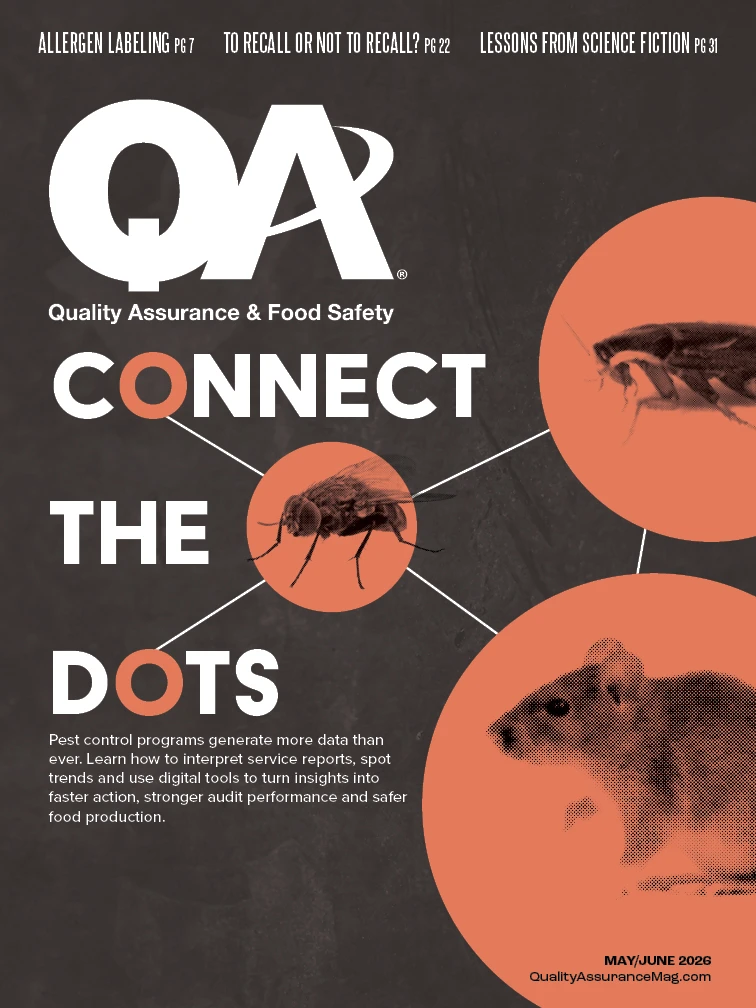
Explore the May/June 2026 Issue
Check out more from this issue and find your next story to read.
Latest from Quality Assurance & Food Safety
- Taylor Farms Removes Iceberg Lettuce Sourced from Mexico Amid Cyclospora Outbreak
- FDA, CDC Tie Multistate Cyclospora Outbreak to Taco Bell Lettuce
- BCG and CGF Release New Report on AI Usage by CPG and Retail Companies
- IntelliAM AI Launches Industrial Intelligence Platform
- QA Virtual Conference to Explore Pest Control Strategies for Food Facilities
- Meat and Poultry Companies Adopt Product of USA Label
- Klobuchar Urges CDC, FDA to Restore Food Safety Funding as Cyclosporiasis Cases Rise
- International Experts Share New Scientific Advice to Support Global Food Safety at 102nd JECFA Meeting