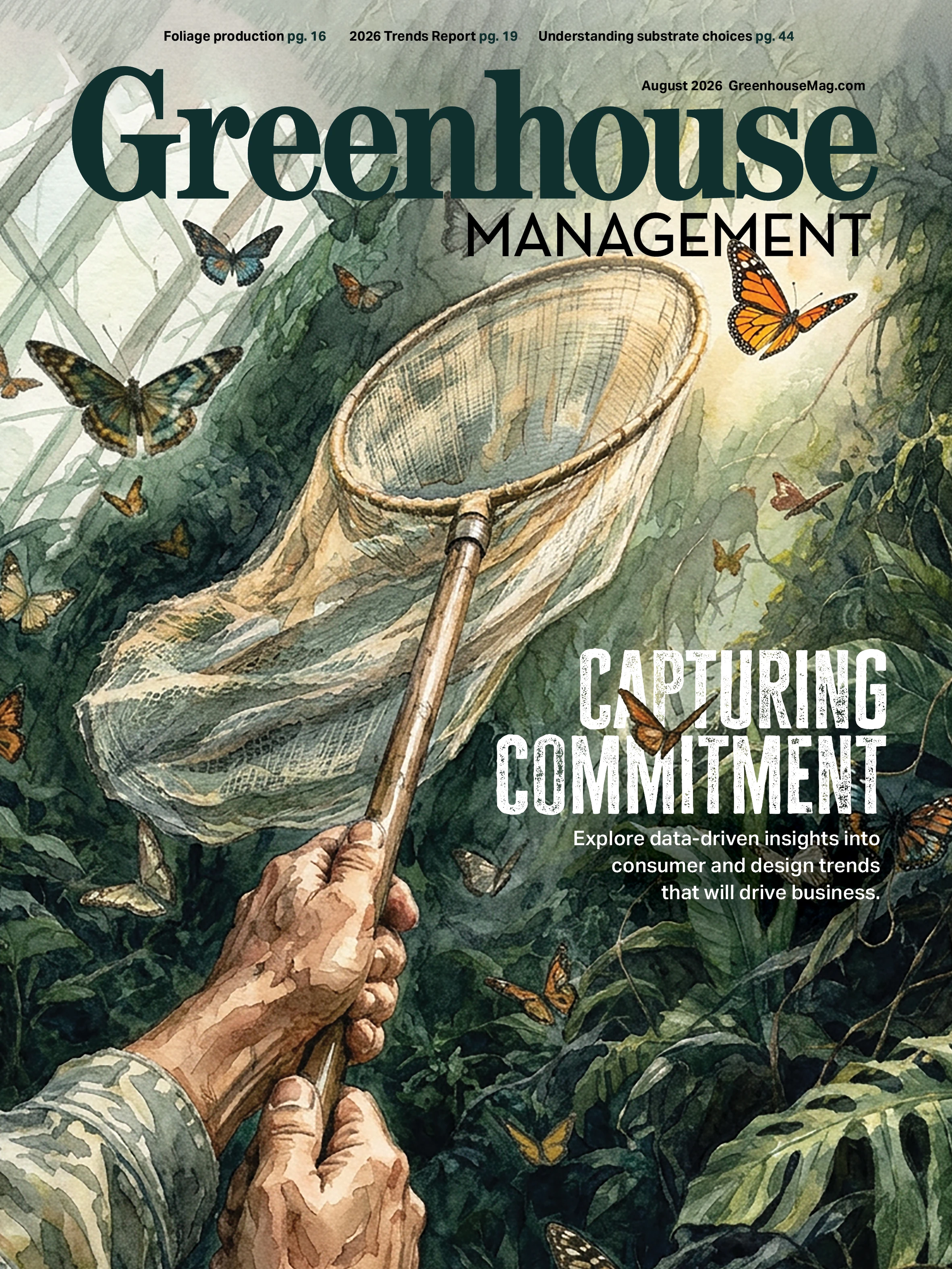
Editor's Note: This article originally appeared in the August 2026 print edition of Greenhouse Management under the headline “Capturing commitment.”

It’s time for the horticultural industry to face a cold, hard fact:
The boom times have ended. The world has changed. Offices have been clawing back work-from-home time. Inflationary pressures and a logistics-choking Iran war have made everything more expensive. The trend of new garden consumers has slowed, and familiar stalwarts are dropping out.
That’s the essential story of the National Gardening Association’s 2026 National Gardening Survey. The annual survey conducted earlier this year by Garden Research, the research division of the National Gardening Association, surveyed 2,491 individuals on their lawn and garden-related activities and associated spending.
At the core of the report is a paradox: Spending is up, but participation is down. That’s an outcome that Garden Research Executive Director Dave Whitinger says he doesn’t think the organization has seen in the past 50 years.
“Every year, we’re either popping the champagne cork or saying it’s a bummer that we lost,” Whitinger says. “This year, it’s like, well, which is it? Do we celebrate or not? And I think the answer is this is not a year of celebration. It’s a year of reduced participation. And then you see why they’re spending more money. The answer is it costs more. They’re paying more money, and they’re getting less for the same amount.”
In a time of declining participation and high costs, it’s important for the industry to capture the committed gardeners that have remained both in the stores and in their gardens. The path to success is in knowing exactly who the consumer is and what trends are driving their purchasing behavior.

Lifting the barbell
Economic pressures don’t hit all consumers in the same way, and increasing costs don’t necessarily result in predictable consumer behaviors. The survey reveals the complicated financial reality for garden consumers has led some populations to retreat more than others.
More gardening activities were noted among married homeowners annually earning under $25,000 and between $35,000 and $74,999, as well as as those earning over $200,000. Unmarried people, renters and households in the $50,000 to $74,999 and $100,000 to $199,999 income brackets saw “a substantial decrease in participation.”
The result is a barbell-shaped consumer base, with lower-income and higher-income brackets seeing higher participation in gardening activities, while the middle class essentially drops out. It’s a demographic shift that Whitinger says should be particularly clarifying.
“Businesses, now’s the time to decide,” Whitinger says. “We can’t shoot for the middle anymore. We need to choose which way we’re going to go as business owners.”
The imperative to know your customer is even stronger now because it relates directly to pricing. Do you cater to high-end clientele who are looking for the best products and who can absorb increased costs? Is your community affluent enough to drive that kind of business forward, or do you seek out an opportunity to plant your flag in affordability? Do you offer low cost and high volume for gardeners on a budget that simply want less expensive plants, seeds and bulbs?
"Businesses, now’s the time to decide. We can’t shoot for the middle anymore. We need to choose which way we’re going to go as business owners." -Dave Whitinger, Garden Research
Inflation nation
The increased cost of everything is likely one of the many causes middle-income gardeners have been exiting their hobby. Squeezed as they are from all sides, they are looking for places to cut, and a pretty garden simply doesn’t make as much sense as it did in the past.
There are other reasons, of course, like increased demands on their time in a post-COVID, return-to-office world.
But inflation is important beyond changing consumer behaviors. It also complicates the horticulture industry’s ability to know where the money is actually being spent. Without controlling for inflation, it would appear as if every plant category or garden and lawn service were on an upswing.
The takeaway would naturally be that gardeners are buying and doing more. But that can’t be true, because the data show garden activities decreasing.
To see through this paradox and find the real signal, the association compared the percentage change in prices reported to them over the last five years and compared that percentage to the inflation rate reported by the U.S. Bureau of Labor Statistics for the relevant category. Growth above the inflationary threshold was considered “real,” while a percentage of growth below the threshold was considered a decline.
After clearing away the obfuscating influence of inflation, true growth was revealed in some critical product categories: herbs, berries, fruit trees and vegetables. And the distinct edible theme makes sense to Whitinger.
“During COVID, people started growing things to eat because they were home. They wanted something to do. It was a health thing for a lot of them,” he says. “I think a lot of that is still there, but I do think that inflation is a huge part of the reason to grow things. I mean, the reality is vegetables in the store are the most expensive food you can buy aside from beef. So, every tomato that you grow yourself is a tomato that you’re not having to buy at the grocery store.”
Southern exposure
As horticultural businesses contend with the gardeners who are laying their trowels aside, it’s important for them to focus on the gardeners who are still planting and those who are growing their own patch for the first time. To that end, the survey uncovered some important demographic shifts.
When looking at the individuals who started gardening for the first time in 2025, a majority were female (59% compared to 46% in 2024). They were also likely to be in areas where there are fewer seasonal barriers to gardening, with 37% in Southern regions and 30% in Western regions. Finally, a meaningful percentage (34%) were Hispanic, compared to those identifying as white (31%), which saw a fall from 41% in 2024.
The important consumer to focus on in upcoming years? More often, they are female, Hispanic and from warmer climes.
“I think a lot of people want to see things in their own language. I think that there are cultural differences,” says Whitinger. “If I had a garden center here where I live in the Dallas-Fort Worth area, I would hire Hispanics to work up front and engage customers directly. I would be looking for the influencers that are using the Spanish language, and I’d be paying them to promote my shop.”
More from the 2026 Trends Report:
The gardener who stayed: Are white, middle-aged women still gardening?
A seat at the table: Why are gardeners purchasing more edible plants in 2026?
Beyond translation: How Hispanic culture influences horticulture industry marketing
Dopamine digging: The Garden Media Group's 2027 Garden Trends Report
2026 RHS Chelsea Flower Show: 6 trends and takeaways from the RHS Chelsea Flower Show 2026
Explore the August 2026 Issue
Check out more from this issue and find your next story to read.
Latest from Greenhouse Management
- The Growth Industry Episode 17: Investing in IGCs with WorryFree® Plants
- New UF study sheds light on the hidden toll of back pain among horticulture workers
- 2026 Irrigation and Automation Market Report: Tradition rains
- Empowering the Future of Precision Cultivation: Resource Efficiency, Root-Zone Science and Scalable Automation
- Oasis Grower Solutions hires plant scientist Timothy Frey
- New green industry leadership development program for women now available
- Clean production protocol
- Jiffy hosting Microgreens Grower Day