Editor's Note: This article originally appeared in the September 2026 print edition of Greenhouse Management under the headline “Draw the line. Defend your crop..”
When it comes to battling persistent diseases like Botrytis, Fusarium, Rhizoctonia and powdery mildew, growers have a new line of defense: BattleLine® Fungicide from SEPRO Land.
BattleLine delivers broad-spectrum disease control through locally systemic and contact activity, protecting greenhouse crops from key foliar and root diseases that quickly reduce crop quality and marketability.
With the proven active ingredient, triflumizole, BattleLine works as a preventive and curative choice, says JC Chong, Ph.D., technical development manager of ornamentals at SEPRO Land. BattleLine offers flexible application methods, including foliar sprays, soil drenches, cutting soaks and chemigation.
Botrytis
Botrytis may cause leaf and flower spot and blights, stem cankers, damping off and cutting root rot. Left unmanaged, those symptoms can quickly affect the quality of a crop.
In a two-year trial as an early curative control where the disease was already present at application, BattleLine at 3.5 fluid ounces per 100 gallons reduced Botrytis incidence more than 75% within a week. At 4.3 fluid ounces, the reduction exceeded 80%.
Chong suggests growers follow up a week later with a second BattleLine application and then rotate to another program partner, and disease incidence will continue to drop.
Fusarium
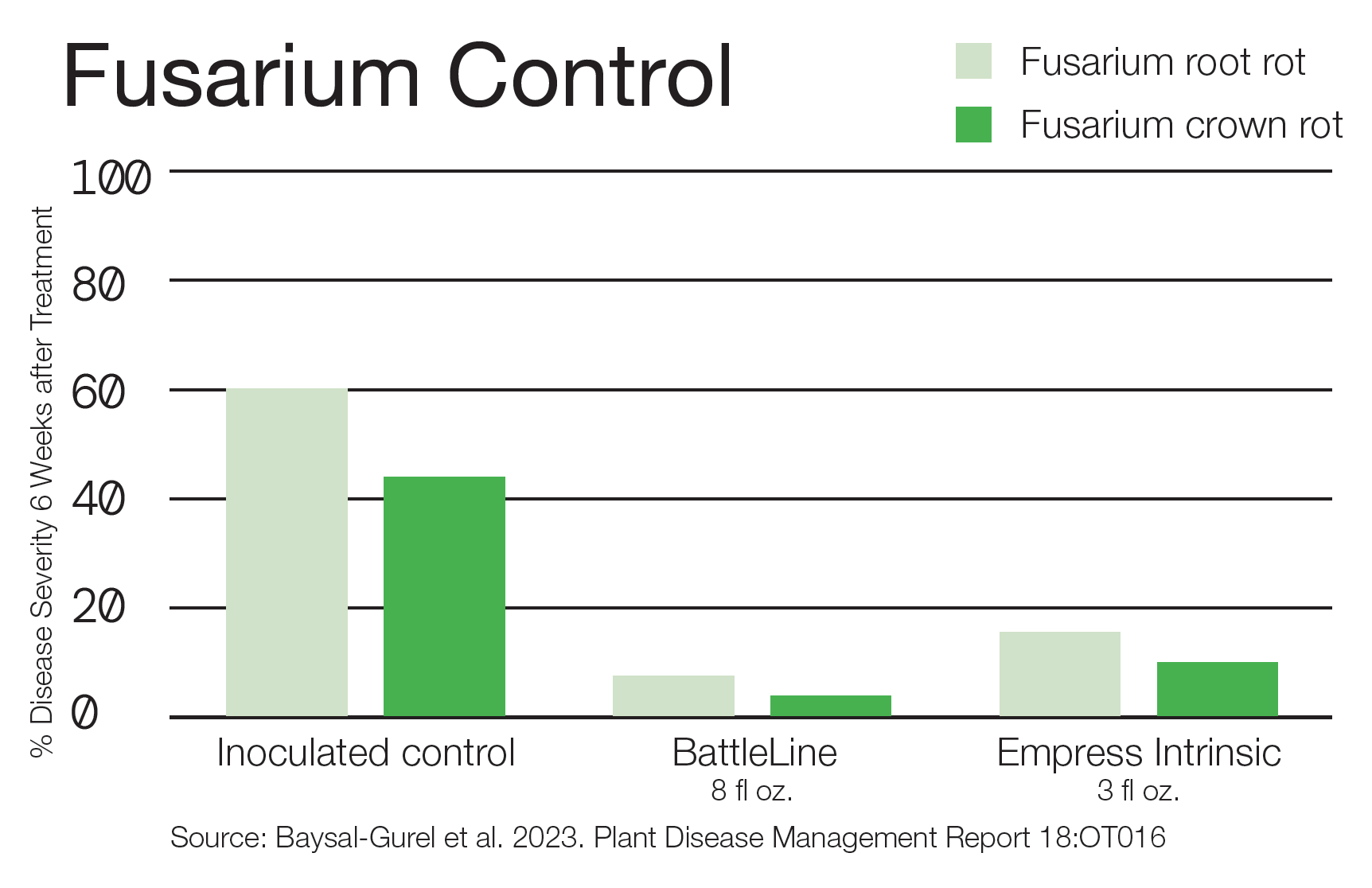
BattleLine as a drench gives growers another way to protect crops from difficult root and crown diseases. In a Tennessee trial, researchers inoculated oakleaf hydrangea with Fusarium and applied BattleLine at 8 fluid ounces per 100 gallons.
Above ground, more than 70% of inoculated control plants developed crown rot symptoms, while fewer than 2% of BattleLine-treated plants showed symptoms. Below ground, root rot infection reached 60% in the control plants versus roughly 8% with BattleLine.
On mums, Fusarium can become especially problematic when plants are stressed by excessive temperatures or fertilizer salt buildup, which can create an opening for the pathogen. Chong suggests drenching early, before symptoms appear, to get BattleLine into the root zone.
For growers going in curatively, a single BattleLine drench protects plants for roughly two to four weeks, and Chong suggests a second drench at two weeks. “After the second drench, growers can use another product in the rotation program,” he explains.
Powdery mildew
Powdery mildew is another formidable disease, and BattleLine’s label extends beyond ornamentals to greenhouse tomatoes and cucumbers, including transplants. That can be especially useful for operations producing vegetable starts in the spring.
In a greenhouse cucumber trial, inoculated control plants reached 63% disease incidence. BattleLine applications at the 8 fluid ounce per 100-gallon rate dropped it to less than 0.1%.
“BattleLine is an extremely effective product against powdery mildew. And the data from this trial was generated on cucumber, but it’s definitely translatable to ornamentals,” Chong says.
The chemistry behind the AI
BattleLine is a FRAC 3 fungicide, and FRAC 3 fungicides carry a reputation for growth regulation. Chong tested BattleLine across 14 species as a spray and a plug dip against other FRAC 3 fungicides. He found Banner Maxx stunted pansy, SunPatiens and vinca, and it reduced flowering on impatiens. However, BattleLine produced no stunting, even at 8 fluid ounces, he says. With any product, he recommends growers conduct their own trial.
“Most FRAC 3 fungicides are triazoles, the class behind many commercial PGRs like Topflor, A-Rest and Sumagic. But BattleLine is an imidazole and has extremely weak plant growth regulating effects,” Chong explains. “So weak that no commercial PGR product has been developed from that particular class. BattleLine is very safe for a lot of bedding plants.”
By combining broad-spectrum disease control, multiple application options, strong crop safety and a fit within resistance-management programs, BattleLine gives growers another tool to protect crop quality, and ultimately protect the value of every plant moving toward market.
For trial charts and season-long rotation programs, visit battlelinefungicide.com.

Explore the September 2026 Issue
Check out more from this issue and find your next story to read.
Latest from Greenhouse Management
- The Growth Industry Episode 17: Investing in IGCs with WorryFree® Plants
- New UF study sheds light on the hidden toll of back pain among horticulture workers
- 2026 Irrigation and Automation Market Report: Tradition rains
- Empowering the Future of Precision Cultivation: Resource Efficiency, Root-Zone Science and Scalable Automation
- Oasis Grower Solutions hires plant scientist Timothy Frey
- New green industry leadership development program for women now available
- Clean production protocol
- Jiffy hosting Microgreens Grower Day