Mark Leichty

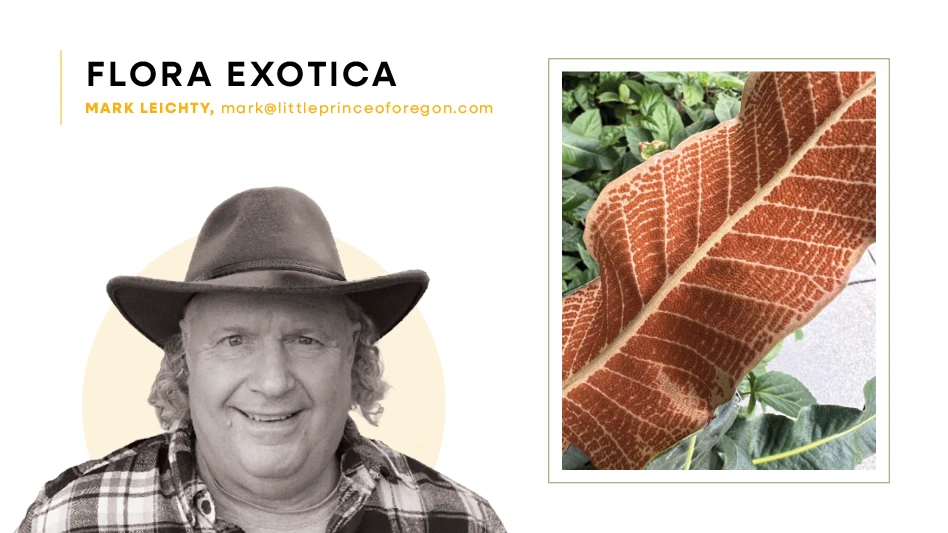
I was driving past the The Spheres in Seattle recently and recalled that there are beautiful plantings of Pyrrosia sheareri outside the spheres. I drove around the block once with my camera, then parked directly in front of the main entrance, in what was possibly a fire lane. It was a quick in-and-out operation, lasting only about two minutes, and I ended up walking away with some amazing photographs.
Pyrrosia is a widespread group of epiphytic ferns, ranging from Africa through Asia and into the Pacific. The name Pyrrosia comes from the Greek word Pyrrohs, meaning red, and refers to the red sporangia on the undersides of the fronds. These are not delicate, woodland ferns. Instead, they occupy exposed positions on tree trunks and cliffs where moisture is intermittent and conditions can turn harsh in a hurry. Their defining feature is a dense covering of fine hairs on the fronds, giving them a soft, sometimes silvery cast. This felt-like surface serves a practical purpose, helping the plant conserve moisture and reflect excess light. It is a simple but effective strategy, and one that allows Pyrrosia to persist where less adaptable species would quickly give up.

Among the many species, Pyrrosia sheareri stands out as a bit of a quiet gem. Native to the humid forests of Southeast Asia, it grows as an epiphyte, slowly spreading along branches by means of creeping rhizomes. It is not a plant you’re likely to encounter often, which makes coming across it even more rewarding. It is hardy in USDA Zones 7-10. The fronds are simple, elongated and covered in that characteristic fine indumentum, giving them a subdued, almost matte finish. There is no bold display here, just a plant perfectly suited to its niche.
In cultivation, P. sheareri proves to be more accommodating than its understated appearance might suggest. It does best in bright, filtered light with good air movement and moderate humidity. Like many epiphytes, it is far more tolerant of drying out than of excessive moisture. Once established, it asks for very little. I suppose that’s part of the appeal. Plants like Pyrrosia sheareri don’t demand attention in the way more flamboyant species do, but they reward those who take the time to notice them.

Explore the May 2026 Issue
Check out more from this issue and find your next story to read.
Latest from Nursery Management
- The Growth Industry Episode 14: Meet Lionel van der Walt, AmericanHort's new CEO
- Growers and suppliers say BFG Supply Co. will close
- Stemmer from BioWorks
- BioWorks introduces Stemmer silicon-based plant health solution
- Silver Fern awarded grant to expand AI-powered demand planning for greenhouse, nursery growers
- All-America Selections announces first three new AAS Winners for 2027
- 2026 Special Recognition Award recipients announced at PPA National Symposium
- [WATCH] July issue recap