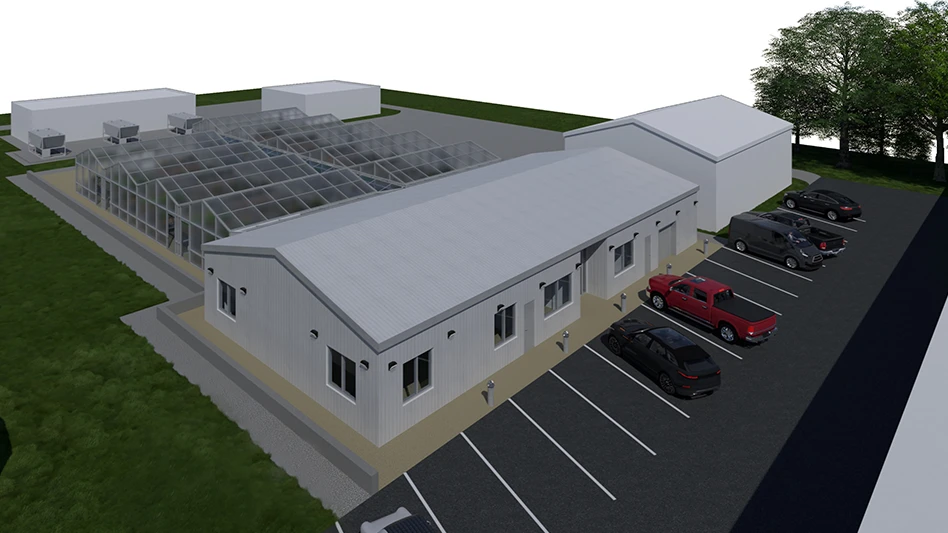
Photo © Bob's Market & Greenhouses
For more than 50 years, Bob’s Market & Greenhouses has been a fixture on the banks of the Ohio River, sitting on the western edge of West Virginia in Mason.
Founded by Bob Barnitz and his wife Corena, the family business has grown through three generations from a local produce grower into a diversified operation with 25 acres of greenhouses and 5 acres of outdoor production. Today, the business produces at least 700,000 finished plants annually and is one of the 10 largest wholesale seedling producers in the United States.
As the operation has expanded, so has the need to improve efficiency, consistency, and post-harvest performance — especially as shrink continues to challenge growers across the industry. Estimated at more than $500 million annually, shrink is often tied to declining plant quality at retail, pushing growers to refine both substrate and fertility strategies.
In 2019, Bob’s Market began working with Profile Products to trial HydraFiber as an alternative component to replace perlite. The engineered wood fiber-based component, typically blended with peat at 30% to 40%, is designed to improve air porosity and water availability while reducing overall input costs. This supports stronger root development and maintains stable moisture levels.
The team quickly saw the advantages. The highly compressed fibers improved shipping and storage efficiency, while the physical properties of the mix allowed for less frequent irrigation and greater margins for incidental under- or over-watering.
By 2021, Bob’s Market had transitioned most major crops — including ferns, mums, poinsettias and hanging baskets — to HydraFiber-based mixes. Following Profile Products’ acquisition of Florikan that same year, the team began exploring additional opportunities to refine its nutrition program through controlled-release fertilizers, which Bob’s soon incorporated into their fern and mum crops in 2022.
Bob’s Market’s shift reflects a broader trend in the industry, where controlled-release fertilizer (CRF) programs are increasingly viewed as a complement or replacement for more traditional water-soluble fertilizer (WSF) systems.
Florikan fertilizers, like Nutricote or Gal-Xe One, are applied in a single application, directly to the soil, and release nutrients gradually through coated prills, continually delivering macro- and micro-nutrients to the root zone. This microdosing approach reduces nutrient loss between containers. It also limits leaching during irrigation and provides more consistent EC in growing media.
For growers, the operational benefits are significant. CRF programs require less labor, reduce equipment maintenance, and eliminate concerns over missed applications or fertilizer washout during heavy irrigation. Less total nitrogen is typically required, and the risk of plant damage from feeding fluctuations is minimized.
At Bob’s Market, those advantages translated quickly into improved workflow and crop performance.
“Using a controlled-release fertilizer means less tank mixing of liquid feed,” noted four-year veteran grower Ashley Riffle. “It frees us up to focus on other things and takes away so much of the pressure.”
“We hardly fed our mums this season, and the mums stayed green,” added Shaya Russell, who has spent the past five years as a grower for Bob’s Market. “With the high temperatures this summer, we used more water with less supplemental liquid feed, and we did not see any yellowing.”
The team currently uses a CRF with Gal-Xe One 17-5-11 180-day duration, initially trialed in ferns and is now incorporated into mum production at a rate of 5 pounds per cubic yard. Additional trials are underway in hanging baskets.
The combination of HydraFiber and CRFs also reflects findings from ongoing research trials evaluating plant performance and shelf life. Studies using popular annual and perennial crops — including calibrachoa, pansy, impatiens, geranium, lantana and vinca — have compared HydraFiber mixes with CRF rates ranging from 2 to 8 pounds per cubic yard against standard continuous WSF programs based on delivery of 125 ppm nitrogen.
In those trials, plants grown in HydraFiber wood fiber and Nutricote CRF-amended growing media showed improved rooting, provided more stable media pH and electrical conductivity or salt levels, and reduced mineral nutrient leaching from the container. Because nutrients remain in the root zone, plants experience less stress and develop more uniform growth.
Equally important is performance after plants leave the greenhouse. Once retail-ready, trial crops are irrigated with clear water to simulate store and consumer conditions. Under these conditions, plants grown with Nutricote maintain higher nutrient levels in leaf tissue, improved foliar color and better overall visual quality. These attributes reduce shrink and help with sell-through rates.
“The main goal of the trials is to evaluate Profile’s technology, HydraFiber and Nutricote [as a system], to produce plants that maintain a high level of quality in the retail space and help reduce losses for growers,” said Brandon White, an applied R&D scientist with Profile Growing Solutions.
“Shelf life has always been difficult to measure, and many times has been limited to simply looking at the plants to see if they were attractive or not,” White continued. “But in our trials, we wanted to take that measurement a step further and assess quality data like nitrogen levels in the leaf tissue, track [growing media] pH and electrical conductivity, use photography and implement a qualitative rating scale for plant health to get a better sense of the impact the HydraFiber and Nutricote media [system] is having at different stages of the growth cycle.”
To date, results indicate higher foliar nutrient levels, better foliar tone and flower color, and improved visual quality in plants grown with the combination HydraFiber and CRF-amended growing media, particularly as post-production time increases. These improvements contribute to better sell-through at retail and a stronger bottom line for growers.
At Bob’s Market, these gains are especially valuable as labor constraints continue to impact operations. The company employs more than 100 full-time employees and 100 seasonal workers, yet efficiency remains a constant focus.
“Growers have to continue to find ways to do things more efficiently and to automate more processes because it’s so hard to find labor,” Barnitz said. “HydraFiber and Gal-Xe One help so much because we’re checking pH and EC a lot less often. We’re able to get plants to re-hydrate if an irrigation cycle is missed . . . This all helps so much when you have limited hours in the day.”
Recommended rates for the CRF vary depending on crop and production system, but 4 to 8 pounds per cubic yard is common for many annual and perennial crops, with lower rates used when transitioning from constant liquid feed programs and higher controlled release fertilizer rates under more demanding conditions.
Growers or blenders interested in learning more and starting HydraFiber and Nutricote (CRF) trials can visit profilegrowing.com or contact Profile Growing Solutions at growing@profileproducts.com or 800-496-0955.
Latest from Greenhouse Management
- The Growth Industry Episode 17: Investing in IGCs with WorryFree® Plants
- New UF study sheds light on the hidden toll of back pain among horticulture workers
- 2026 Irrigation and Automation Market Report: Tradition rains
- Empowering the Future of Precision Cultivation: Resource Efficiency, Root-Zone Science and Scalable Automation
- Oasis Grower Solutions hires plant scientist Timothy Frey
- New green industry leadership development program for women now available
- Clean production protocol
- Jiffy hosting Microgreens Grower Day