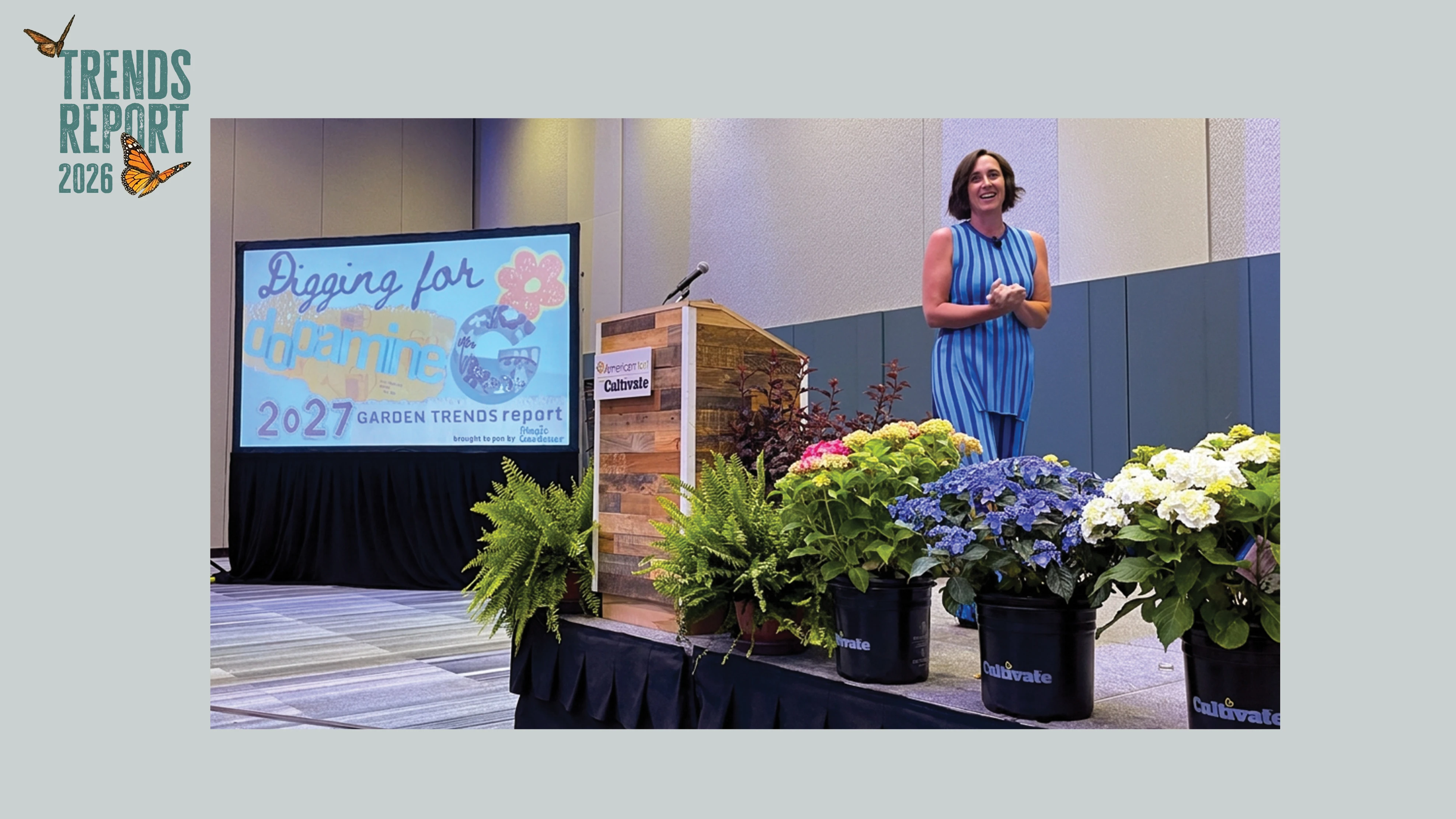
Photo © Anthony Elder
Each year, the AmericanHort State of the Industry address at Cultivate'26 offers a snapshot of where the green industry stands — and where it may be headed next.
This year's session featured AmericanHort Chief Economist Charlie Hall, who examined the industry's economic performance, followed by AmericanHort Vice President of Advocacy and Government Affairs Matt Mika, who outlined the organization's priorities on Capitol Hill.
Here are eight takeaways from the keynote session.
AmericanHort Chief Economist Charlie Hall on the 2026 economy for horticulture
1. Don't judge 2026 by year-over-year comparisons alone
Hall's first message was one of perspective. Although many growers experienced only modest gains this spring, he cautioned against relying solely on year-over-year comparisons.
"If you ask me was spring good or bad, I'll say yes," Hall says. "That's my answer."
According to Hall's benchmarking data, 81% of growers reported higher gross sales during the first half of 2026 than during the same period last year, but most increases were between 0% and 5%. More importantly, 98% of growers remain ahead of where they were in 2019.
His takeaway: "There’s mixed regional performance across all sectors in the industry. Negative comps aren't the whole story."
2. The pandemic gardening boom has proven surprisingly durable
Many economists expected demand to fall back to pre-pandemic levels once consumers resumed normal spending habits. That hasn't happened.
Hall noted that after several periods where consumer purchases appeared ready to decline, demand rebounded each time.
"We had anywhere from 18 to 20 million new gardeners during that time period," Hall says. "Apparently we've captured them, and they're still engaged."
Unit sales have continued climbing modestly alongside revenue, suggesting consumers are buying more plants — not simply paying higher prices.
Rather than booming or declining, Hall described the market as "moving sideways" while maintaining an elevated plateau.
3. Managing costs is becoming more important than chasing growth
Hall acknowledged that growers continue facing pressure from labor costs, tariffs and other inputs despite generally healthy sales.
His advice was practical.
"We've got to sharpen the pencil," Hall says. "We have to find those operational efficiencies and manage our cost structure."
He also encouraged growers to evaluate their product mix through SKU rationalization rather than relying on across-the-board price increases to recover higher costs.
4. Know why customers buy from you
Hall closed his presentation by emphasizing that customer relationships will become an increasingly valuable competitive advantage.
"You got to know your value proposition," Hall says. "What is it that's different about you that's different from everyone else that's growing and installing and servicing flowers, shrubs and trees around the country?"
He encouraged businesses to better utilize customer analytics while promoting one message consumers increasingly value.
"We have to, as an industry, continue blowing our own horn in terms of the health and well-being benefits that we bring."
His final slide summarized the message succinctly: "Customer analytics are critical. Focus on your value proposition. Be agile. Manage relationships."
AmericanHort's advocacy priorities: Matt Mika's political takeaways
While Hall focused on economics, Mika shifted the conversation toward Washington, emphasizing that the industry's future depends on growers becoming active advocates.
5. If growers don't speak up, someone else will
Mika repeatedly encouraged attendees to build relationships with elected officials before legislation directly affects their businesses.
"You all got to get engaged," he says. "You all got to show up."
His advice extended beyond visits to Washington.
"You got to tell your story," Mika says, encouraging growers to invite members of Congress and local officials to tour their operations and better understand the industry's workforce and supply chain challenges.
He reinforced the point with one memorable line from his team: "If you're not at the dinner table, you're on the menu."
6. Labor reform remains the industry's biggest legislative priority
When Mika asked attendees about the biggest challenge facing horticulture, the answer came quickly.
"Labor, labor, labor," he says.
He noted that labor now accounts for roughly 44% of growers' input costs and highlighted AmericanHort's work supporting legislation that would modernize and simplify the H-2A program.
"We need everyone in the room to sign up," Mika said of AmericanHort's VoterVoice advocacy platform. "We want to get as many folks out there because they need to hear how important this is."
7. The Farm Bill presents a major opportunity for horticulture
Mika called the current proposal "the most horticulture specialty crop Farm Bill ever."
He pointed to increased specialty crop research funding, expanded advisory representation and other provisions that reflect years of advocacy by growers and industry organizations.
"You have a voice," Mika reminded attendees. "Use that voice. Come talk to us."
(Note: The House passed its version of the Farm Bill in April 2026. The Senate Agriculture Committee released its Farm Bill draft in June 2026. Once the Senate passes its version, the House and Senate Agriculture Committees will meet for a conference committee to reconcile any differences between the two bills.)
8. AmericanHort's success depends on member participation
Mika concluded by reminding attendees that advocacy is most effective when growers remain engaged year-round.
"If you have a problem, reach out to us, let us know," he says. "We want to be as helpful as we can."
He encouraged businesses to become involved through AmericanHort membership, state associations, Capitol Hill fly-ins and the organization's advocacy campaigns.
Ultimately, Mika argued that growers themselves are the industry's most effective advocates. Legislators can only understand horticulture's economic impact, workforce needs and regulatory challenges when they hear directly from the businesses that experience them every day.
Latest from Nursery Management
- The Growth Industry Episode 14: Meet Lionel van der Walt, AmericanHort's new CEO
- Growers and suppliers say BFG Supply Co. will close
- Stemmer from BioWorks
- BioWorks introduces Stemmer silicon-based plant health solution
- Silver Fern awarded grant to expand AI-powered demand planning for greenhouse, nursery growers
- All-America Selections announces first three new AAS Winners for 2027
- 2026 Special Recognition Award recipients announced at PPA National Symposium
- [WATCH] July issue recap