Editor's Note: This article originally appeared in the October 2026 print edition of Greenhouse Management under the headline “Lighting to target.”
At Burnaby Lake Greenhouses in British Columbia, Canada, LED trials go back a long way. David Vander Ende says his uncle, Ken, has been trialing LEDs for well over 15 years.
“We’ve been trialing and using LEDs because we felt it was the inevitable future of horticultural lighting,” he says.
After trying other brands, they kept coming back to Philips LEDs.

As technology advanced significantly, Burnaby Lake began implementing Philips LEDs on a larger scale. The grower’s initial driver was a shift away from high-pressure sodium lighting.
Today, Burnaby Lake Greenhouses uses Philips LED toplighting with dimming functionality on kalanchoes, begonias, callas and tropical foliage.
The lights have created more compact growth, sped up crop time and improved plant health, especially through the darker months. Plants branch better and stay more compact, he adds, and the greenhouse uses fewer PGRs. On the 15- to 16-week crops, production time has dropped by about a week to a week and a half because of the LED performance and capabilities, he explains.
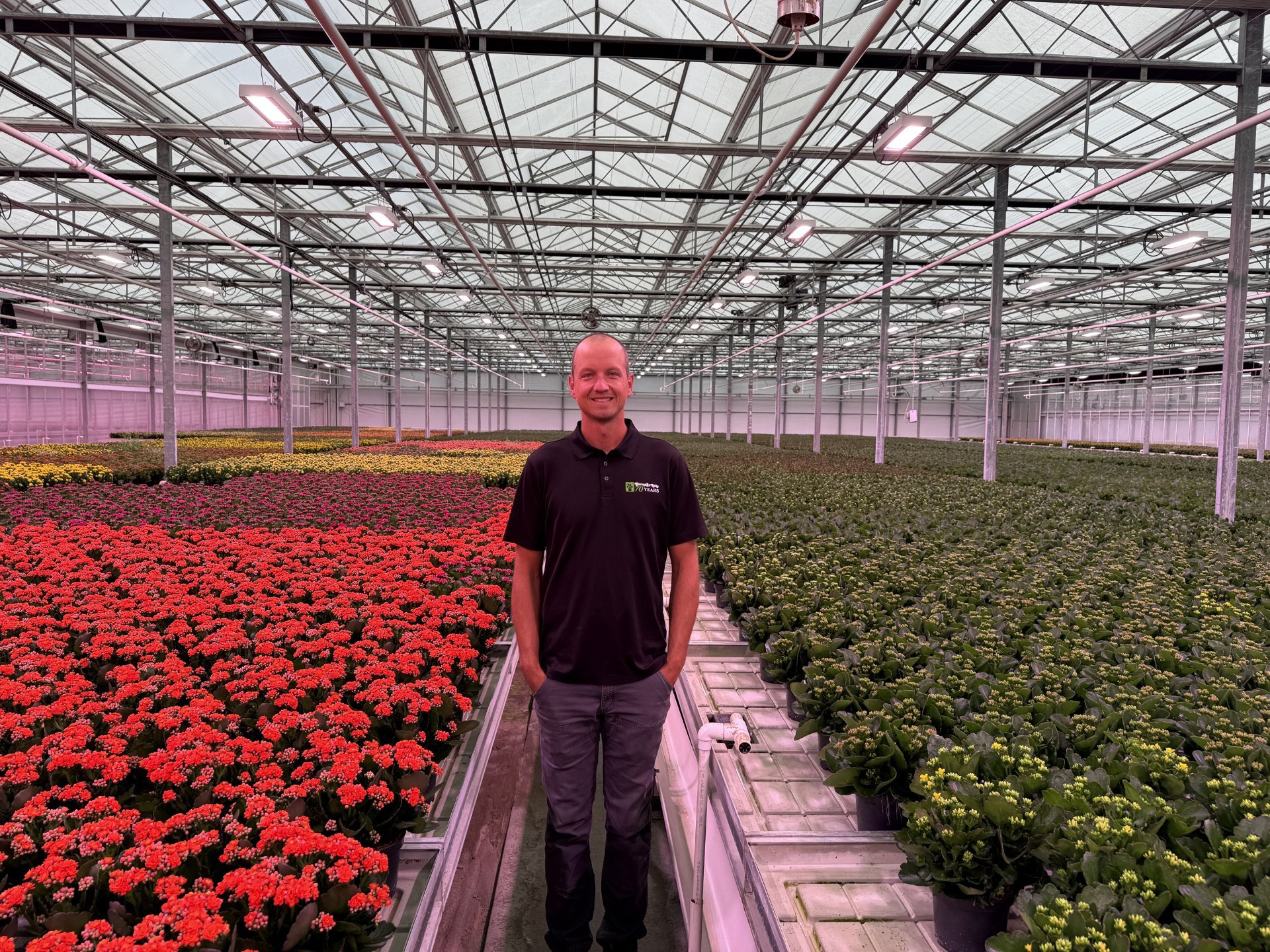
During the darker days of the year, natural light can’t reach the greenhouse’s target daily light integral, so supplemental lighting makes up the difference. That’s where Philips’ LED dimming features provide advantages.
“For some crops, we set a target daily quantity of light from natural and supplemental light combined. Our environmental control system knows those targets, as well as the daily weather forecast,” Vander Ende explains. “It uses that data to dim the lights, or turn them off early, on any given day if the target DLI will be met while it’s still bright outside. The goal is to avoid wasting electricity when outside light is adequate for the plants.”
Vander Ende says he prefers lights that are 60% to 65% red. That, coupled with Philips’ dimming technology, gives employees a better working environment during the day, and the settings can be adjusted after regular working hours.
“We understand that leaning toward a more white spectrum might not be the most efficient spectrum, but we have found a good balance between function and creating a comfortable work environment for our employees,” he says.
Next, Vander Ende plans to explore how different spectrums affect growth, since the Toplighting Force 800W fixture offers spectrum control.
After trying other brands, Burnaby Lake gravitated toward Signify for its quality product and superior support.
“Lighting is more complicated than it used to be, so partnering with a stable company that is well-equipped with support is important,” he says.
Although Vander Ende has not yet done an ROI calculation, he says the partnership with Signify has been a good investment because “they’re a quality supplier that offers a good product that is best suited for our operation.”
For growers looking to upgrade to LEDs, Vander Ende advises that there is no one-size-fits-all solution.
“Every greenhouse has different crops, operational workflows and goals. We proceed with every installation cautiously, trying to foresee issues and address them ahead of time. But we strongly believe in the future of LEDs and will continue to make a transition away from HPS,” he says.

Explore the October 2026 Issue
Check out more from this issue and find your next story to read.
Latest from Greenhouse Management
- The Growth Industry Episode 17: Investing in IGCs with WorryFree® Plants
- New UF study sheds light on the hidden toll of back pain among horticulture workers
- 2026 Irrigation and Automation Market Report: Tradition rains
- Empowering the Future of Precision Cultivation: Resource Efficiency, Root-Zone Science and Scalable Automation
- Oasis Grower Solutions hires plant scientist Timothy Frey
- New green industry leadership development program for women now available
- Clean production protocol
- Jiffy hosting Microgreens Grower Day