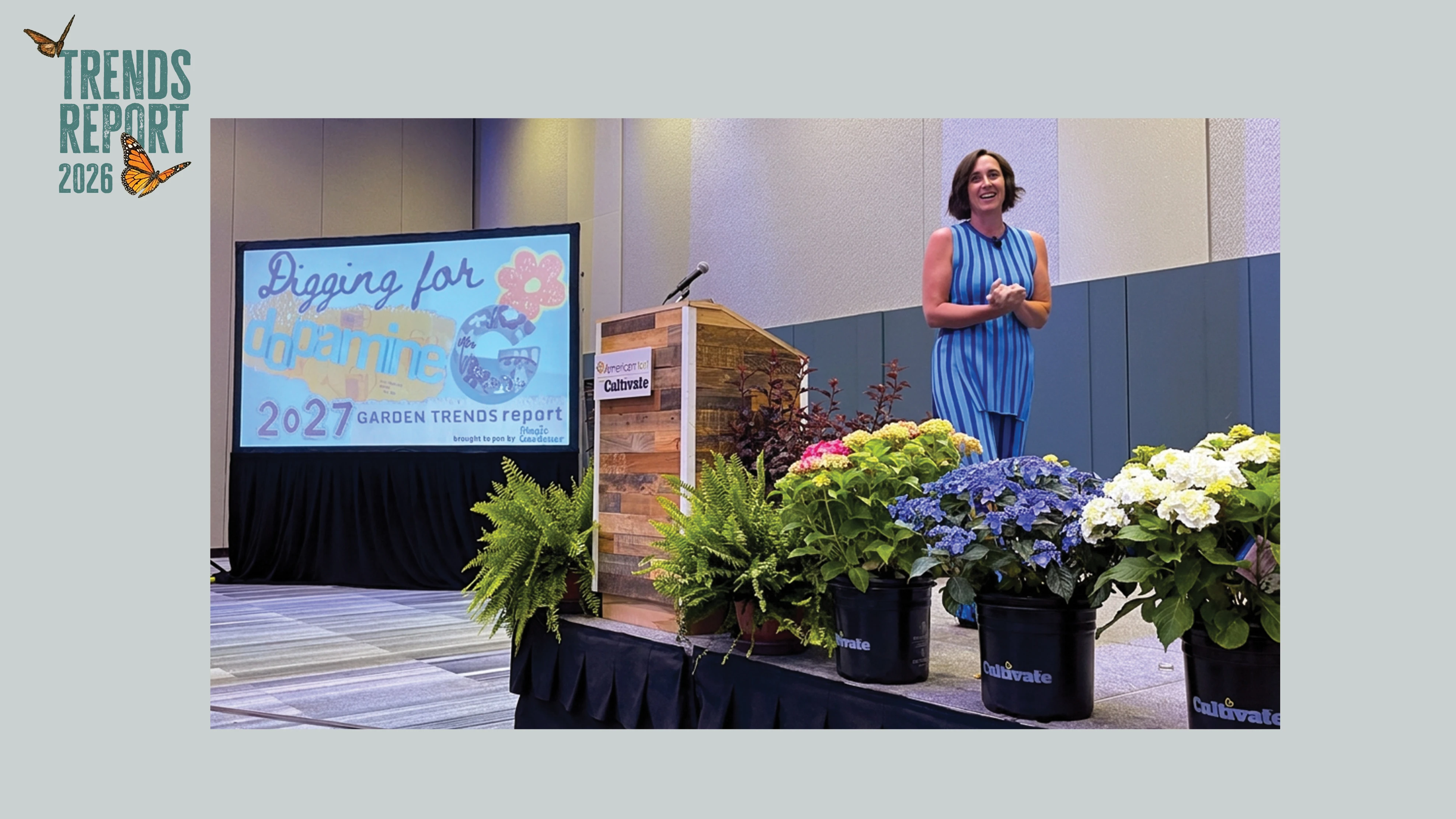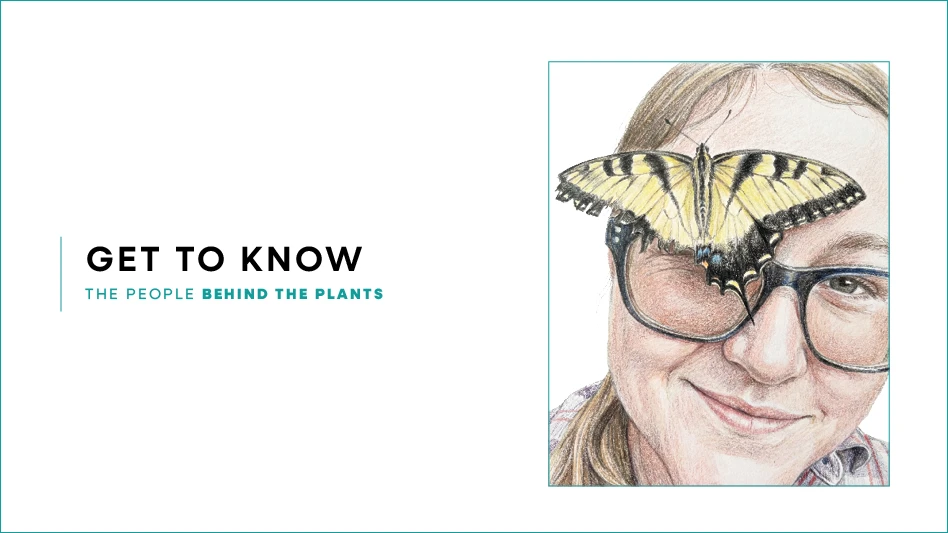
Amanda Bratcher photo | Illustrated with Adobe Firefly
When it comes to horticulture education, Amanda Bratcher can’t wear enough hats. The extension agent for the North Carolina Cooperative Extension’s Lee County Center leads and trains the North Carolina State Extension Master Gardener Volunteers, works with the Pollinator Haven Garden, coordinates the area’s pollinator census, directs a regional Small Farm Boot Camp and recently earned the Emerging Horticultural Professional Award as part of the 2025 Great American Gardeners Awards.
Anthony Elder: What got you involved in horticulture?
Amanda Bratcher: I went to a technical high school. In the early 2000s, they were telling us, ‘Go into computers. Go into computers. You are going to make money; it’s going to be great.’
I am good at computers, but it’s miserable. The idea of doing tech support for people was soul-crushing. And I realized that being outside and working with plants was way more interesting. And I was really fortunate where I grew up in Gaston County, North Carolina, where there is the Daniel Stowe Botanical Garden. And as a Girl Scout, they would always have us come out every couple of years to work on badges. My little high school brain was like, ‘Hey man, people make money working there. I should go do that.’ And, thankfully, NC State University is one of the best horticulture schools in the country. It really opened my eyes.
AE: What is it like teaching several generations about horticulture?
AB: I was very fortunate — my mom growing up was a daycare teacher. She worked with (children) ages three through five for the first 15 years of my life.
Every person is unique. So, seeing that modeled actually helped me understand that I need to meet people where they are. My job is not just to know all this stuff, (but) to also be able to go, ‘OK, this person standing in front of me, this audience in front of me, this group of people that I’m speaking with, where are they at? What level of interest do they have, and how can I quickly assess where they’re at so I can meet them where they are and then help them access the level of information that they can actually absorb?’
I think people appreciate that. And at the end of the day, I’m not trying to speak over them or trying to dumb anything down for them. They feel like they’ve come along with me on this journey of horticulture.
AE: How can established growers benefit from your work and/or research happening within universities?
AB: Extension is a really great way to access the universities, and I will say NC State has tried to improve that pipeline and that line of communication in North Carolina. We’ve got the Plant Sciences Initiative — its mission is to be responsive to the industry; to try and facilitate conversations between industry and researchers at the university; and to try and engage extension agents in the county level so there is more communication.
If researchers are working on something and they need help, really, they should be talking to extension about how to find people to work with in the counties, because a lot of times our job is to go speak to growers and to let them know what’s going on (in the industry).

Explore the May 2026 Issue
Check out more from this issue and find your next story to read.
Latest from Nursery Management
- The Growth Industry Episode 14: Meet Lionel van der Walt, AmericanHort's new CEO
- Growers and suppliers say BFG Supply Co. will close
- Stemmer from BioWorks
- BioWorks introduces Stemmer silicon-based plant health solution
- Silver Fern awarded grant to expand AI-powered demand planning for greenhouse, nursery growers
- All-America Selections announces first three new AAS Winners for 2027
- 2026 Special Recognition Award recipients announced at PPA National Symposium
- [WATCH] July issue recap