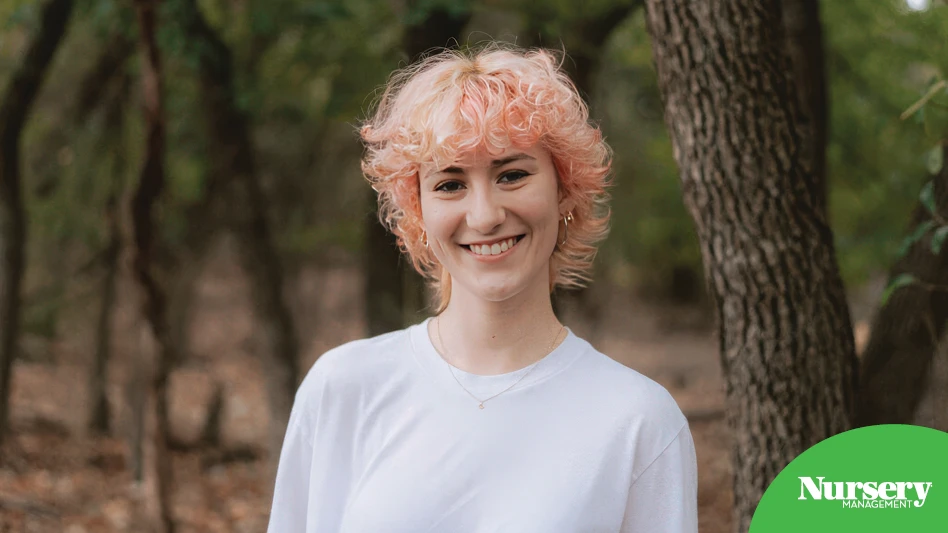
Born and raised in Austin, Texas, Elia Vaclav grew up surrounded by heat, humidity and a familiar palette of native plants. This summer, the Texas State University student traded that southern landscape for long, cool days in peony fields overlooking Alaska’s Kachemak Bay. Her three-month summer internship at Alaska Perfect Peony marks the farthest placement in the history of the American Floral Endowment’s program, taking her more than 4,300 miles from home.
For Vaclav, who is majoring in agriculture with an emphasis on horticulture, the experience offered full immersion into a new climate, crop and corner of the floriculture industry. At a time when Alaska Perfect Peony’s founder is rethinking the farm’s future, this internship also offered the operation a hopeful glimpse into the next generation.

Pioneering peonies
Alaska Perfect Peony started growing peonies for the cut flower market in 2006, becoming the first peony farm in Alaska after university researchers saw economic potential for the crop. “When fresh-cut peonies are available in Alaska, they aren’t available anywhere else in the world,” explains founder Rita Jo Shoultz. “Peonies love our cold soils, and our extensively long days make our flowers larger with a more intense color.”
Now, Shoultz says, there are about 200 farms across Alaska, and a few of them have eclipsed hers in size. Alaska Perfect Peony still draws tourists and locals to its botanical gardens, greenhouses and 25 acres of flowering fields. But Shoultz, 84, and her son and business partner, Shannon, 66, are “ready to slow down,” she says.
A historically harsh winter added pressure, damaging crops across the state, while labor becomes increasingly more difficult to find. A few years ago, at full capacity, the farm employed 13 people; but now, Shoultz says, “we’re lucky if we have 6 or 7.” So, this season, as Alaska Perfect Peony scaled back production, Shoultz tried something new: welcoming the farm’s first intern through the American Floral Endowment (AFE).

Pursuing ornamental plants
Growing up in Texas, Vaclav was surrounded by her mom’s houseplants and her grandma’s flower garden. “Being able to see how careful dedication to keeping plants alive can [produce] a beautiful outcome was really inspiring,” she says. Her family’s passion for ornamentals drew her interest, prompting her to pursue a horticulture minor inside Texas State’s agriculture program.
Vaclav learned about the AFE internship program through her professor, who encouraged her to apply. With three semesters left, Vaclav traveled thousands of miles to spend the summer exploring a new growing environment while learning firsthand about specialty flower production.
“I really wanted her to see the overall picture. I didn’t just want her to weed. I wanted her to look at the whole process and see, from one end to the other, and even some of the financial parts of it and how hard it is to get help,” Shoultz says. “I wanted her to have a full farm experience.”
Vaclav arrived at Alaska Perfect Peony in mid-May, before the buds started to open. She jumped right in to maintenance projects like repairing fence posts, preparing the fields and tending the botanical gardens — where she discovered several new plants and found some familiar specimens growing quite differently than she’d seen before.
“Texas natives are nothing like Alaska natives,” she says. “I didn’t know horsetail could be a weed, and one of my favorite flowers, lily of the valley, is actually a weed here, too. It’s completely different.”

Passing down knowledge
Since the peony season began in late July, delayed by Alaska’s coldest winter on record, Vaclav has been busy processing flowers for the cut flower market, working closely with Shoultz to understand the operation.
Alaska Perfect Peony regularly hosts volunteer workers through World Wide Opportunities on Organic Farms (WWOOF). Typically, Shoultz says, these “WWOOFers” only stay for a few weeks, which doesn’t allow in-depth training. Having Vaclav all summer long has been a welcome opportunity for her to share knowledge, not just instructions.
“Knowing that Elia is thinking about this as a lifetime career changed my modus operandi,” Shoultz says. “I don’t just say, ‘Do this. Do that.’ I tell her the whole story of why we’re doing things.”
Meanwhile, Vaclav has found opportunities to pass on her knowledge to the other WWOOFers she lives and works with on the farm, while also hiking and biking throughout the region with them. “It’s been a really fun mix of exploring the beautiful landscape of Alaska, and also being able to get my hands dirty and experience real floriculture,” she says.
During the three months Vaclav spent at Alaska Perfect Peony, Shoultz watched her blossom from a shy young girl into a dedicated worker. “Elia has been totally committed to what she’s doing every day,” she says. “I’m glad to see the next generation coming on board like this. Our people are aging out of the industry, and this has been a major concern for a long time, so seeing young people step up is so encouraging.”
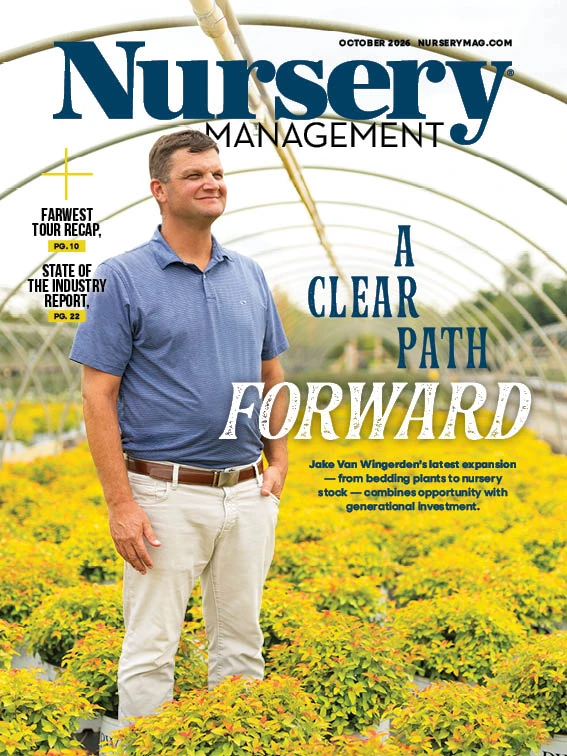
Explore the October 2026 Issue
Check out more from this issue and find your next story to read.
Latest from Nursery Management
- Stat of the Week: 44% of growers plan to produce more container-grown perennials
- Oasis Grower Solutions hires plant scientist Timothy Frey
- Seed Your Future launches '50K to Grow 50K' campaign to connect young people with horticulture careers
- American Floral Endowment announces two new Vic & Margaret Ball Internship Committee members
- Midwest Groundcovers explores strategic partnerships for Merry Christmas Holly and Peter Orum collection of proprietary Ilex genetics
- Cities may be the ultimate training grounds for invasive species, UF/IFAS researchers say
- USDA invests in U.S. fertilizer manufacturing
- Sinocrassula yunnanensis