Nate Smith
Editor's Note: This article originally appeared in the July 2026 print edition of Nursery Management under the headline “How to wake a sleeping giant.”

Breezy Hill Nursery began in 1980 as a design-build landscape company, when Jerry Epping and his wife, Colleen, founded it with nothing but a wheelbarrow and a dump truck.
After spending a little too much time waiting in nursery holding yards, Jerry decided to build a nursery to support his landscape operations. Soon enough, his nursery was supplying his jobs. He scaled it up over the years, buying the property in Salem, Wisconsin, where the current headquarters is located.
Acquisitions in 2003, 2011 and 2019 gave Breezy Hill nearly 1,200 acres of production spread across four locations in Wisconsin and Illinois.
In high school, current owner and CEO Bradd Epping would trim and fertilize shrubs at his parents’ nursery. He graduated from Utah State University in 2007 with a bachelor’s degree in landscape architecture and a minor in ornamental horticulture.

“It’s been a fulfilling career and definitely something I watched my father enjoy and something that I definitely wanted to pursue,” Bradd says. “You can watch things grow and nurture them, then on the landscape end and design end, you can renovate an ugly, overgrown landscape into something beautiful. You can really see your impact at the end of the day.”
Bradd had been working beside his father for 20 years, but he’d noticed that as the business grew, its support systems hadn’t expanded with it. Frankly, it was straining at the seams. The nursery had been operating with 20-year-old unsupported ERP software until about six years ago.
“The company grew pretty big, pretty quickly,” Bradd says.
In 2015 Breezy Hill was about a $14 million company. By 2025, it had grown to nearly $34 million. Landscape construction and maintenance made up the largest chunk at $22 million, the nursery brought in about $10.5 million and Breezy Hill’s two retail garden centers added another $3 million.

In 2019, Jerry was diagnosed with stage four cancer. It was a struggle, but by 2022, Bradd says his father was starting to beat it.
“It was his birthday, and it was a super beautiful night,” Bradd remembers. “October 3, probably 60 to 70 degrees. He was on his motorcycle coming back after working with one of the managers about the layout of the farm. The sun was setting, and a driver turned in front of him and hit his motorcycle. He died from that motorcycle accident.”
For a year after the tragedy, the team banded together. The business held on while Bradd and his family figured out what to do next.
“It was kumbaya, things were good,” Bradd says. “But I saw a need within the existing team to dial it in more. My perception was that our inventory was loose, and I knew we could do a better job.”
This turning point in Breezy Hill’s history was an opportunity to reshape the business. The second-generation leader was ready to revitalize the company.

Transformation time
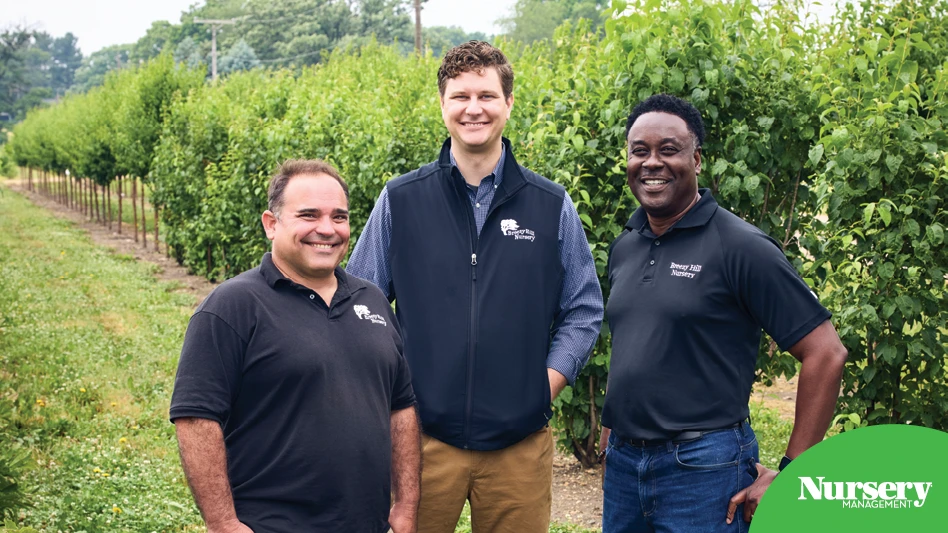
About a year after Jerry died, Bradd received a call from John Terhesh. At the time, John Terhesh was president of Goodmark Nurseries, a competitor in the Midwest. Bradd knew him to be a very process-oriented nurseryman.
“John puts a lot of science to things, and he just lays things out in a manner that I can digest and the team can digest,” Bradd says. “So, when he asked me if I needed any help, I jumped at the opportunity.”
Terhesh joined Breezy Hill Nursery as vice president in February 2024, and Bradd tasked him with transforming the nursery into a modern, scalable force.
Bradd says the management team at Breezy Hill operated with more of a shoot-from-the-hip type of forecasting and analysis. By contrast, Terhesh is analytical. He’s focused on metrics, benchmarks and key performance indicators. Not everyone was willing to buy into his way of running a nursery. Some had been doing their jobs the same way for 20 years and weren’t willing to change. He showed them why their methods weren’t performing well, but they were resistant. Next, Bradd and Terhesh made the calls to remove those people.
“I think the industry really shies away from this topic in general, but to run a successful business you have to have your team aligned,” Terhesh says. “You can’t pull people forever.”
Terhesh believes nursery decision-makers often let fear stop them from firing a low-performing employee or one who is reluctant to adopt new methods.
“I think the fear is ‘if I get rid of this person, he knows so much about our industry, I’m never going to find anybody else,’” Terhesh says.
It’s true that with baby boomers retiring, there is a lack of employees stepping up to fill those spots. But Terhesh says his generation accepts the labor shortage as normal operating conditions.
“I graduated in 2009,” he says. “So, my entire career, we haven’t had people.”
However, the lack of available horticulturally trained workers has forced nursery managers to branch out. Terhesh says he’s learned to hire people with the right attitude and skill set and then teach them the horticulture side of the business.
“John’s put together a great team to help us with controls, inventory and growing great products,” Bradd says.

New perspectives
Breezy Hill invested heavily in the sales team as part of its reinvention, going from a team of two to a team of seven. Most of the new staff did not have horticulture experience but were top-notch salespeople, Terhesh says.
In December 2024, Terhesh and Bradd brought Erick Harris on board to manage this new sales team. He’d most recently been national sales manager for McHutchison, but he has 33 years of experience with companies like Philip Morris and Grainger.
“When I sat down with John and Bradd, I realized they were serious about winning,” Harris says. “A lot of people say they want to win, then when the price of winning comes up, they’re not willing to pay it.”
Harris says winning companies provide resources and make tough decisions when somebody’s not performing, even if that somebody is well-liked by the leaders or by the whole organization.
Whatever industry he’s been in, Harris says, successful leaders have a plan and they are constantly learning. He says Terhesh’s work ethic and devotion to research impressed him.
“Since I’ve been in the horticulture industry, I’ll see plant people and I’ll see businesspeople, but rarely do I see the two together where they have both skill sets, and he has it,” Harris says.
Before he pushes the nursery to invest in new technology, Terhesh devours all the information he can find about it, then he visits other nurseries that are using it. After reading about it, talking about it and seeing it in person, if he thinks it can be adapted at Breezy Hill, he’ll bring it in for a trial run. And it’s common for him to want to see some improvements before he pulls the trigger.
Harris started the horticulture sales part of his career at Ball Seed, and he’d seen plenty of advanced automation at big growers. But Breezy Hill didn’t have any of that. Workers had been potting and planting by hand, until last year when the nursery invested in several machines.
“Now what used to take three weeks, we do triple the capacity in about seven days,” Harris says. “Those are the types of actions that I’ve seen that show he’s serious about winning.”

A pathway to better service
Terhesh spent his first year at Breezy Hill listening to customers, understanding their frustrations and learning where there were gaps between expectation and reality.
“Our processes were inconsistent from one location to the next,” Terhesh says. “Communication was unreliable. Inventory accuracy was poor. We simply weren’t delivering a good, consistent product to the customers or a consistent customer experience at all. And because of that, the reputation of Breezy Hill really slipped.”
His next step was to question why the reputation was lacking.
“Customers told me directly that they lost confidence in us,” he says. “They couldn’t trust the information or the follow through.”
Breezy Hill’s marketing manager, Nicolina Balazs, surveyed their customers and received a lot of negative feedback. Customers said their Breezy Hill contacts wouldn’t call or email them back and wouldn’t follow up.

However, there were reasons to believe in a turnaround.
“A lot of customers have told me that we are a sleeping giant in the Midwest,” Terhesh says. “And if we could figure it out, we’re definitely going to be a dominant force in the market.”
Harris delved into the survey and called the nursery’s top 20 customers to provide another data point. He pinpointed the bottleneck: sales capacity. Breezy Hill only had two outside sales reps who drove around their coverage area seeing customers face-to-face, and one person split between inside sales and customer service.
Harris pitched the idea of increasing the sales team to two outside reps, two inside reps and two customer service reps. The outside reps would focus on customers that were greater than $10,000 in annual sales, the customer service reps would support them and handle the follow-up work that was falling through the cracks, and the two inside reps would handle smaller customers. Terhesh and Bradd agreed with the plan.
The first year under the new system focused on improving relationships and changing pricing expectations. Some long-term customers were out of line with where pricing should be, so there was some pullback. However, the realigned pricing has helped the business keep a healthier profit margin, and because the team continued to follow up in person with those customers, spring booking was ahead $1.5 million for 2026 over 2025.
Harris’ team also focused on bringing in new customers, particularly commercial landscapers, that still have projects in the summer months after the spring rush ends.
Breezy Hill is taking its commitment to customer service seriously, and to ensure the complaints about follow-through wouldn’t be repeated, Harris had his new sales team perform a season review with their five biggest customers. They travel to see them in person and ask what they did well or poorly. It’s also an opportunity to show the customers how much they purchased and remind them of how Breezy Hill helped them with their business. The feedback they receive is passed on to the relevant department and helps validate the progress they’ve made.

Measure to manage
Terhesh is data-driven, and so the sales and production teams spend time evaluating whether their changes are working.
“If you can’t track it, you can’t change it,” he says. “We want to make sure that anything we want to change is somewhat trackable.”
Breezy Hill uses a system of OKRs, or objectives and key results. The objective would be a broad goal, like improve quality across all containers. The key results would be the trackable metrics that go into achieving that objective. Each department manager has seven to 10 metrics they are tracking. They build out the steps their teams should take to improve those metrics.
For many nurseries, it would be a big leap to adopt a program like this. But Terhesh says it’s important to note that while some people will resist, others will excel.
“Before rolling this out, there was some anxiety of ‘oh man, people are going to be upset about this and (that) we’re looking at these numbers,’ but actually the opposite ends up being true,” he says. “The people like reporting on their numbers because it shows the work they’re doing and they kind of like to brag about it, like ‘look, I got this number to there.’”
Harris appreciates that the commitment to evaluating business data doesn’t fall off the priority list when it’s no longer convenient. Philip Morris was also big on data when Harris worked there, and everyone from sales representatives to district managers had to create a “game plan,” but once the selling season started rolling, any adherence to the plan dissipated.
That’s not the case at Breezy Hill, Harris says. Everyone from sales, marketing, production, IT and logistics to the CFO and the owner meets to discuss different aspects of the five-year strategic plan. That’s on top of the regular sales and production meetings in which Terhesh pulls the numbers and discusses what plant material will be short or long, and in what sizes.
Breezy Hill’s nursery output is mostly field grown, but it does about 80 acres of container production. Bringing in machinery to automate tasks has helped the nursery share labor between locations. Most of its production is over 900 acres across two farms that are 10 minutes apart. Before the machinery arrived, the nursery was hand potting, which required six people for six months of planting. Terhesh says the new equipment made short work of Breezy Hill’s containers, knocking out the entire production list in about 10 days.
This enabled the nursery to reduce labor by 20%. Breezy Hill made it through spring 2025 with 23 fewer H-2A workers. But the employees didn’t struggle. Lance Platts, operations manager and 38-year Breezy Hill veteran, said it was the smoothest spring they’d ever had.
“When you’re in chaos and you don’t have the processes, you need more people to fill those gaps,” Terhesh says. “But if you could standardize how things operate and have that communication from the sales side feeding the production pipeline, it really smooths everything out and you don’t need those extra people anymore.”

Looking ahead
Year one was about fixing the customer experience, building a sales team and creating some initial production efficiencies. Going into year two of the five-year plan, the next steps are refining these procedures, ramping up marketing, automatization and improving field efficiencies, especially regarding inventory. Terhesh has been working with Moss Robotics to test that company’s AI, GPS and LiDAR-powered inventory management system.
It’s still early to tell how the changes have impacted Breezy Hill. Terhesh says customer service is a night-and-day difference, and production and logistics issues were cleared up pretty quickly. But he also has heard it takes three years for customers to respond to changes and five years before they trust you.
“We still have a bit of time before the market reacts to it,” he says. “Our industry’s pretty slow. But the customers that are working with us have provided super positive feedback and are so happy that we’ve been listening to them.”
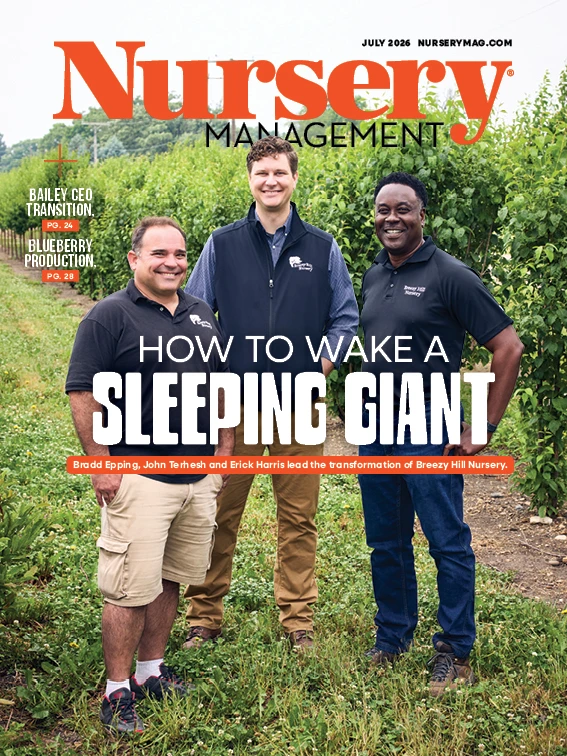
Explore the July 2026 Issue
Check out more from this issue and find your next story to read.
Latest from Nursery Management
- The Growth Industry Episode 14: Meet Lionel van der Walt, AmericanHort's new CEO
- Growers and suppliers say BFG Supply Co. will close
- Stemmer from BioWorks
- BioWorks introduces Stemmer silicon-based plant health solution
- Silver Fern awarded grant to expand AI-powered demand planning for greenhouse, nursery growers
- All-America Selections announces first three new AAS Winners for 2027
- 2026 Special Recognition Award recipients announced at PPA National Symposium
- [WATCH] July issue recap