Anna | Adobe Stock
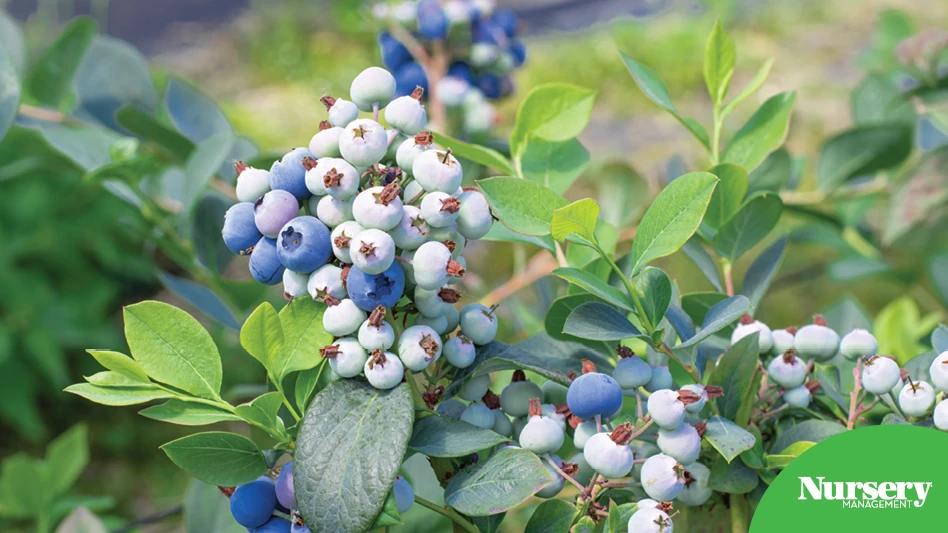
Nearly two decades ago, I remember walking through a garden center with my father and seeing a young blueberry bush sitting on a retail bench. It was not an impressive plant. It was small, weak-looking and growing in a container that seemed designed to hold it only long enough for someone to buy it and plant it in the yard.
When no one was looking, I filled my hand with a few berries and ate them. I remember telling my father afterward that I wished we could grow blueberries inside our house so I could pick them yearround. At the time, that sounded like a child’s idea. Blueberries belonged in fields, gardens and landscapes.
Years later, I saw my first commercial container blueberry farm in Central California after being first introduced to Israel Holby (co-author) at a North American Strawberry Growers Association meeting. Israel asked if I wanted to visit one of his customers. I expected to see something interesting. What I did not expect was to realize how large and serious the container blueberry industry had become.
Rows of blueberry plants were no longer tied to the limitations of native soil. They were being grown in designed rootzones, with containers, substrates, irrigation, drainage and crop timing all working together. That one visit changed how I thought about blueberries in pots and showed me that this was not a novelty. It was a rapidly growing industry.
That industry is now expanding quickly in several regions of the world. In Peru, blueberry production has grown into a major export sector, with production occurring both in the ground and in containers where the rootzone can be customized with materials such as coconut coir, pine bark and other structured components. In China, blueberry acreage and production have also expanded rapidly, with provinces such as Yunnan using protected production and soilless substrate systems to supply winter and early spring markets.
One reason for the shift is simple: blueberries are rootzone-sensitive plants. They prefer acidic, well-drained conditions with enough moisture to support active growth but enough air to keep fine roots healthy. Many soils do not naturally provide that balance. Containers give growers the chance to build the rootzone instead of fighting the soil.

A better pot starts with a grower problem
Engineered blueberry containers did not come from the idea that growers simply needed a different-looking pot. They came from a more practical question: What does a container need to do when the crop inside it is expected to remain productive for several years?
That question matters because many early blueberry containers were borrowed from the nursery industry. Nursery pots were available, familiar and affordable, but they were not necessarily designed for a fruiting perennial crop. A nursery plant may only need to look good long enough to be sold. A containerized blueberry planting may need to remain productive in the same rootzone for five to 10 years.
That changes the job of the container. It is no longer just a vessel to hold a plant. It has to support drainage, oxygen, irrigation uniformity, root development, plant stability, handling, cooling and substrate performance, and it has to do this across multiple seasons. For blueberry growers, the best container decisions usually begin with the crop's long-term rootzone needs, not with the container itself.

Choosing container size with purpose
Container size is usually one of the first decisions growers make. Blueberry container options currently on the market range from roughly 20 to 40 liters, reflecting the reality that there is no single perfect size for every region, cultivar or production model.
Smaller containers, typically around 20 to 25 liters, can reduce substrate and container costs while allowing higher planting densities. That can be attractive where early return, rapid establishment or upfront cost control are the priority. University of Florida guidance notes that early container-based blueberry farms often used large nursery pots around 10 to 13 gallons, or about 38 to 49 liters, while many current commercial plantings are typically using smaller 5- to 7-gallon containers, or about 19 to 26 liters, because they are less expensive to fill and can allow more even moisture distribution. See the UFL publication here.
Larger containers, often in the 30-to-40-liter range, can provide more root volume, physical stability and buffering capacity. In this context, buffering has both a physical and chemical meaning. Physically, more substrate volume can hold more water and give the crop more forgiveness between irrigation events. Chemically, the substrate and fertigation program influences how stable the rootzone remains in pH, EC and nutrient supply. Larger containers may be useful for vigorous cultivars, long-term plantings, warmer climates or systems where growers want more insurance during periods of high water demand.
Regional economics also matter. In parts of Yunnan, growers may focus heavily on small containers, low-cost substrates and rapid short-term returns. In parts of Peru and Morocco, another trend is emerging. Some growers recognize the benefits of classic blended substrates, but cost and supply limits can push them toward larger containers filled with lower-cost 100% coir. The larger container becomes a way to recover some of the physical buffer that might otherwise come from a more expensive blended substrate.
The key is not to choose the largest container possible. The better goal is to choose the smallest container that can still support the cultivar's long-term rootzone needs. A container that is too small may save money upfront but increase irrigation pressure later. A container that is too large may add substrate cost without improving production. Blueberry variety matters here since some cultivars simply do not need large containers, while others may justify more root volume because of vigor, crop load, climate or production cycle.

Pots, bags and color
Growers also have to decide whether to use rigid pots or substrate bags. Both can work, but the reasons for choosing them are different. Substrate bags are often selected because they are inexpensive and can simplify early production decisions. In many systems, bags are purchased prefilled or used with a standard substrate program, which can reduce the need for growers to separately choose, purchase and fill individual containers.
From a rootzone standpoint, bags can perform well when the substrate has enough structure, the bag drains properly and irrigation is managed carefully. The challenge is that bags usually provide less physical structure than rigid pots. They can be harder to move, reposition, inspect, cool and manage consistently over multiple seasons. Because they sit closer to the ground and have less defined container geometry, growers also need to pay close attention to drainage, wetting patterns, rootzone temperature and emitter placement.
Rigid pots offer a different value proposition. They hold their shape, are easier to move and space and can be engineered with legs, grooves, drainage holes, anchors and bases that help water leave the rootzone more predictably. Those details matter because the bottom of the container is often where poor design shows up.
Container color is another practical decision. Black pots are common and durable, but they absorb more heat. White pots can reflect more light and help reduce heat loading in warm climates, although they may show algae, staining or wear more easily. Terracotta or light brown containers may offer a visual and thermal compromise, and they are a more common regional preference in places such as Morocco and Spain. In hot climates, cooling skirts or other container-cooling strategies can also be important. Keeping the rootzone cooler may reduce stress and, in some systems, reduce how much irrigation water is being used mainly as a cooling tool.

The substrate has to survive the crop
The container is only half the rootzone. The substrate must also perform over time.
Blueberry substrates are typically built from fibrous and coarse components. Peat, coconut coir, pine bark, perlite, wood fiber and other materials may be used to balance water retention with drainage and aeration. The challenge is that container blueberries are not short-term nursery crops. A production substrate may need to support several years of root growth, irrigation, fertigation, salt management and seasonal wetting and drying.
Organic materials change over time. They can decompose, shrink, settle, or lose structure in the warm, moist conditions inside pots or bags. As the substrate changes, so can the distribution of air and water. A mix that drained well at planting may behave differently several seasons later.
For that reason, more growers are thinking carefully about the first container and substrate decision. Repotting adds labor, cost, plant stress and logistical complexity. Many growers want to transplant into a production container and keep the crop there until yield declines or the rootzone no longer performs. That makes substrate stability, drainage design and irrigation strategy central to the life of the planting.

What growers should watch
A good container does not replace management, but it can make good management easier.
Growers should watch how uniformly containers dry across the block, especially between edge rows and interior rows. They should check whether drainage water leaves the container cleanly or pools beneath it. They should monitor leachate pH and EC because soilless substrates have limited buffering capacity and can respond quickly to irrigation water, fertilizer and crop uptake.
Emitter number and placement also matter. In commercial blueberry systems, growers commonly use two or four emitters per container, either as stakes or inline emitters. The goal is not just to deliver enough water, but to wet the rootzone uniformly. This becomes especially important in large containers filled with 100% coir because the wet zone under each emitter can be relatively narrow.
Root inspection is still useful, but the most serious root restriction problem is often not circling in a production container. It is nursery plants left too long in small pots before transplanting. Once roots become severely bound in the nursery stage, the plant may carry that problem into the production system. Growers should inspect young plants before planting and then continue checking root distribution, lower-profile moisture, drainage and plant response after establishment.

Building the crop from the roots up
Container blueberry production is growing because it gives producers more control. It allows them to manage pH, substrate structure, drainage, plant density, irrigation, fertigation, cooling and production timing in ways that are difficult in many native soils. But control only helps when the system is designed well.
A bag can work if it is inexpensive, drains well and is managed carefully. A rigid pot can work if it is engineered around roots, water, oxygen, cooling and handling. A smaller container can work if irrigation is precise and the production cycle fits the volume. A larger container can work if the cultivar, climate, substrate and business model justify the added cost.
And in containerized blueberry production, that may be the real future of the crop — not just more plants in pots, but better rootzones by design.

Explore the July 2026 Issue
Check out more from this issue and find your next story to read.
Latest from Nursery Management
- The Growth Industry Episode 14: Meet Lionel van der Walt, AmericanHort's new CEO
- Growers and suppliers say BFG Supply Co. will close
- Stemmer from BioWorks
- BioWorks introduces Stemmer silicon-based plant health solution
- Silver Fern awarded grant to expand AI-powered demand planning for greenhouse, nursery growers
- All-America Selections announces first three new AAS Winners for 2027
- 2026 Special Recognition Award recipients announced at PPA National Symposium
- [WATCH] July issue recap