Courtesy of FAO
A new scientific article led by the Food and Agriculture Organization of the United Nations (FAO) highlights food safety as a central pillar of pandemic preparedness and response.
Published in npj Science of Food, the article "Building resilient food safety systems through a One Health approach to prepare for the next pandemic" explores how pandemics affect not only human health but also the safety, resilience and functioning of agrifood systems worldwide.
While pandemics are commonly viewed through a clinical or epidemiological lens, the authors argue that their impacts on food safety systems have received comparatively little attention despite their importance for public health, consumer protection and food security, FAO said.
The review highlights how health emergencies can disrupt food inspection services, laboratory capacity, surveillance systems, traceability mechanisms and regulatory oversight, creating vulnerabilities throughout food supply chains. Experiences during the COVID-19 pandemic demonstrated how the diversion of resources and workforce shortages can weaken food safety controls and increase risks related to food contamination and fraud, according to FAO.
The article adopts a One Health perspective, recognizing the close connections between people, animals, plants and the environment. Many emerging infectious diseases originate at the interfaces where wildlife, livestock, food production systems and human populations interact. Climate change, land-use change, intensification of agriculture, globalization of trade and increasing antimicrobial resistance further contribute to these risks, said FAO.
The authors emphasize that food safety should not be considered only as a downstream issue addressed after outbreaks occur, but rather as an essential component of prevention, preparedness and resilience planning.
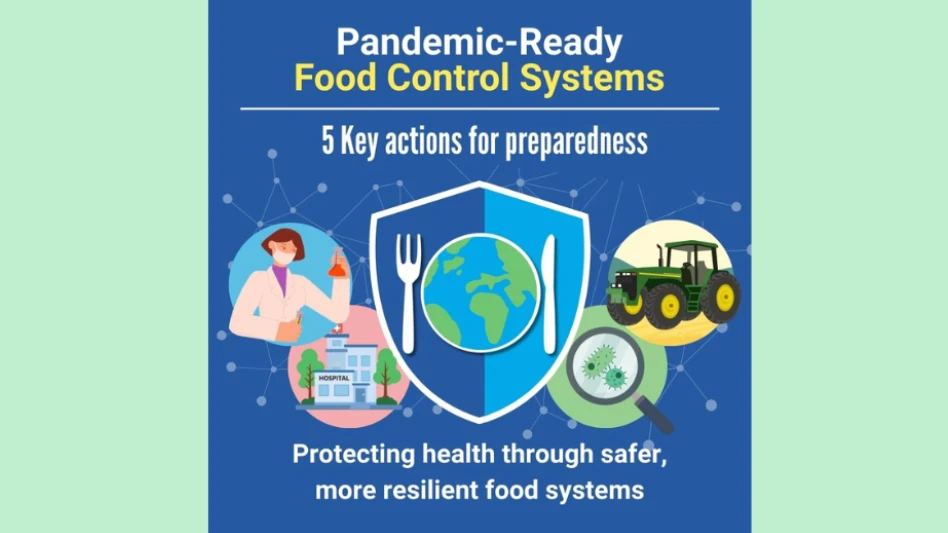
The paper identifies five priority actions for developing pandemic-ready food control systems: strengthening multisectoral coordination, implementing integrated surveillance across sectors, expanding laboratory capacity for food testing, building rapid response capabilities, and modernizing legal and regulatory frameworks to support resilient agrifood systems and emergency preparedness.
"Food safety is a critical component of the One Health approach because the health of people, animals, plants and the environment are intrinsically interconnected. Strengthening food safety systems is therefore not only essential for protecting consumers and ensuring trust in agrifood systems, but also a key investment in pandemic preparedness and global health security," said Maura Di Martino, paper co-author and food safety specialist in the Division of Agrifood Systems and Food Safety, FAO.
The article contributes to ongoing discussions on food safety within One Health and pandemic preparedness frameworks, FAO said.
Reference
Di Martino, M., Shadomy, S., Topazio, D., et al. (2026). Building resilient food safety systems through a One Health approach to prepare for the next pandemic. npj Science of Food, 10, 209. https://doi.org/10.1038/s41538-026-00798-4
Latest from Quality Assurance & Food Safety
- ARCO Design/Build Names Brian Shoop Director of Process Engineering for Food & Beverage
- How Indoor Farmers Manage Food Safety Risks
- Food Allergy Advocate Devin Sailer Named One of America’s Ten Outstanding Young Americans
- The Hidden Risks of Flies in Food Facilities
- From Reactive to Proactive: How Remote Monitoring Transforms Rodent Control in Food Facilities
- Getting the Most from Your Pest Management Partnership
- Remote Monitoring Technology for Food Processing IPM Programs
- Beyond the Trap Line: What a Real Pest Risk Assessment Looks Like