When entering a food or beverage facility, whether for the third or thousandth time, food safety auditors don’t always know what they’re going to see — despite knowing what to look for.
Auditors are prepared to assess these facilities to ensure they meet the standards ultimately designed to keep the food supply chain and its consumers safe. Whether professionals are auditing from the first-, second- or third-party perspective, they share similar overarching goals: identify problem areas, evaluate compliance and prioritize food safety.
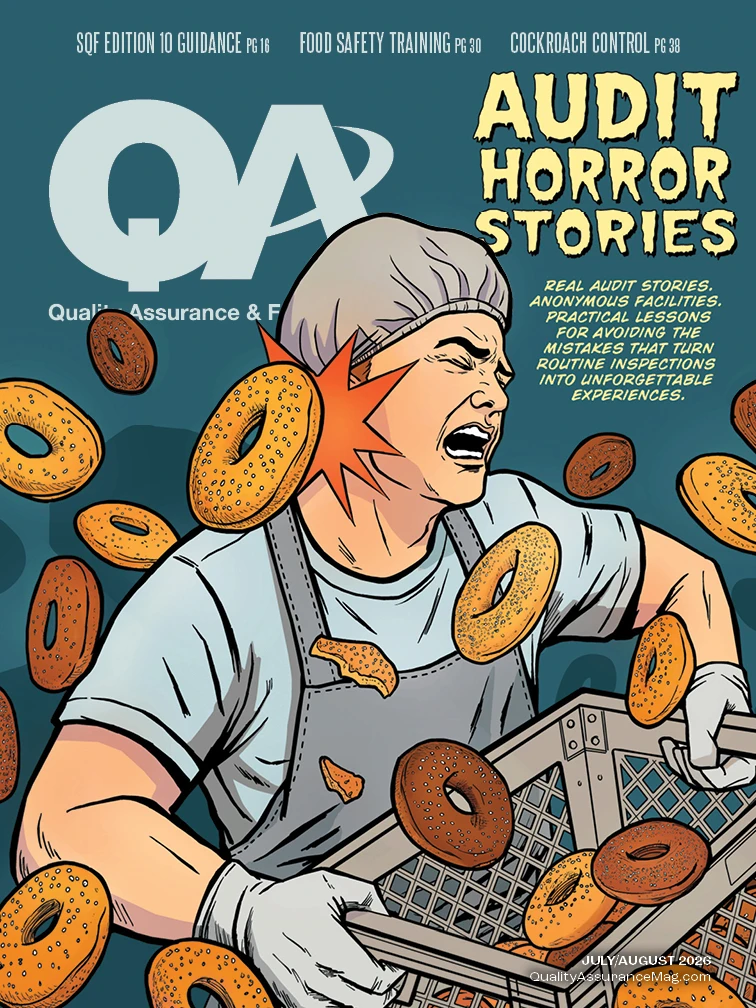
But what do auditors do when the unexpected happens during an audit? For instance, when an unfortunate equipment malfunction at a bagel facility results in bread being launched off a conveyer at high speeds, pummeling the employee on the line trying to catch them?
For Nate Call, CEO, Qualitas Executive Group, a quality and compliance consulting firm in the consumer packaged goods (CPG) industry, who witnessed the aforementioned bagel incident, unforeseen auditing experiences can be funny or frightening stories to tell, with food safety and quality assurance lessons woven throughout.
Cigarettes and Flip Flops.
Call’s most unforgettable audit happened when he accidentally showed up to a facility a week earlier than scheduled. He walked into the facility, signed in and rang the bell, but no one came to greet him.
“So, being the nosy auditor I am, I just started checking doors and walking around and trying to gain access to the facility and talk to someone,” said Call. “I end up going around the side of this facility, walk through this giant equipment door, and there I see the COO smoking a cigarette next to a tank, like a huge, 5,000-gallon tank, wearing shorts and flip flops, [and] there’s a little dog running around next to him.”
After he got the COO’s attention, Call said the executive panicked, acknowledged Call was supposed to come for the audit the following week and asked for a couple of minutes to prepare.
“I just ended up leaving,” Call said.
A Cat's Paradise.
Food facilities need a strong pest control program, so when Call was discussing the topic with a facility he was auditing, he was confused when management couldn’t procure any pest control records but kept jesting about “cats.”
It turns out, Call said, the facility’s staff wasn’t joking.
“Their entire pest control program was literally using cats that they had rescued,” he said. “What ended up happening is they built this enormous tire structure, like a cat’s paradise, basically, behind their facility, and there were just cats everywhere.”
The owner’s wife rescued the cats, and staff allowed them to roam free around the facility. Although Call didn’t see any signs of mice, he was quite concerned about the sanitation problems caused by the feline-run pest control program.
“The owner looks at me and goes, ‘Oh, my wife has access to dogs, too, so if we need to get the cats out, we’ll bring in the dogs,’” Call said. “And I just made a joke, like, ‘At some point, you’re going to tell me we’ll bring in sharks to get rid of a bear.’”

Flying Bagels.
About five years ago, Call was present at what he said was the funniest audit he’s ever experienced. A group of 12 people, including Call, were walking around a bagel facility when they happened upon an equipment malfunction during the packaging process.
The bagels pass through a slicer and are cut by a band saw that’s positioned sideways, Call said. At the other end of the slicer, where the bagels came out, the conveyor was running too fast and out of control, launching bagels at the employee working the line.
“There was the slicer, the out-of-control conveyor and then a sharp 90 degree left turn,” Call said. “There’s a guy with a box trying to catch these bagels, and he was just getting annihilated.”
Bad Liars.
Call estimated he has conducted around 800 audits throughout his career. Twice, he has seen oily rags combust in a garbage bin. He has watched police officers enter facilities and take employees off the line.
“You see a lot of things just by repetition and chance,” he said. “[Like] the power mysteriously going out when you ask for a certain record that can only be shared electronically.”
Less than 1% of the time, Call said, audits reveal something more troubling: a compromise of integrity.
“People doctoring documents where they’re sitting across from me, and there’s glass behind them, and I can see them doing things in the reflection of the glass,” Call said.
He’s had management tell him they need to grab records that have been stuck in a filing cabinet for years, only to come back with a stack of papers still warm from the printer.
“I often remind people that the consumer is not this nebulous person,” Call said. “We don’t launch everything we make into outer space for the aliens to eat. This is food for your family, for your caregivers, for your friends, for people you care about. So, [by] taking a shortcut here and there, cutting a corner, doing those things, you are putting the people you love and care about at risk.”
Investing in Professionals.
Beyond the comedic, frightening, unexpected and concerning audit experiences Call shared that help reveal what food and beverage facilities could be doing better, there’s another issue he often sees facilities overlook.
“An issue that we see at sites, and it’s more site leadership overlooking this, or underestimating the impact of this, is hiring quality and food safety people and putting them in positions that are far beyond their level of qualification,” Call said. “We grab a food science graduate straight out of college. They’re the quality manager, the director or senior quality manager, because they have the technical expertise, but they skip that beginner step. And I would say the beginner step is the most important in someone’s professional journey, especially in food safety and quality.”
Privacy, Please.
An audit horror story can be claimed by anyone on a facility’s site, not just the auditor. This was the case for Sean Berdan, owner of CleanOps Quality Consulting, a food safety consulting firm specializing in sanitation and quality, and senior sanitation advisor for Culture Advisory Group, another consulting firm assisting food, beverage and health product companies.
At the time of his unforgettable audit experience, Berdan was filling in for a colleague during an audit. Berdan met with the auditor as he looked through some paperwork before deciding he wanted to start with the facility’s sanitation rooms.
“We go walking into the area where the chemicals are and the sanitation gear is kept,” Berdan said. “We walk through, and standing in the chemical shower is a gentleman. Pants around his ankles. He had been decanting some chemicals, and the chemical line split, and it’s all over his middle [area]. He wasn’t wearing the proper PPE, obviously. He didn’t have an apron on, and so it got on his pants and it immediately started to burn.”
Berdan said the auditor walked into the scene and then promptly turned around.
“I stayed to see what was actually going on and saw the damage to the chemical line, and we got that person some medical attention,” he said. “Then I had to sit down with the auditor and explain what had happened.”
Leadership Gone Wrong.
During a sanitation audit Berdan was conducting, senior leadership arrived at the facility and decided to watch his inspection. The facility manager brought the company leaders onto the production floor. Berdan said some of the executives didn’t wash their hands, one of them wasn’t wearing their hair net properly, a few of them had rings and watches on and another walked down the floor wearing loafers.
The leadership team began asking Berdan questions. Instead of answering them, Berdan turned to the facility manager to ask who these people were. After the manager answered, Berdan questioned why he allowed them onto the floor when they had clearly violated sanitation and safety protocols. The company leaders then ran back to the production floor’s door.
“And [the facility manager] goes, ‘I’m so happy you said something. Every time they come to the plant, they do this,’” Berdan said. “So, I said, ‘Before I leave, can you give me all of their contact information? Because I’m going to write it in my report, and I want to send it to every single one of them.’”
In reflecting on this audit, where the facility manager was nervous to speak up and leadership lacked care for sanitation, Berdan said a strong food safety culture centers the people doing the work on the facility floor.
“You get on LinkedIn, and every third article that somebody’s writing is about food safety culture, and they all go, ‘It’s got to start at the top down.’ And while that’s true, it’s more about the people who are on the floor and live it every day,” Berdan said. “Do they feel safe to call out an issue, or do they feel like they’re going to be punished for calling out something? They should feel safe.”
Let It Drip.
For QIMA Auditor Pavel Gonzalez-Prego, one particularly memorable audit occurred during a gap assessment at a seafood processing facility in Vancouver, Canada, more than a decade ago.
“The site ultimately received 72 minor, 35 major and five critical nonconformities,” he said.
One of the critical findings involved water dripping from the ceiling directly onto products being processed on a roll-stock packaging machine.
“Management initially argued the product was not ready-to-eat and would be cooked by consumers,” Gonzalez-Prego recalled. “However, when I inspected the floor above, I discovered that a restroom was located directly over the processing area. I was shocked by the situation.”
Gonzalez-Prego encountered a similar situation during an unannounced audit at a New Jersey meat processing facility that produced high-risk, ready-to-eat deli products.
“Within minutes of beginning the facility inspection, I found water leaking from the ceiling directly onto fully cooked deli products stored on racks inside the ready-to-eat cooler,” he said.
Even after the issue was identified, site personnel insisted the acidic ingredients used in their final products would address any food safety concerns. However, root cause analysis revealed a severe storm the previous night had clogged the roof drainage system. Rainwater had accumulated on the roof and entered the cooler through the exhaust system.
Once the true cause was understood, the facility recognized the seriousness of the situation and took appropriate corrective actions, Gonzalez-Prego said.
Tick, Tick, Boom.
In another situation at a clam processing facility, Gonzalez-Prego was forced to evacuate after a suspicious object was found. It turned out to be a real bomb that was unintentionally collected during clam harvesting operations.
Caught in a Jam.
Small issues can turn into big problems if left unaddressed. Gonzalez-Prego said one situation involved a combination of poor product flow management, inadequate training and excessive technology reliance.
“A soup processor experienced a conveyor jam due to poor product spacing and flow,” he said. “After the jam was cleared, seafood soup production resumed.”
The next production run was a vegetable product that did not contain seafood. An operator failed to follow the established changeover and inspection procedures and was unaware that a seafood container was lodged inside the X-ray machine. Gonzalez-Prego said the container was mixed with the subsequent vegetable production run.
“The facility also relied on an automated label verification system designed to reject incorrect products,” he said. “Unfortunately, the system failed at the critical moment.”
The jam resulted in the entire production run of vegetable product being recalled.
Watch Your Step.
At an apple packing facility, Gonzalez-Prego observed powdered foot dip spread throughout the facility — including onto food- contact surfaces and equipment.
Trouble Overhead.
“One issue facilities consistently underestimate is the condition of overhead areas, particularly above exposed products, ingredients, packaging and food-contact surfaces,” Gonzalez-Prego said.
Examples he gave included ceiling holes, gaps or damage that allow dirt, debris, condensation or contaminants to fall onto products.
“Dust accumulation and loose objects in overhead areas present unnecessary contamination risks,” Gonzalez-Prego said. “These areas are often overlooked because they are located in what I call ‘orphan areas,’ spaces that are too high for sanitation personnel to routinely clean but too low to be included in maintenance activities. As a result, dust and debris can accumulate unnoticed for long periods.”
Gonzalez-Prego stressed that gearboxes without catch pans and excessively lubricated bearings can contaminate ingredients or workspaces, creating a critical food safety issue that could lead to product adulteration or a recall.
Rain on Me.
While some audit experiences can be scary, for Sharon K. K. Beals, founder of SKKB-LLC, the most unforgettable audit experiences are the ones where she learned something new and was able to carry that lesson forward.
“I remember walking through a facility and going under a roll-up door,” Beals said. “The auditor, who’s taller than I was, just reached up and poked it in the center, because a lot of these roll-up doors will have hollow bumpers. She pushed up, and we all got rained on.”
This lesson allowed Beals to add a new trick to her bag when checking facilities.
Writing on the Wall.
Sometimes, Beals would smudge her initials into what she and a former coworker called “bio-crud” dirtying hard-to-reach cleaning areas.
“The next time I’d come back and look to see if my initials were still there,” she said. “I’m ashamed to say that sometimes they were. I think one of the most embarrassing things is when a non-compliance gets brought up, and someone in the room will say, ‘Well, we’ve done that before, and it was OK.’”
Caught by the Clock.
Beals said she’s been surprised by documentation that has clearly been pencil-whipped, with initials signing off on checks just three minutes apart, while the rooms are a 20-minute walk away from each other.
In a day and age where an abundance of electronic data is available, it’s hard to hide or falsify this kind of information, she said.
If You Give a Mouse a Cookie.
It is possible for a small food safety issue to grow into something much bigger if left unchecked. Sometimes, these issues can be found during an audit, Beals said.
“You know that old story of ‘if you give a mouse a cookie,’ and it just keeps escalating,” she said. “There’s nothing worse than being in the middle of an audit or review, and you find a little thread, and you start pulling. That’s the time you go, ‘You know what, I have to get to the bottom of this.’ You don’t want to do it in front of the auditor, but you definitely want to address it.”
She said sometimes an issue that appears to be small and innocent can wind up being a serious problem after it is investigated more deeply.
“That’s the time to seize control and say, ‘You know what, time out. I have to get to the bottom of this,’” Beals said. “Pass the auditor off to a different section of the audit until you can get it addressed.”
Don’t Audit Alone.
Beals stressed the power of a cross-functional team.
“We all talk about how food safety is a team sport,” she said. “As somebody who used to review GFSI audits, I would look to see who’s not only at the opening and closing meetings, but who’s there throughout the audit. The audits where there has been very clear and active participation by different members and departments within the facility do so much better.”
Although audits can be scary and stressful, there is always something to learn and improve for the next one, Beals said.
Explore the July/August 2026 Issue
Check out more from this issue and find your next story to read.
Latest from Quality Assurance & Food Safety
- FSIS to Expand Animal Drug Residue Testing Capabilities
- FDA Advises Food Facilities to Protect Registration Information
- FDA Says Cyclospora Lettuce Test Was False Positive
- Taylor Farms Removes Iceberg Lettuce Sourced from Mexico Amid Cyclospora Outbreak
- FDA, CDC Tie Multistate Cyclospora Outbreak to Taco Bell Lettuce
- BCG and CGF Release New Report on AI Usage by CPG and Retail Companies
- IntelliAM AI Launches Industrial Intelligence Platform
- QA Virtual Conference to Explore Pest Control Strategies for Food Facilities