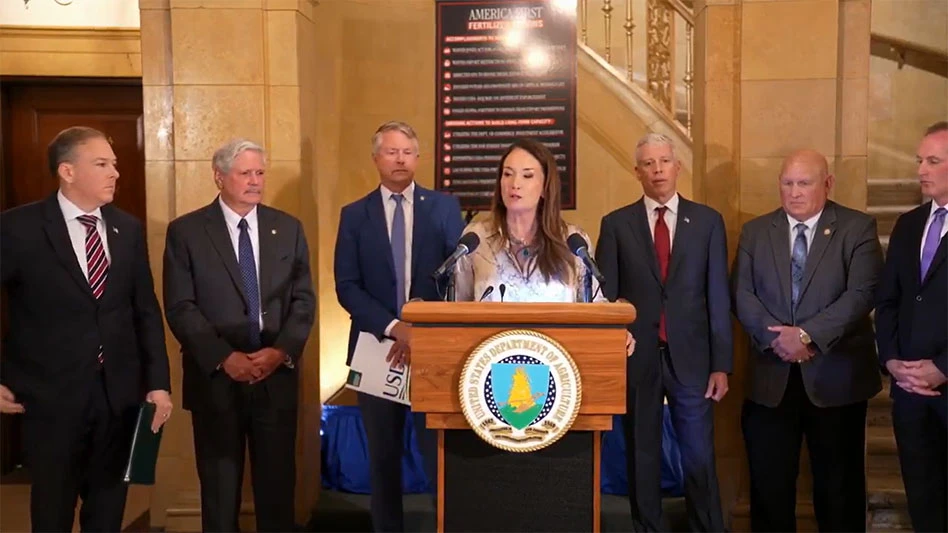
Photo courtesy of USDA
The U.S. Department of Agriculture is taking steps to curb reliance on imported fertilizer and expand domestic fertilizer production.
On May 19, 2026, U.S. Secretary of Agriculture Brooke Rollins, U.S. Secretary of Energy Chris Wright, U.S. Environmental Protection Agency Administrator Lee Zeldin, U.S. House Agriculture Committee Chairman Glenn “GT” Thompson and other members of Congress and government officials addressed concerns about skyrocketing fertilizer costs at a press conference.
Each year, the U.S. imports about 20 million metric tons of fertilizer — which amounts to about $9 billion in annual foreign purchases, according to House Ag Committee research.
Rollins said the agency’s overall goal is to increase domestic fertilizer production by about 4.5 million tons per year.
She announced several initiatives to make progress toward that goal, including accelerated permitting for a major ammonia plant in Louisiana, renewed efforts to revive projects from a Biden administration grant program, and the search for a full-time input economist focused on agricultural input costs and market transparency.
The first project Rollins highlighted was accelerated permitting for the Blue Point Project in Louisiana, a proposed $3.7 billion ammonia plant. Rollins said permitting for the project is expected to be completed within 45 days and that once completed, the facility would become the world’s largest ammonia plant.
Second, USDA is revamping the Biden administration’s Fertilizer Production Expansion Program. Rollins said the agency plans to work directly to move several high-impact projects forward, including an $80 million Washington state project that is expected to produce hydrogen ammonia fertilizer and a $3.9 million Iowa project expanding domestic organic fertilizer production.
Third, Rollins announced plans for USDA to hire a full-time crop input economist dedicated to tracking input costs and improving market transparency for producers.
Since the Strait of Hormuz closed in February, fertilizer and fuel prices have increased dramatically. Prices for New Orleans granular urea, the most common nitrogen fertilizer, spiked to $567.50 per ton in May, a 45% increase from February, according to Michigan Farm News’ Fuel and Fertilizer Price Tracker.
Editor's note: Watch highlights from the press conference here, from Secretary Rollins' post on X.
Latest from Nursery Management
- The Growth Industry Episode 14: Meet Lionel van der Walt, AmericanHort's new CEO
- Growers and suppliers say BFG Supply Co. will close
- Stemmer from BioWorks
- BioWorks introduces Stemmer silicon-based plant health solution
- Silver Fern awarded grant to expand AI-powered demand planning for greenhouse, nursery growers
- All-America Selections announces first three new AAS Winners for 2027
- 2026 Special Recognition Award recipients announced at PPA National Symposium
- [WATCH] July issue recap