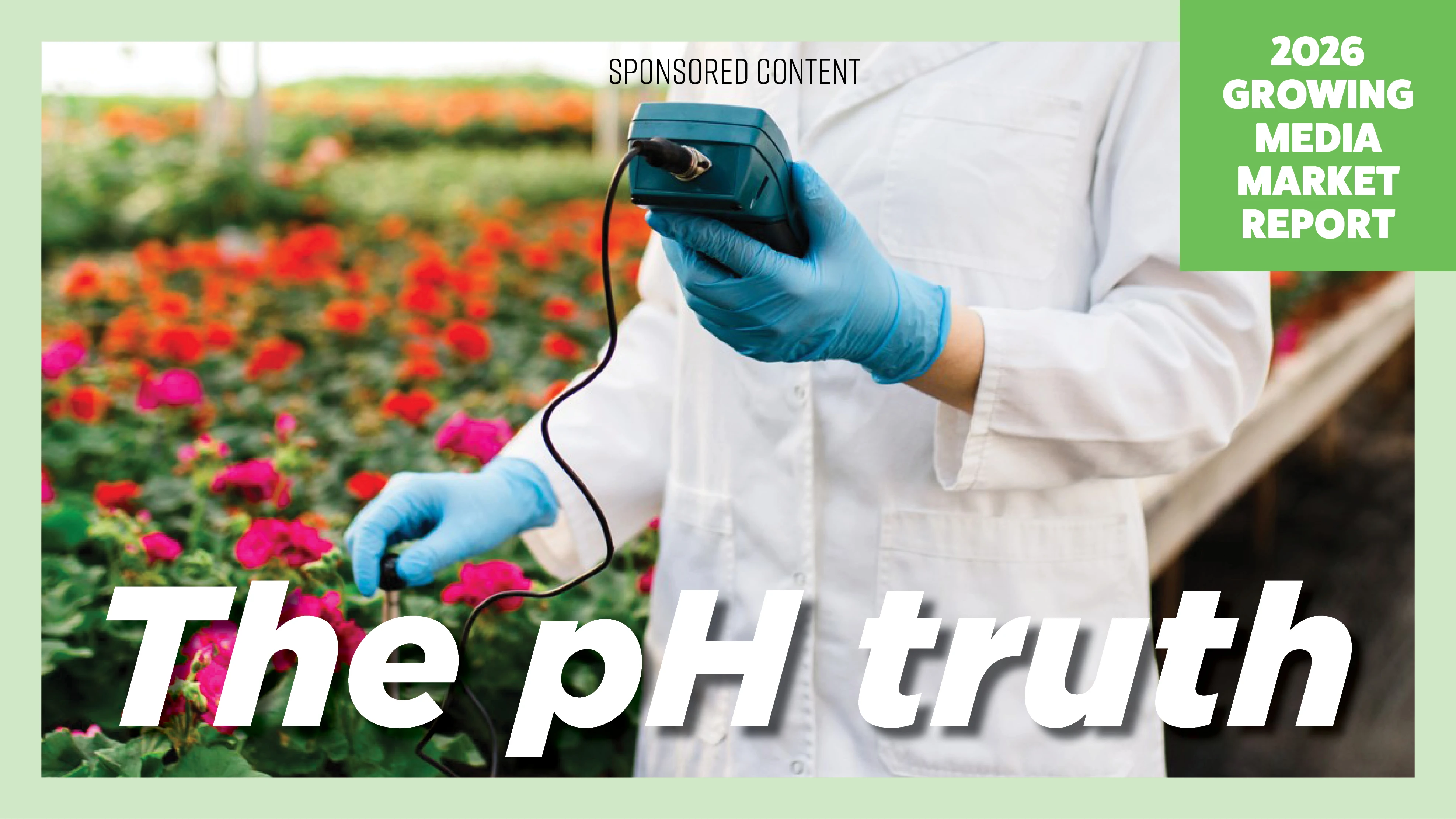
Photos courtesy of Premier Tech
Editor's Note: This article originally appeared in the July 2026 print edition of Greenhouse Management under the headline “The pH truth.”

Did you know that some of the most common pH management decisions in the greenhouse are based on practices borrowed from field soil production and simply do not work the same way in soilless growing media?
Have you ever considered using gypsum to raise growing medium pH, added sulfur to lower it or considered how your fertilizer’s nitrogen form fits into the equation? This article is for you.
Let’s dive into the science behind three of the most persistent myths in growing media pH management.
MYTH #1: Gypsum raises the pH of growing media.
Here’s the truth: it is not calcium that raises pH; it is the carbonate ion in limestone that neutralizes acid and increases it. As gypsum does not contain carbonate, that reaction does not happen. When plants take up calcium and sulfate from gypsum, both elements are absorbed in nearly equal amounts, and the net pH effect is neutral. Gypsum is valuable as a fertilizer supplement delivering calcium and sulfate for healthy plant development, but it is not a limestone replacement. When upward pH adjustment is needed, limestone is your best option.
MYTH #2: Sulfur lowers the pH of growing media.
Elemental sulfur can acidify field soils effectively; however, it is far less effective in soilless growing media, which have very low populations of the bacteria needed to drive the conversion of sulfur to sulfuric acid. And with most greenhouse crops wrapping up in just three to 12 weeks, there is not enough time for those bacteria to build up and produce a meaningful pH response. Although iron sulfate and aluminum sulfate might slightly alter the growing medium pH, they must be used at rates that introduce phytotoxic levels of iron, aluminum or excess salts in soilless media.
MYTH #3: Nitrogen source does not affect pH.
This one is less a myth and more a missed opportunity. When plants take up ammoniacal nitrogen, their roots release hydrogen ions, lowering pH. When they take up nitrate nitrogen, they release hydroxyl or bicarbonate ions, raising pH. Urea nitrogen, when taken up in its natural form, does not influence the pH; however, naturally occurring bacteria will convert urea to ammonium, which can lower the pH. Therefore, high-ammonium fertilizer formulations help bring pH down; high-nitrate fertilizers raise it.
The takeaway
- Gypsum provides plants with calcium and sulfate; it does not adjust pH.
- Elemental sulfur adjusts the pH of mineral soil, but not soilless growing media.
- Fertilizer serves two roles: providing plant nutrients and changing the pH.
- Regular pH monitoring can help avoid nutrient problems.
Read more from the 2026 Growing Media Market Report:
From the Sponsor: A shared passion for growing
Research: Quality blend
Production: Trial and error

Explore the July 2026 Issue
Check out more from this issue and find your next story to read.