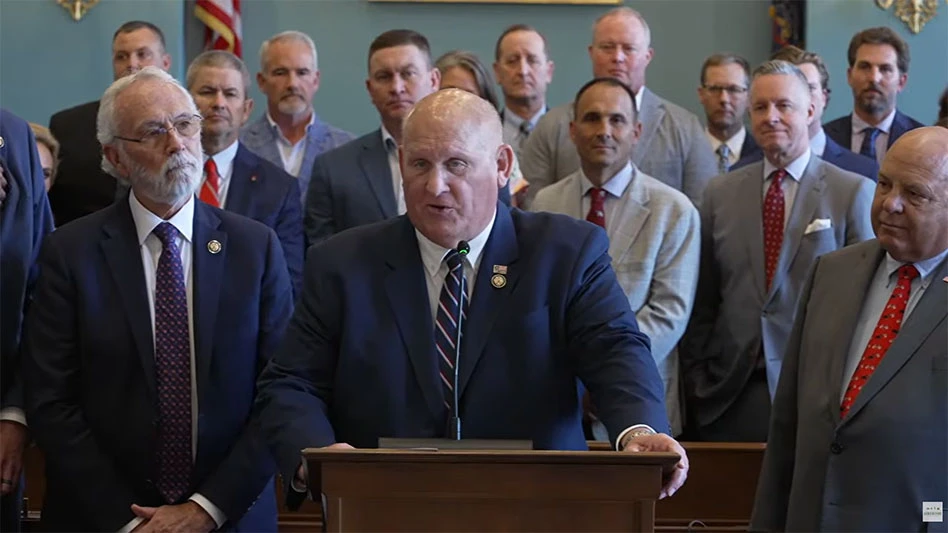
Photo courtesy of House Agriculture Committee
On June 30, House Agriculture Committee Chair Glenn “G.T.” Thompson (R-PA-15) introduced H.R.9535, the Securing Agriculture's Workforce Act, a bipartisan bill that would deliver reforms to the program that horticulture and specialty crop businesses rely on to meet their workforce needs.
“This bill was years in the making, and its reforms are long overdue,” Thompson said. “Congress has not updated the H-2A visa program since Ronald Reagan was president of the United States, and if you ask anyone who used the program, they’ll say that you can tell.”
The H-2A program has remained largely unchanged statutorily since its creation in 1986. Outdated eligibility requirements, unpredictable wage structures and a fragmented application process have made the program increasingly difficult and costly to use, even as demand for H-2A workers has nearly quadrupled over the past decade.
For horticulture and specialty crop producers, these inefficiencies translate directly into workforce uncertainty, higher operating costs and real risk to production. In a press conference announcing the bill, Thompson said the program’s cost has driven some producers to bankruptcy.
“I decided we couldn’t sit back and let someone else solve this problem,” Thompson said.
The bill was modeled on the recommendations made by a bipartisan agriculture labor working group created last Congress, which included eight Republicans and eight Democrats.
The reforms within the bill are sorted into three main categories: expanding access, controlling cost and streamlining the overall process.
Click here for a deeper dive into SAWA’s key reforms.
Several of the bill’s cosponsors also spoke at the event, including Rep. Dan Newhouse (R-WA-04), a third-generation farmer who has introduced several pieces of legislation aimed at H-2A reform since being elected to Congress in 2015.
“I truly think we have an excellent chance — with this kind of coalition, and the understanding of the urgency facing American farmers today — of getting this across the finish line,” Newhouse said.
SAWA has 41 cosponsors and is supported by more than 400 agriculture stakeholder groups, including the Farm Bureau and AmericanHort.
“AmericanHort applauds House Agriculture Committee Chairman Glenn 'GT' Thompson for his leadership and foresight in advancing meaningful H-2A reform.," said Matt Mika, vice president of advocacy and government affairs at AmericanHort. "The Securing Agriculture’s Workforce Act recognizes the labor realities facing the horticulture industry, while taking important steps to streamline the program, improve workforce flexibility and provide greater certainty for employers and workers alike.
"This legislation is the result of years of bipartisan work led by Chairman GT Thompson, the House Agriculture Committee and committee staff who stepped forward to tackle a long-standing challenge that many were unwilling to take on," Mika continued. "We look forward to continuing our work with congressional leaders, staff and industry partners to advance reforms that strengthen the competitiveness of U.S. horticulture, support green industry businesses and ensure a stable, reliable workforce for the future.”
The bill is not without detractors. The United Food and Commercial Workers International Union, which represents workers in the meatpacking, food processing and grocery industries, among others, released a statement condemning the bill.
UFCW’s opposition centers around SAWA’s expanded use of the H-2A visa program to non-agricultural, year-round jobs, noting concern for potentially displacing workers in industries like meat, poultry and seafood processing.
To watch the press conference in its entirety, click here.
The next step for the bill would be a markup hearing in the House Judiciary Committee, and eventually advancing the legislation to the full House floor for a vote.
Latest from Nursery Management
- The Growth Industry Episode 14: Meet Lionel van der Walt, AmericanHort's new CEO
- Growers and suppliers say BFG Supply Co. will close
- Stemmer from BioWorks
- BioWorks introduces Stemmer silicon-based plant health solution
- Silver Fern awarded grant to expand AI-powered demand planning for greenhouse, nursery growers
- All-America Selections announces first three new AAS Winners for 2027
- 2026 Special Recognition Award recipients announced at PPA National Symposium
- [WATCH] July issue recap