Located in Oregon’s Willamette Valley, JLPN is a family seedling operation with Trystan Lewis, graft manager, joining the business as the fourth generation. The family business started with Trystan’s great grandfather, Merriwether Lewis, as a bare root seedling production.
Sold to his grandfather, Bill Lewis, then his dad, John Lewis, the nursery now produces bare root and container grown fruit and ornamental bare root deciduous shade tree seedlings. It also specializes in cultivar rooted cuttings, grafting and budding under stock.
Since Trystan joined, the nursery has added conifer plugs and Stage 3 tissue culture acclimation to the production line.
Katie McDaniel: How did you get started in horticulture?
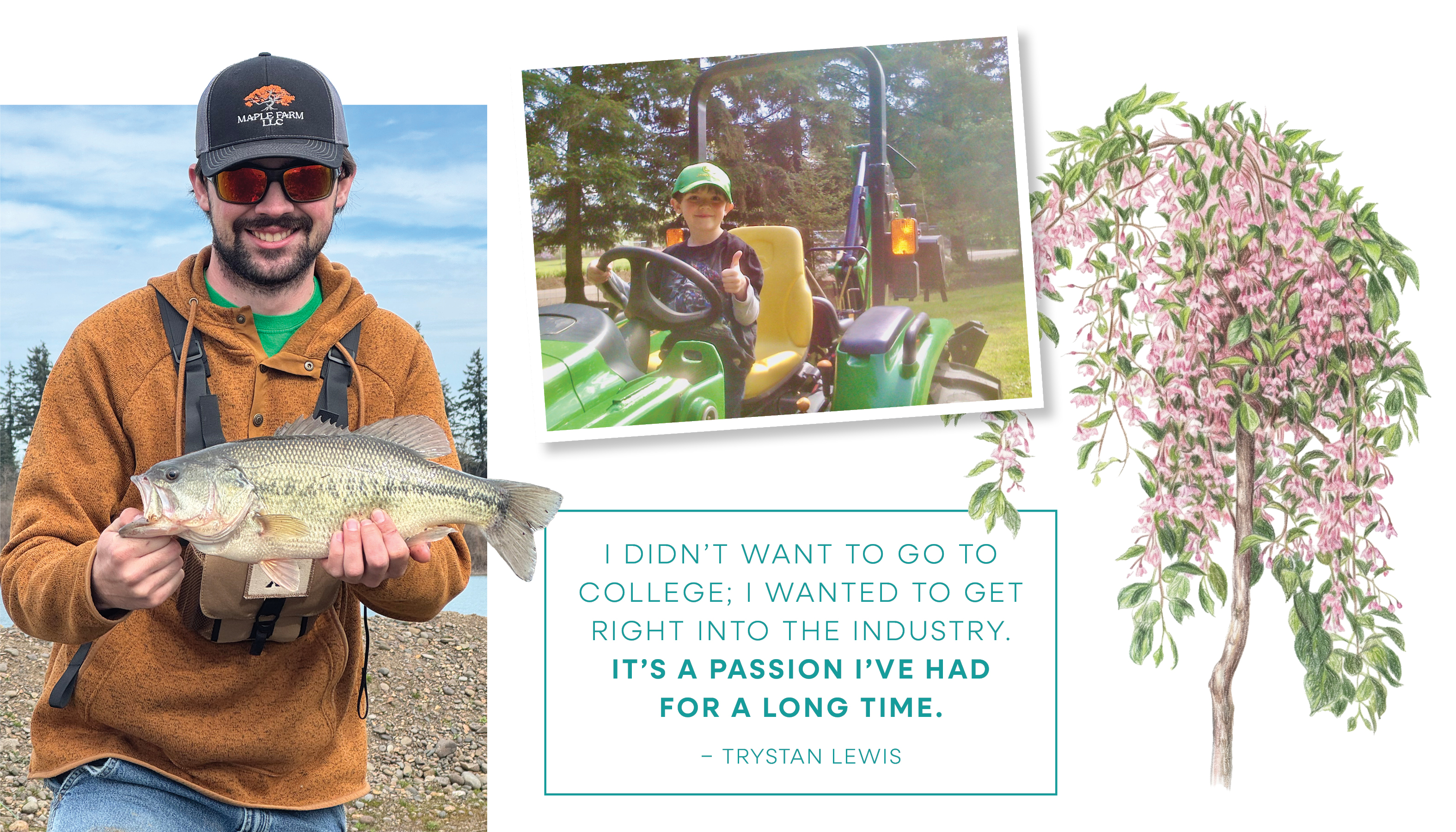
Trystan Lewis: I grew up in the industry. I’ve been around it my whole life. It’s been what I have wanted to do ever since I was in first grade. Once I got out of high school, I jumped right into it. I didn’t want to go to college; I wanted to get right into the industry. It’s a passion I’ve had for a long time.
KM: Do you have a first memory of being at the nursery?
TL: It’s not a work-related thing, but one of the youngest memories I have was, on the weekends, I would always be at the nursery with my grandma who lives here. My dad would always take us around on the golf carts because, as a little kid, riding around the golf cart on the nursery, it’s just so much fun.
So, one of the first memories I have is driving a golf cart through a mud puddle and getting it stuck. Then my dad would pull us out. He would constantly tell us, ‘Don’t drive through the mud puddles!’ For that exact reason, I would do it. So, that’s probably one of the first memories I have of being a little kid getting a golf cart stuck (laughs).
KM: What have you learned about the nursery business over the years?
TL: There’s a lot to it. A lot of people think that growing a tree is super simple and easy, like you just put the tree in the ground, give it some water and it grows. But no, there’s a lot more to it. I found out that you got to watch out for disease, pests, so that was an eye opener when I first started doing this. There’s just a lot more to it than people normally think. And just how many different things that people do with trees: grafting, budding, cuttings and then tissue culture too, which is really cool in my opinion.
KM: What do you do as graft manager at JLPN?
TL: I just basically do grafting, so I do side veneer grafting, whip and tongue. Then I tried stump grafting. It’s only my second year into it, so I’m still learning. But I got some guys trained now that know how to graft, so I don’t have to oversee it as much. I still like doing it, so I’m in there with them, just grafting this time of year. Then throughout the rest of the year, it’s potting up, taking care of them, watching out for diseases and leading them up. And watering too, of course. Can’t forget that. So yeah, overseeing, making sure everything’s nice and healthy, and we’re growing a good, solid, beautiful one gallon.
KM: What is your favorite part of the job?
TL: The actual grafting part is so satisfying. When you see it take and start growing, it’s satisfying seeing something that you took, like a basic rootstock, like a green Japanese maple, and you put a lion’s head on it and it starts growing; it’s just cool.
KM: What does being a part of the family business mean to you?
TL: It’s amazing to me, carrying on the next generation. Being fourth generation, carrying the family legacy on, brings a lot of pride to me and the passion I have for it, too. I hope one day my kids will find the same interest and want to carry on the legacy.
KM: What are some lessons your dad and grandfather have taught you?
TL: I would say the biggest one that my dad taught me from a really young age was little numbers become big numbers. Basically like, if one tree dies in a flat or a couple of bad trees get stuck in a flat, and people are doing that every 10 flats, that number is going to add up and you’re going to have a lot of bad product in there. So, that’s the key.
KM: What do you enjoy doing when you’re not working?
TL: That’s a long list; I could go on for hours about that. But I would say fishing, hunting, woodworking and welding. I like being outdoors too, and then woodworking is super satisfying.
KM: What is your favorite plant and why?
TL: Well, I’m going to be very biased here, but my favorite plant is probably Marley’s Pink. It’s a weeping pink Japanese snowbell. The flowers are just absolutely beautiful, and it smells wonderful.
For more: jlpnliners.comLatest from Nursery Management
- The Growth Industry Episode 14: Meet Lionel van der Walt, AmericanHort's new CEO
- Growers and suppliers say BFG Supply Co. will close
- Stemmer from BioWorks
- BioWorks introduces Stemmer silicon-based plant health solution
- Silver Fern awarded grant to expand AI-powered demand planning for greenhouse, nursery growers
- All-America Selections announces first three new AAS Winners for 2027
- 2026 Special Recognition Award recipients announced at PPA National Symposium
- [WATCH] July issue recap