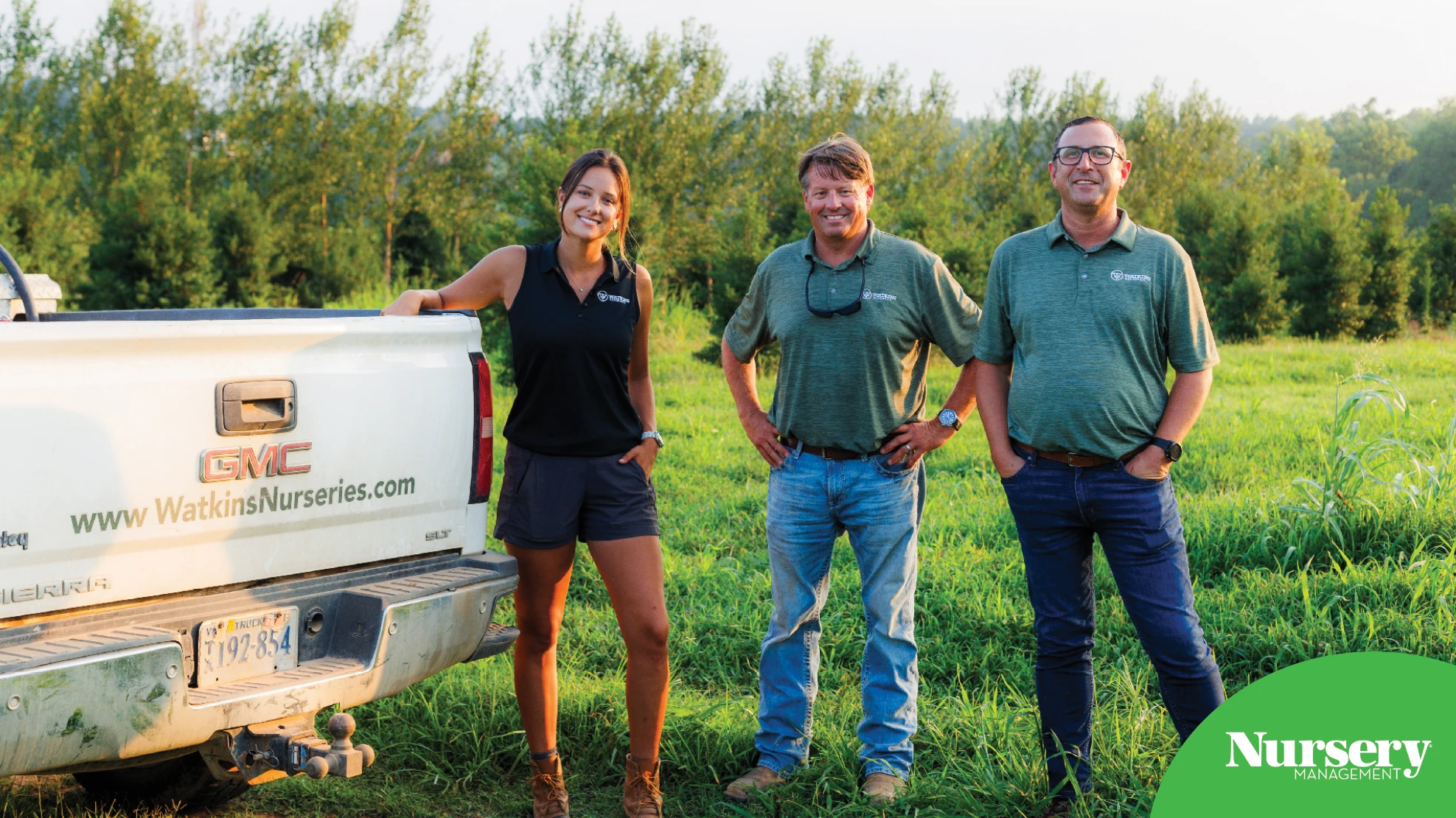
Photos By James Linkowitz
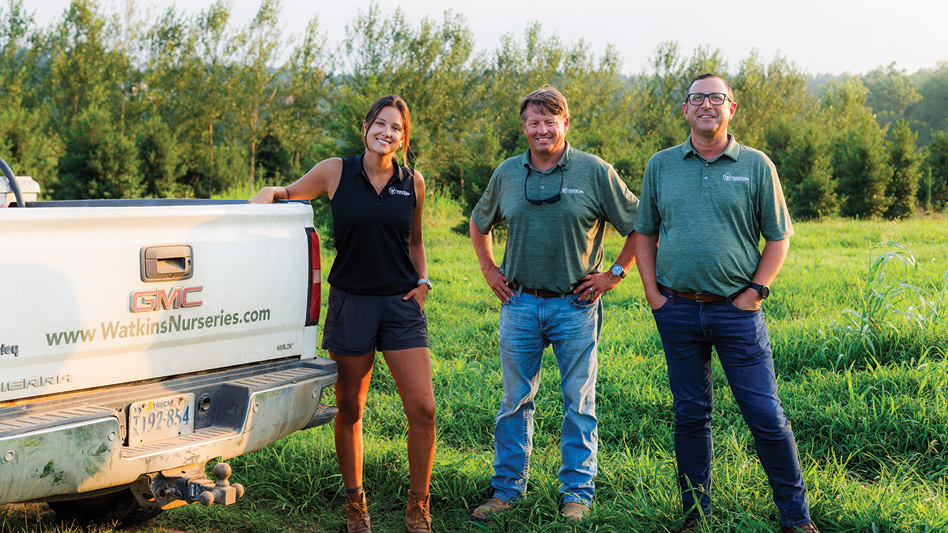
There’s a spot in Amelia County, Virginia, where Robert Watkins finds peace.
Nestled in the rural Piedmont region, the overlook frames a landscape of rolling hills, small ridges and broad river valleys thick with oak, hickory and tall pine stands. Scrubby edges and brushy clearings frame agricultural fields and open pastures.
“Our farm in Amelia County, there’s something about that property and being there watching the sun come up and seeing the start of the day,” he says. “It’s very peaceful and it’s just beautiful. You can basically see almost the entire growing operation from there. It’s my go-to spot.”
The first blush of morning offers a temporary respite from the daily chaos of running Watkins Nurseries. Founded in 1876 by John Benjamin Watkins, the tree farm is one of Virginia’s oldest continuously operating horticultural businesses, which celebrates its 150th anniversary this year.
The milestone weighs heavily on Watkins, 50, who represents the fifth generation to lead the operation. It is a remarkable achievement, given the perceived failure rate across successive generations of family businesses. According to an oft-cited Harvard Business School study, only 30% of family firms survive the transition to the second generation, 13% remain viable into the third and a mere 3% reach the fourth generation of family leadership.
Watkins knows the odds. Managing those numbers and protecting the legacy has meant steering the historic business through significant economic and structural headwinds. For Watkins, it has meant both resilience and reinvention.


Navigating the headwinds
Watkins has worked at the family’s nursery for as long as he can remember. He took the reins during a rocky generational transition in 2008 and 2009, amid the global economic downturn, inheriting financial burdens and partner buyouts. Because the core nursery operation alone could not generate the liquidity needed to satisfy those obligations, Watkins had to diversify the business.
Despite restructuring efforts, the financial weight forced a Chapter 11 bankruptcy filing in 2020. It proved a necessary mechanism to stabilize the nursery’s foundation.
“It wasn’t because we weren’t doing our day-to-day work,” Watkins says. “It was just some older challenges that we had to deal with as I assumed operation of the business.”
The journey was deeply humbling and profoundly complex. Over the past quarter century, Watkins explains how the nursery’s physical landscape underwent a dramatic transformation. The encroachment of Virginia Route 288 forced the sale of generational land, altering the property’s footprint.
Coping with the loss of that acreage was difficult, particularly as the family worked to compensate stakeholders who held equity but had never been active in daily operations.
“I hated that, but I knew that’s what had to happen,” he says. “It did make me reflect on the fact that we were losing what really made the family what it was, and everything we stood for was kind of fading away.”
Despite these painful setbacks, Watkins focused on the enduring importance of the family enterprise. “I really felt like it was my role to figure out how to bring (together) the core of the business and the legacy of this company and family then revitalize it.”

A higher purpose
The turning point came for Watkins at an Oklahoma City seminar featuring David Green, the founder and CEO of Hobby Lobby. From $600 in seed money, Green famously grew his company into the world’s largest privately owned arts-and-crafts retailer. Watkins was struck by Green’s philosophy regarding legacy, family and corporate purpose.
“He hit the nail right on the head,” Watkins says. “[Green] talked about the legacy of what you do and how you do it and how it all ties together. That there’s a greater reason for what we do, and that legacy and the continuation of the business is a big chunk of that.”
Seeing a multibillion-dollar operation prioritize principles over profit underscored a vital truth and a higher purpose. Watkins realized that while maintaining market leadership was vital, his true mission was to instill a deep appreciation for the nursery’s heritage in the incoming generation.
The business’ longevity hinges on this generational transition. By positioning his children, nieces and nephews to succeed, Watkins aims to ensure the sixth generation views the business as a living, historic legacy worth fiercely protecting.
“Coming up on our 150th year, I realized the money doesn’t matter,” he says. “It’s the operation and the importance of family. My role is to keep the business successful and to keep us on top of the ball, but to also instill in the next generation who want to be involved that this is more than just a job.”
Until then, Watkins is elated at the prospect of his children’s eagerness to enter the fold. Liza, 18, and Chase, 16, both worked in the business this past summer. Liza assisted with administrative tasks, while Chase worked in nursery production. Hunter, 12, is still too young to plot a potential career path.
“I overhear [Liza and Chase] talking about their day-to-day happenings at Watkins,” he says. “I listen to them and hear how excited they are to talk about working in the business. That excites me.”

Stewardship in the crosshairs
As regional urbanization and commercial development close in, Watkins must exercise his responsibilities as land steward. While one specific piece of the family-owned operation sits in the development crosshairs — a legacy property over which he lacks full control — Watkins maintains sole ownership of the nursery’s primary growing, landscaping and farmers market operations.
Watkins balances strict conservation with intentional, long-term expansion. He safeguards the operation’s core properties while exploring opportunities to acquire surrounding land and place it into conservation easements, protecting its agricultural heritage.
Watkins plans to expand the family’s 500-acre operation, including a lease-purchase option on 400 acres alongside plans for an additional 400 acres in Amelia County. If successful, this expansion would nearly triple the nursery’s size, providing the operation with a sustainable buffer in a region where developers are transforming traditional farms into housing developments.
“I want to preserve that land, and I want my neighbors to know that that’s my intent,” Watkins says. “There are a lot of folks around us that don’t have any interest in agriculture or the ability to farm their land. So, someone comes by with a healthy checkbook, and it makes it awfully tempting.”
While an expansion is in the works, Watkins believes in maintaining a controlled, highly nimble operation. This lean structure allows the nursery to pivot rapidly in response to real-time market demands and seasonal shifts, seamlessly transitioning crews from harvesting and landscaping to winter snow management. This flexibility optimizes financial returns while keeping the workforce consistently engaged.


Scaling up
Transitioning the nearly 150-year-old operation into a modern green-industry enterprise began around 2002, with a strategy to enrich low-organic-matter soil and accelerate tree growth, Watkins says. Recognizing that a field-grown nursery required large-scale composting, Watkins began producing his own organic matter.
To scale this compost project, Watkins partnered with a family-owned grocery store chain to repurpose fruit and vegetable trimmings and collaborated with the City of Richmond and Chesterfield and Henrico counties to collect and compost their leaves.
“We began composting everything together and were soon producing quite a bit of compost,” he says, adding that today the company processes over 85,000 tons of green waste annually. “In doing that, we began looking for new revenue streams.”
Processing this volume of material exceeded the capacity of the operation’s traditional nursery equipment and required an expensive upgrade, Watkins says. To justify the capital investment, he began bagging and selling the surplus compost.
This pivot funded a trommel screen, allowing the operation to screen native topsoil and create a custom 50/50 soil-compost blend, utilized for residential yards, potting soil and field-growing operations.
“As we got further down that rabbit hole, we learned there was a demand for recycling wood waste,” Watkins says. “So, I started tinkering with that, and we began doing on-site grinding for land-clearing operations.”
A partnership with a central Virginia bagging company, which purchased both the nursery’s compost and manufactured mulch, further accelerated growth. By 2026, the nursery had centralized its recycling and production pipeline, processing raw materials into a diverse inventory of proprietary dyed mulches, traditional hardwood bark mulch sourced from sawmill bark, specialized topsoils and biofilter media used in regional sediment basins.
To maximize convenience for the region’s landscape professionals, Watkins coupled this manufacturing capability with a plant center and re-wholesale yard.
“It all just kind of ballooned from there,” Watkins says. “Today, we’re really trying to become a one-stop shop, supplying local landscape contractors with everything from A to Z.”
These ancillary operations have proven vital to the nursery’s long-term health. Diversification was an economic necessity that eliminated the cash-flow volatility of a strictly seasonal business model, Watkins says. As a result, it opened doors to infrastructure and technology projects, allowing his team to expand their expertise into civil road construction, data center development and large-scale solar farms.
“We used to be a seasonal business, and we’ve taken that seasonality out of it,” Watkins says. “Growing up in the nursery business, you realize it’s a very narrow track. By expanding out, it’s been a really good opportunity for me and for the team.”
The Market at Watkins is the most recent component in the nursery’s diversification. Located at the historic 330-acre home base in Amelia Court House, a small rural community and the unincorporated county seat of Amelia County, the marketplace serves as a local hub for farm-fresh produce, regional artisan goods and essential plant materials. For Watkins, the concept stems from a return to the company’s roots and his deep-seated passion for community engagement.
“My heart always goes back to where I started in the nursery business, which was working in our garden center, helping people and being involved,” Watkins says. “I was six years old helping carry plants out to cars. I’ve always had a passion for that [engagement].”
Despite a heavy historical presence and frequent retail crossover at the company’s locations, the facilities were not structured for retail operations. In fact, Watkins says when the construction of Route 288 forced a relocation, the family stepped away from the retail sector altogether.
While commercial contractors provide vital, steady volume for the business, Watkins emphasizes it’s the retail customer who brings a special energy to the operation.
“I love the one-on-one interaction with retail customers, people who want to be there buying what you’re selling,” Watkins says. “With retail, I saw an opportunity there for us. Amelia County is pretty rural, but I felt like we had a beautiful spot and it would be the first rung on the ladder of getting us started more with the community.”
Positioned as an incubation project rather than a revenue driver, The Market at Watkins focuses on supporting the local economy. Watkins has established a strict purchasing standard, buying goods outright from local artisans and suppliers rather than using consignment, even if it incurs higher upfront costs. This approach has enabled the nursery to establish a firm foothold in the community, providing rural residents with access to high-quality plants, tools and regional products.
“It’s a pet project that we’re growing, and we do have some pretty strong expectations on growth,” Watkins says. “We want to continue to improve and carry more products and … become more of a community-type center in the years to come.”

Culture over micromanagement
In addition to a growing presence in the community, Watkins anchors the nursery’s identity to its workforce. He embodies a family-first philosophy toward employees, noting that the company consistently goes above and beyond to protect team members’ happiness and well-being, cementing a foundational loyalty that will sustain the business for generations to come.
While many recognize Watkins’ relentless work ethic, his quiet generosity and deep dedication to his extended family of employees often go unnoticed, according to his wife Laura, whom he married just over 20 years ago after a blind date.
“Robert would do anything for his employees just to make sure that they’re happy and that this is where they want to be,” Laura says. “A lot of people don’t know this, but there have been times when an employee had been tight on money. Robert has been known to lend them some here and there to make sure they’re covered. He wants to make sure all his employees are taken care of.”
Watkins is a hands-on leader in the nursery’s day-to-day operations. However, he places a lot of trust and responsibility in his staff, favoring collaboration over micromanagement.
Recently hired Farm Manager Madison Barnard credits much of her operational success over the last year to the high degree of autonomy and trust granted by Watkins. Instead of rigid directives, Barnard and Watkins engage in daily check-ins to assess what is working, identify necessary adjustments and ensure the business remains agile.
“When I first started here, Robert told me if I ever had any questions, just call. Now, when you hear somebody say that, you typically think, ‘I can’t be calling him about everything,’” Barnard says. “But I can attest I call him numerous times a day with lots of questions that might even sound silly after I’ve asked and he’s explained [the answer]. He picks up every time, happy to answer and talk through whatever question I have. It was the first thing I noticed right off the bat… he wasn’t joking. That alone says a lot.”
Watkins acts as the strategic bridge between departments. Ultimately, this seamless, daily collaboration provides Bernard with the freedom to make critical decisions while maintaining a unified vision for the nursery.
General Manager Shane Elmore spent 23 years with big-box retailer Lowe’s before joining the nursery in September 2024. The nursery’s collaborative culture and joint mindset require a foundational humility and a genuine desire to improve. This forward-thinking energy starts with Watkins.
“It’s understanding what the business landscape looks like and how our customers are rapidly changing,” Elmore says. “Robert really listens to us and understands our goals, where we want to go and how we’re going to get there. That’s huge.”
Elmore says one of Watkins’ greatest strengths as a leader is his humility and his willingness to welcome fresh ideas into the operation.
“He recognizes how critical it is for leadership to embrace constant evolution because companies that remain clever and unafraid of change tend to survive and prosper,” Elmore adds.
Age and leadership have taught Watkins the critical value of deliberate focus. It’s a lesson that will serve him well as he continues to prepare the nursery for the next 150 years.
Mike Zawacki is a Cleveland-based journalist and frequent contributor who has covered various aspects of the green, horticultural, sports turf, and irrigation industries for the last 20 years.
Explore the August 2026 Issue
Check out more from this issue and find your next story to read.